

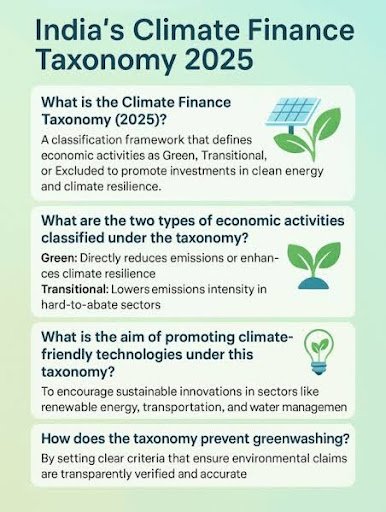
Why in News: In May 2025, the Ministry of Finance released India’s draft Climate Finance Taxonomy for public consultation to guide climate-aligned investments and prevent greenwashing.
Introduction
- India released its draft Climate Finance Taxonomy (May 2025) to mobilise climate-aligned investments and prevent greenwashing.
- It is envisioned as a “living framework”, adaptable to evolving national priorities and international obligations.
- As India pushes for net-zero by 2070, a credible taxonomy is vital to direct finance flows towards sustainable pathways.
Significance of the Climate Finance Taxonomy
- Mobilisation of Finance: Provides clarity to investors, channels funds into mitigation, adaptation, and transition.
- Prevention of Greenwashing: Ensures climate claims are backed by credible, standardised definitions.
- Policy Alignment: Harmonises domestic finance instruments (green bonds, carbon credits) with global norms.
- Investor Confidence: A predictable, transparent framework encourages long-term climate investments.
- Support to Net-Zero Goals: Helps align public and private investment flows with India’s NDCs and UNFCCC commitments.
Challenges and Concerns
1. Review Mechanism: Needs structured, predictable annual and 5-year revisions; current draft may lack institutionalisation.
2. Legal Coherence: Must align with Energy Conservation Act, SEBI regulations, Carbon Credit Trading Scheme, avoiding overlaps.
3. Accessibility: MSMEs, informal sector, and vulnerable communities may find compliance burdensome.
4. Evolving Standards: Climate finance definitions are dynamic; thresholds for GHG reduction, efficiency must be periodically updated.
5. Institutional Capacity: Lack of a dedicated standing body could weaken accountability and stakeholder engagement.
Way Forward
Structured Review:
- Annual reviews → responsive course corrections.
- Five-year reviews → long-term resilience, aligned with NDC cycles & global stocktake.
Institutional Accountability:
- Standing unit within DEA or multi-stakeholder expert committee.
- Public dashboards for transparency.
Inclusivity:
- Simplified entry points, staggered compliance for MSMEs and small manufacturers.
Legal & Policy Integration:
- Harmonise with green bond frameworks, carbon credit markets, and fiscal measures.
Capacity Building:
- Strengthen financial regulators, industry, and civil society for taxonomy implementation.
Ethical & Developmental Angle
- Climate finance taxonomy is not just a financial instrument but a tool of climate justice.
- By easing access for vulnerable communities and MSMEs, it ensures equitable transition.
- It embodies the principle of common but differentiated responsibilities in practice—balancing growth with sustainability.
Conclusion
India’s Climate Finance Taxonomy can become a cornerstone of sustainable finance governance. For India’s Amrit Kaal vision and net-zero pathway, it is essential that this “living document” remains adaptive, accountable, and aligned with both domestic realities and global standards.
Relevance
GS Paper III: Environment, climate change, sustainable finance, green bonds, carbon markets.
Mains Practice Question
Q. India’s draft Climate Finance Taxonomy is described as a “living framework.” Discuss how it can strengthen climate-aligned investments while addressing challenges of inclusivity, transparency, and accountability. (10/15 marks)
