

Why in News: The government plans to amend the Civil Liability for Nuclear Damages Act, 2010 and the Atomic Energy Act, 1962 to ease supplier liability norms and allow private participation in nuclear energy, sparking opposition concerns over safety and accountability.
Introduction
- India’s nuclear policy stands at a crucial crossroad.
- The government has indicated its intent to amend the Civil Liability for Nuclear Damages Act (CLNDA), 2010 and the Atomic Energy Act (AEA), 1962.
- These proposed changes will redefine questions of supplier liability, private participation, and nuclear energy expansion — with long-term implications for energy security, citizen safety, and climate commitments.
Historical Context
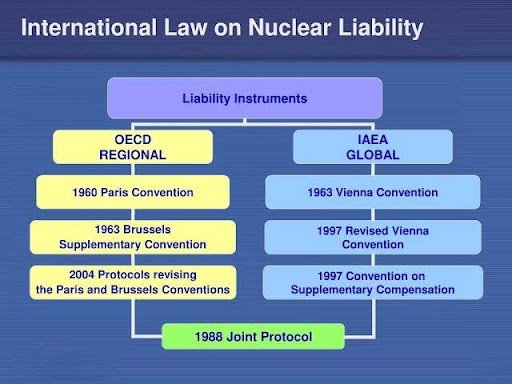
- CLNDA, 2010 was enacted to provide a domestic compensation mechanism for nuclear accidents, since India was not part of global conventions.
- The Act was debated in the backdrop of Bhopal Gas tragedy (1984), Gulf of Mexico oil spill (2010), and Fukushima disaster (2011), reinforcing the need for strict liability norms.
- Opposition pressed for extending liability beyond operators to suppliers of reactor equipment — a move that raised safety standards but discouraged Western suppliers.
- Attempts to amend/tweak the law in later years failed to attract greater international participation.
- In parallel, the Raja Ramanna Committee (1997) report triggered debates on whether private sector participation should be allowed in nuclear energy — but reforms were deferred.
Current Proposals
- Amendments to CLNDA: Dilution of supplier liability, aligning with the Convention on Supplementary Compensation (CSC) framework.
- Amendments to AEA: Allowing private sector participation in nuclear energy for the first time.
Energy Expansion Targets:
- Current installed capacity: 8.8 GW (2023) from 24 reactors.
- Target: 22.48 GW by 2031-32 and 100 GW by 2047.
- Small Modular Reactors (SMRs) identified as a potential growth area.
Opposition’s Concerns
- Dilution of Accountability – Reduced liability for suppliers could compromise public safety.
- Foreign Influence – Seen as a move to appease U.S. and French suppliers ahead of diplomatic engagements.
- Domestic Risks – Burden of compensation shifted largely to operators and, indirectly, the state.
- Precedent of 2010 – Similar charges of timing legislation with foreign visits were raised during U.S. President Obama’s visit.
- Citizen Protection – Opposition argues that aligning too closely with international conventions compromises safeguards for Indian citizens.
Parliamentary Dynamics and Role of Opposition
Past Examples:
- Amendments to Patents Act, 1970, insurance FDI reforms, and Land Boundary Agreement with Bangladesh were initially opposed but later supported, showing bipartisan consensus in national interest.
Current Scenario:
Opposition’s responsibility is to scrutinise proposals, ensure balance between national interest and public safety, and not merely engage in political obstruction.
Key Issues Requiring Debate
- Liability Framework – Balancing safety of citizens with attracting suppliers.
- Private Participation – Assessing risks and opportunities in opening nuclear energy to private firms.
- Technological Pathways – Evaluating viability and safety of SMRs.
- Nuclear Waste Disposal – Long-term environmental and health challenges.
- Energy Security and Climate Goals – Role of nuclear energy in reducing carbon footprint while ensuring resilience.
Conclusion
India’s nuclear journey reflects the tension between safety, sovereignty, and international cooperation. As amendments to CLNDA and AEA resurface, the Opposition has a duty to engage in constructive debate, ensuring accountability is not diluted, safety is prioritised, and long-term national interest is safeguarded
UPSC Relevance
GS Paper 2 – Polity & Governance
- Role of Parliament in law-making and Opposition’s responsibility in safeguarding citizen rights.
GS Paper 3 – Science & Technology / Energy
- Nuclear energy and its role in India’s energy security and climate change mitigation.
Mains Practice Questions
Q. “Dilution of supplier liability in nuclear energy undermines citizen safety but is essential for global cooperation.” Critically examine in the context of proposed amendments to the Civil Liability for Nuclear Damages Act, 2010. (10 marks)
