Questions of UPSC CSE Mains 2025
- Discuss the ‘corrupt practices’ for the purpose of the Representation of the People Act, 1951. Analyze whether the increase in the assets of the legislators and/or their associates, disproportionate to their known sources of income, would constitute ‘undue influence’ and consequently a corrupt practice.
(Answer in 150 words) 10 - Comment on the need of administrative tribunals as compared to the court system. Assess the impact of the recent tribunal reforms through rationalization of tribunals made in 2021.
(Answer in 150 words) 10 - Compare and contrast the President’s power to pardon in India and in the USA. Are there any limits to it in both the countries? What are ‘preemptive pardons’?
(Answer in 150 words) 10 - Discuss the nature of Jammu and Kashmir Legislative Assembly after the Jammu and Kashmir Reorganization Act, 2019. Briefly describe the powers and functions of the Assembly of the Union Territory of Jammu and Kashmir.
(Answer in 150 words) 10 - “The Attorney General of India plays a crucial role in guiding the legal framework of the Union Government and ensuring sound governance through legal counsel.” Discuss his responsibilities, rights and limitations in this regard.
(Answer in 150 words) 10 - Women’s social capital complements in advancing empowerment and gender equity. Explain.
(Answer in 150 words) 10 - e-governance projects have a built-in bias towards technology and back-end integration than user-centric designs. Examine.
(Answer in 150 words) 10 - Civil Society Organizations are often perceived as being anti-State actors than non-State actors. Do you agree? Justify.
(Answer in 150 words) 10 - India-Africa digital partnership is achieving mutual respect, co-development and long-term institutional partnerships. Elaborate.
(Answer in 150 words) 10 - “With the waning of globalization, post-Cold War world is becoming a site of sovereign nationalism.” Elucidate.
(Answer in 150 words) 10 - “Constitutional morality is the fulcrum which acts as an essential check upon the high functionaries and citizens alike…”
In view of the above observation of the Supreme Court, explain the concept of constitutional morality and its application to ensure balance between judicial independence and judicial accountability in India.
(Answer in 250 words) 15 - Indian Constitution has conferred the amending power on the ordinary legislative institutions with a few procedural hurdles. In view of this statement, examine the procedural and substantive limitations on the amending power of the Parliament to change the Constitution.
(Answer in 250 words) 15 - Discuss the evolution of collegium system in India. Critically examine the advantages and disadvantages of the system of appointment of the Judges of the Supreme Court of India and that of the USA.
(Answer in 250 words) 15 - Examine the evolving pattern of Centre-State financial relations in the context of planned development in India. How far have the recent reforms impacted the fiscal federalism in India?
(Answer in 250 words) 15 - What are environmental pressure groups? Discuss their role in raising awareness, influencing policies and advocating for environmental protection in India.
(Answer in 250 words) 15 - Inequality in the ownership pattern of resources is one of the major causes of poverty. Discuss in the context of ‘paradox of poverty’.
(Answer in 250 words) 15 - “In contemporary development models, decision-making and problem-solving responsibilities are not located close to the source of information and execution defeating the objectives of development.” Critically evaluate.
(Answer in 250 words) 15 - The National Commission for Protection of Child Rights has to address the challenges faced by children in the digital era. Examine the existing policies and suggest measures the Commission can initiate to tackle the issue.
(Answer in 250 words) 15 - “Energy security constitutes the dominant kingpin of India’s foreign policy, and is linked with India’s overarching influence in Middle Eastern countries.” How would you integrate energy security with India’s foreign policy trajectories in the coming years?
(Answer in 250 words) 15 - “The reform process in the United Nations remains unresolved, because of the delicate imbalance of East and West and entanglement of the USA vs. Russo-Chinese alliance.” Examine and critically evaluate the East-West policy confrontations in this regard.
(Answer in 250 words) 15
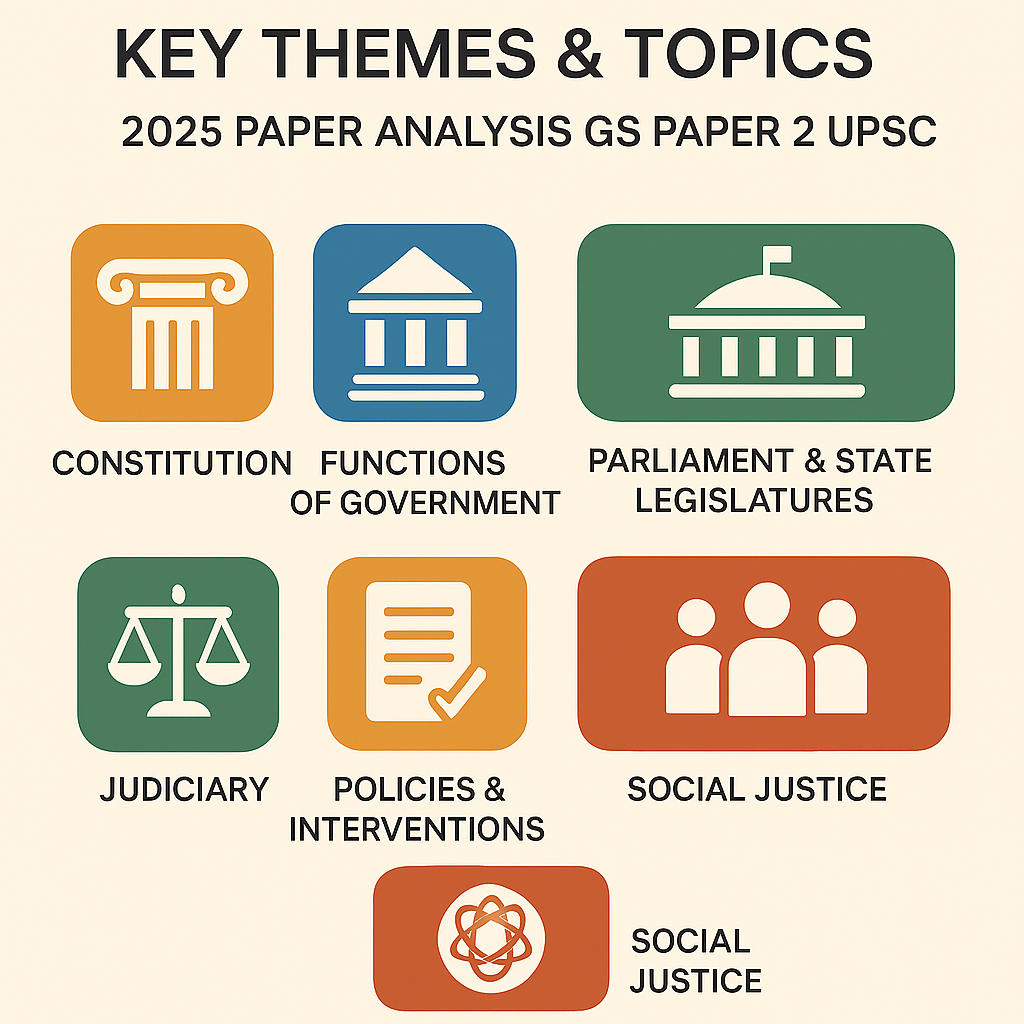
Understanding the 2025 Paper: Key Themes and Subjects
What the Paper is About
The paper continues to check how well a candidate understands the constitution, politics, administration, governance, and global affairs. It focuses on using concepts, recent changes, and current discussions. The questions are designed to make you think and analyze, not just remember facts. You need to know the law and the constitution well and be able to form your own opinions.
A Look at Each Section
1. Constitution and Legal System
- Questions on cheating in elections and leaders having unexplained wealth show a worry about fair elections, mixing law with good conduct.
- Comparing the President’s power to forgive crimes in India and the US, and discussing the balance between court morality and its freedom, tests knowledge of different constitutions and changing legal ideas.
- Questions on Parliament’s power to change the constitution and the system for appointing judges check your understanding of history, limits, and how it compares to the US system.
- This needs a strong grasp of important court cases (like Kesavananda Bharati, Indira Gandhi, NJAC, etc.).
2. Governance and Administration
- Questions on Administrative Tribunals vs. Regular Courts and recent changes to tribunals connect efficient administration to people’s ability to get justice.
- The question on the Attorney General’s job is a standard one, now looked at through modern debates on its independence and responsibility.
- A question on bias in e-governance systems asks for a critical view, looking beyond the excitement of technology to see if it includes everyone and focuses on citizens.
- Questions on Civil Society Organizations (CSOs) test your ability to balance government power with public involvement.
3. Federalism and Regional Matters
- A question on the Jammu & Kashmir Assembly after the 2019 changes checks your knowledge of constitutional updates, debates on self-rule, and how a Union Territory is run.
- Questions on financial relations between the central and state governments, including recent changes, connect to money matters, how the GST Council works, and the role of the Finance Commission.
4. Social Problems
- A question on “women’s social capital” requires linking local networks, Self-Help Groups (SHGs), and official programs to the goal of gender equality.
- The “paradox of poverty and inequality” question is about fair distribution of resources, connecting thinker Amartya Sen’s ideas to today’s policies.
- A question on environmental groups highlights the role of public participation in making climate policy.
- A question on the National Commission for Protection of Child Rights (NCPCR) in the digital age focuses on protecting children online, their privacy, and where laws are missing.
5. International Relations
- A question on India-Africa digital partnerships shows cooperation between developing nations and a focus on digital relations.
- A question on energy security in India’s Middle East policy brings practical politics into foreign policy discussions.
- Questions on United Nations reforms and conflict between East and West show a world with multiple powers and the current deadlock in the UN Security Council.
- A question on fading globalization and rising nationalism needs you to combine world economic trends with political ideas.
Important Things About the Paper
- Good Balance: The constitution, governance, social justice, and international relations all got equal space.
- Comparisons: Comparing India and the US (on pardon powers and choosing judges) requires a wider view.
- Current Focus: Recent topics like 2021 tribunal changes, Jammu & Kashmir after 2019, UN reform issues, and digital partnerships were included.
- Thinking Skills: Most questions asked for comments, analysis, or evaluation, not just description.
- Ethics Underneath: Themes like constitutional morality, social capital, corruption, and inequality test your sense of right and wrong.
How Hard Was It?
Moderate to Tough:
- There were very few simple fact-based questions.
- Most needed you to connect standard knowledge with recent events.
- Giving precise answers in 150 or 250 words made it hard to be both detailed and concise.
What You Should Have Done
- Mention important court cases (like Kesavananda Bharati, Indira Gandhi, NJAC, Shreya Singhal, etc.).
- Use reports from official groups (2nd ARC, Law Commission, Punchhi Commission, Finance Commissions).
- Link your answers to current events (tribunal reforms, GST disputes, G20 results, climate meetings).
- Give a balanced critical opinion instead of a one-sided argument.