

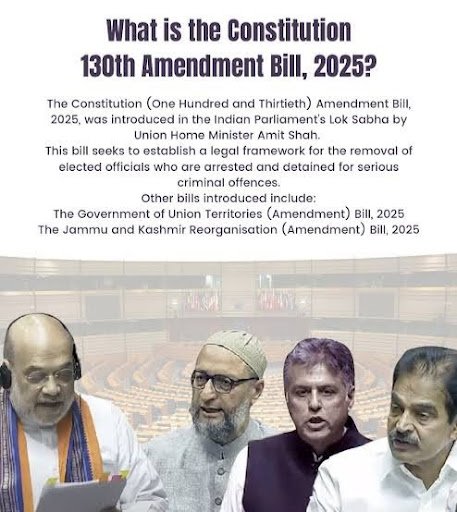
Why in News: The 130th Constitution Amendment Bill, 2025 mandates resignation or removal of Ministers, CMs, and the PM if in custody for 30+ days in serious cases. It aims to curb criminalisation in politics but raises concerns over presumption of innocence, political misuse, and governance instability.
Context and Purpose
- Introduced in Lok Sabha on August 20, 2025.
- Addresses criminalisation of politics and attempts to ensure moral integrity in governance.
- Provision: Ministers, Chief Ministers, Prime Minister must resign or be automatically removed if kept in custody for 30 consecutive days for offences carrying a maximum punishment of five years or more.
- Aim: Clean politics and prevent leaders in custody from holding office, thereby restoring public trust.
Constitutional Basis
- Draws on Articles 75, 164, and 239AA – govern tenure of Union, State, and Delhi Ministers.
- Traditionally: Ministers hold office at pleasure of the President/Governor.
- Judicial interpretation places limits on this discretion – must conform to constitutional morality and propriety.
Judicial Precedents
- S.R. Bommai vs Union of India – stressed constitutional morality, integrity, accountability in governance.
- Manoj Narula vs Union of India – warned against appointment of persons with serious criminal charges as Ministers; ethics are part of constitutional framework.
- Lily Thomas vs Union of India – lawmakers disqualified upon conviction; struck down 3-month appeal grace period under Representation of People Act.
Scale of the Problem: Criminalisation in Politics
Association for Democratic Reforms (ADR) data:
- 2024 General Election: 46% MPs had declared criminal cases.
- 2019: 43%; 2014: 34%; 2009: 30%.
- 55% increase in 15 years.
- Shows deepening crisis of political criminality, which the Bill seeks to address.
Strength of the Bill
1. Addresses criminalisation of politics – sends a strong signal against corrupt leaders continuing in power while in custody.
2. Codifies judicial concerns – gives legislative backing to Supreme Court observations in cases like Manoj Narula and S.R. Bommai on the need for integrity in public office.
3. Restores public trust – reassures citizens that governance will not be run by leaders under prolonged detention.
4. Raises accountability standards – holds Ministers to stricter ethical norms compared to legislators, setting a higher bar for executive responsibility.
5. Timely intervention – responds to the growing trend of MPs/MLAs with criminal cases (46% of MPs in 2024), making it a relevant and urgent reform.
Concerns and Challenges
1. Presumption of Innocence
- Article 21 guarantees right to life and liberty.
- Bill equates arrest/detention with grounds for removal – even before conviction or framing of charges.
- Violates the principle of innocence until proven guilty.
2. Conflict with Representation of the People Act
- RPA, 1951 disqualifies legislators only upon conviction.
- Creates inconsistency: Legislator continues until conviction, but Minister resigns on mere detention.
- Produces asymmetry in constitutional treatment of public officials.
3. Politicisation and Executive Discretion
- Bill inserts:
- Clause 5A after Article 75(5),
- Clause 4A after Article 164(4),
- Clause 5A after Article 239AA(5).
- Ministers removable on advice of PM/CM or automatically after 30 days.
- Allows political manoeuvring:
- The PM may shield allies for 30 days.
- Hostile CM may exploit rule to oust rivals.
- Risks embedding partisanship into accountability.
4. Instability and “Revolving Door” Problem
- Ministers can be reappointed once released from custody.
- Creates cycles of resignation and reinstatement depending on bail/court orders.
- Results in governance instability and potential for legal tactics as political weapons.
5. Over-broad Scope
- Applies to all offences with punishment of 5+ years, including relatively minor offences.
- Not restricted to moral turpitude/corruption-related crimes.
- May deter capable individuals from accepting ministerial office due to harsh consequences of mere detention.
Alternative Approaches – A More Nuanced Model
- Link removal to judicial milestones: e.g., framing of charges by a competent court instead of mere arrest.
- Independent review mechanism: Tribunal or judicial panel to prevent misuse and ensure impartiality.
- Interim suspension: Ministers suspended from office during trial instead of outright removal.
- Limit scope: Restrict to cases of moral turpitude, corruption, serious offences – not all crimes with 5+ year punishment.
Conclusion
The Bill is a bold step against criminalisation in politics, but without safeguards it risks undermining fairness, due process, and stability; a balanced, nuanced approach is needed.
UPSC Relevance
GS Paper II (Polity & Governance):
- Constitutional provisions regarding Ministers (Articles 75, 164, 239AA).
- Separation of powers and checks and balances.
- Issues of criminalisation of politics and electoral reforms.
Mains Practice Question
Q.The Constitution (One Hundred and Thirtieth Amendment) Bill, 2025 seeks to promote clean politics but risks undermining due process and stability. Critically examine the constitutional, ethical, and political implications of the Bill. Suggest reforms for balancing integrity with fairness in governance.
