

Why in News: The Delhi High Court ordered blocking of Sci-Hub and its mirror sites, reigniting debates on access to scientific knowledge.
The Debate on Access to Knowledge
Publishers’ stance:
- Argue piracy undermines intellectual property.
- Defend high subscription costs (lakhs per journal) citing peer review and quality control.
Critics’ view:
- Scientific publishing is unique: authors and peer reviewers are unpaid, research largely funded by public money.
- Publishers’ high profit margins (~30%) resemble rent-seeking.
- Blocking Sci-Hub closes the only access route for many researchers outside elite institutions.
Sci-Hub and Its Limitations
- Founded by Alexandra Elbakyan, Sci-Hub provided free access to millions of papers.
- Legally vulnerable: Courts in the U.S., Europe, and now India have ruled against it.
- Moral appeal weakened by technical unreliability, cryptocurrency-based reward experiments, and growing redundancy due to expanding open access.
- Remains a symbol of resistance to profiteering but less effective today.
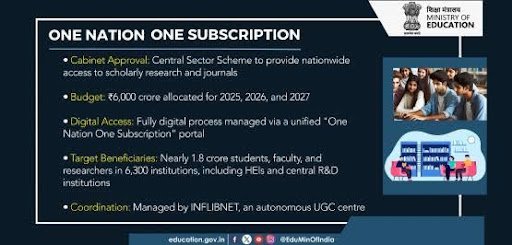
The ONOS Scheme
- Approved in 2024 with an outlay of ₹6,000 crore (Phase I: 2023–2026).
- Negotiates bulk subscription with 30 major publishers covering ~13,000 journals.
- Phase I: Public research institutions.
- Phase II: Extend to private institutions.
- Objective: Ensure equitable access to research material for Indian researchers.
Strengths of ONOS
- Reduces duplication – Instead of every institute subscribing separately, a national-level deal brings cost efficiency.
- Equitable access – Public universities and research centres get uniform access to leading journals.
- International alignment – Similar to EU’s Horizon Europe and U.S. policies mandating open access for federally funded research.
- Frees funds – Allows institutions to redirect budgets to other areas like publishing charges, skilling, or infrastructure.
Limitations and Concerns
- Exclusion in Phase I – Independent researchers and private institutes not yet fully covered.
- Dependence on foreign publishers – Continues reliance on global giants, reinforcing structural imbalance.
- Cost efficiency – With open access expanding (over 50% of papers free), paying crores for subscriptions risks being an expensive detour.
- Copyright transfer issue – Indian researchers still compelled to surrender rights to journals.
- Lack of structural reform – Doesn’t challenge the pay-to-read vs. pay-to-publish imbalance in scholarly communication.
Way Forward
1. User-centric approach – Regular consultation with researchers to ensure only relevant journals are subscribed.
2. Flexible models – Options for per-article access to niche journals beyond ONOS.
3. Strengthen indigenous publishing – Build Indian journals and repositories to reduce dependence.
4. National rights retention policy – Like Harvard/MIT, require researchers to deposit work in institutional repositories regardless of publishers’ restrictions.
5. Shift from pay-to-read to open access – Redirect funds toward institutional repositories, open-access publishing, and archiving systems.
Conclusion
The Delhi High Court’s decision reflects the legal position on copyright, but the larger issue remains: how to ensure equitable and affordable access to knowledge.
UPSC Relevance
GS Paper III
Issues relating to intellectual property rights.
Mains Practice Questions
Q.“Scholarly publishing is unique — publicly funded research, unpaid peer review, yet exorbitant subscription costs. In this context, evaluate India’s options for reforming access to scientific literature.”
