

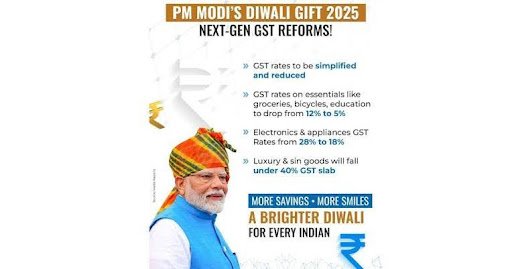
Why in News: The Centre has proposed next-generation GST reforms, rationalising the tax structure into two main slabs (5% and 18%) with higher rates on sin/luxury goods. While aimed at simplification and boosting investment, the move may cause short-term revenue losses, raising the debate on whether States should be compensated.
Introduction
- The Centre’s proposal to rationalise GST slabs into a two-tier structure (5% and 18%) is expected to lower the average tax incidence to around 10%.
- While this reform simplifies taxation and boosts competitiveness, it raises the question of whether States should be compensated for short-term revenue losses.
Arguments in Favour of Compensation
- Unequal Impact: Manufacturing-heavy States like Maharashtra, Karnataka, Tamil Nadu face sharper revenue losses compared to agrarian States.
- Federal Compact: GST subsumed States’ taxation powers; compensation ensures fiscal balance.
- Cooperative Federalism: Maintaining trust and consensus in GST Council requires revenue protection for States.
- Precedent: States were compensated for 5 years after GST rollout, setting expectations of transitional support.
- Welfare and Developmental Needs: States rely heavily on GST for funding welfare and infrastructure.
Arguments Against Compensation
- End of Transition: The 5-year compensation period (2017–22) was a defined arrangement and has ended.
- Fiscal Burden on Centre: Indefinite compensation is unsustainable given deficit pressures.
- Mature Tax System: GST collections have stabilised (~₹1.6–1.7 lakh crore monthly).
- Moral Hazard: Regular bailouts discourage States from improving efficiency and diversifying revenues.
- Long-term Gains: Lower rates improve compliance, widen tax base, and attract investment.
Challenges
- Revenue Volatility: Immediate fiscal stress for industrial States.
- Asymmetric Impact: Uneven distribution of GST benefits and losses.
- Trust Deficit: Risk of friction between Centre and States if concerns are ignored.
- Consensus in GST Council: Disagreements could stall key reforms.
Way Forward
- Time-bound Transitional Support for States with sharper revenue loss.
- GST Contingency Fund financed partly through cess on sin/luxury goods.
- Strengthen Compliance via digitalisation, e-invoicing, and widening tax base.
- Diversify State Revenues through property tax, excise, and investment-led growth.
- Consensus-driven Reforms in GST Council to preserve cooperative federalism.
Conclusion
While permanent compensation is fiscally unsustainable, ignoring asymmetric losses undermines federal trust. A balanced, transitional mechanism — short-term support combined with long-term revenue strengthening — is essential for sustaining GST reforms and preserving the spirit of cooperative federalism.
UPSC Relevance
GS Paper II (Governance, Federalism)
- Issues and challenges of fiscal federalism and cooperative federalism.
GS Paper III (Economy)
- GST reforms, revenue sharing, and fiscal challenges.
