

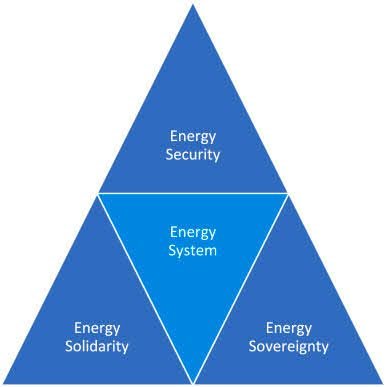
Why in News: India imports over 85% of crude oil and 50% of natural gas, making it highly vulnerable to global shocks. With Russia now India’s top oil supplier and recent Israel–Iran tensions threatening supply routes, the focus has shifted to building an energy sovereignty doctrine for security and resilience.
Introduction
- India imports over 85% of its crude oil and more than 50% of its natural gas.
- This dependence is not just an economic figure but a national security risk, especially in a world of rising conflicts, fragile supply chains, and volatile sea lanes.
- Since 2022, Russia has emerged as India’s largest crude oil supplier (35–40% of imports in 2024–25, up from ~2% pre-Ukraine war). While discounted oil has eased import bills, it exposes over-reliance on a single geopolitical partner.
- Energy sovereignty must therefore be seen as central to economic stability, foreign policy, and national security.
India’s Current Energy Vulnerability
- In FY2023-24, India’s merchandise imports = $677 billion; crude oil & natural gas = $170 billion (~25%).
- Heavy import dependence → pressure on rupee, trade deficit, and macroeconomic stability.
- June 2025: Tensions between Israel & Iran nearly disrupted 20 million barrels/day of oil flows. Brent crude could have crossed $103 per barrel — highlighting fragility of global lifelines.
- Thus, every imported barrel is a liability in times of geopolitical stress.
Global Flashpoints that Redefined Energy Security
1. 1973 Oil Embargo
- Arab embargo quadrupled oil prices.
- Exposed overdependence on OPEC.
- Catalysed strategic petroleum reserves, efficiency mandates, and diversified sourcing.
2. 2011 Fukushima Nuclear Disaster
- Tsunami-induced meltdown in Japan shook global confidence in nuclear power.
- Shift to coal/gas raised emissions.
- Today, nuclear is regaining favour as a low-carbon dispatchable source.
3. 2021 Texas Freeze
- Extreme cold froze pipelines and disabled wind turbines in Texas.
- Showed risks of systems built for cost efficiency, not resilience.
- Lesson: need for weather-hardened, diversified infrastructure.
4. 2022 Russia–Ukraine War
- Europe’s 40% reliance on Russian gas collapsed.
- Result: record LNG prices, coal revival, and urgent diversification.
- Lesson: single-source dependence is strategic vulnerability.
5. 2025 Iberian Peninsula Blackout
- Grid collapse in Spain/Portugal due to over-reliance on intermittent renewables without backup.
- Exposed risks of phasing out conventional capacity too fast.
- Takeaway: Every major shift in global energy has followed a breakdown. India now has the chance to pivot by foresight, not by force.
The Reality of Global Energy Transition
- Despite talk of “green energy,” fossil fuels still meet 80%+ of global primary energy demand.
- Over 90% of transportation still depends on hydrocarbons.
- Renewables (solar/wind) = <10% of mix.
- Oil & gas exploration investments have fallen sharply, but demand remains high → supply is structurally tight & prone to shocks.
- Lesson: Energy transition is a pathway, not a switch.
The Case for Energy Realism and Sovereignty
- Energy security is no longer only a climate discussion; it is a survival strategy.
- India must adopt an energy sovereignty doctrine, anchored in:
- Domestic capacity
- Diversified technology
- Resilient systems
Five Pillars of India’s Energy Sovereignty Doctrine
Coal Gasification & Unlocking Indigenous Energy
- India has 150 billion tonnes of coal reserves.
- Historically unattractive due to high ash content.
- With gasification + carbon capture, coal can be leveraged for syngas, methanol, hydrogen, fertilizers.
- Innovation must overcome the “ash barrier.”
Biofuels: Rural Empowerment Meets Energy Security
- Ethanol blending programme: reduced crude imports, transferred ₹92,000 crore to farmers.
- With E20 target, rural incomes to rise further.
- SATAT scheme: CBG plants generating fuel + bio-manure (20–25% organic carbon).
- Helps restore North India’s degraded soils (currently 0.5% vs healthy 2.5%).
- Benefits: soil health, water retention, reduced run-off & pollution.
Nuclear: Zero-Carbon Baseload
- Current nuclear capacity = 8.8 GW (stagnant).
- Must revive thorium roadmap, secure uranium supplies, and localise Small Modular Reactors (SMRs).
- In a renewable-heavy grid, nuclear ensures dispatchable baseload & reliability.
Green Hydrogen: Own the Tech, Secure the Chain
- Target: 5 MMT annually by 2030.
- Requires localising electrolyser manufacturing, catalyst development, storage tech.
- Goal: not just green hydrogen, but sovereign hydrogen.
Pumped Hydro Storage: Grid Inertia Backbone
- Pumped hydro is durable, proven, and essential for balancing renewables.
- Provides inertia & stability missing in wind/solar-heavy systems.
- India’s topography must be leveraged to build future storage infrastructure.
Shifting Geopolitics in India’s Oil Sourcing
- Earlier: 60% of crude from West Asia.
- Now: <45% (S&P Global Commodities at Sea).
- Reflects deliberate diversification of sourcing.
- Reduced dependence on Hormuz chokepoint.
- Russia has emerged as largest supplier, but heavy reliance is a double-edged sword.
Way Forward: The Age of Energy Sovereignty
- Israel–Iran ceasefire is a reminder: act before the next crisis, not after.
- India must embrace energy realism:
- Diversify sources beyond single partners.
- Build resilience in grids and infrastructure.
- Blend ambition with realism — green transition with sovereign backbone.
- The five pillars (coal gasification, biofuels, nuclear, green hydrogen, pumped hydro) are not secondary but the spine of energy sovereignty.
Conclusion
- The 21st century will not be defined by oil discoveries but by nations that can secure, store, and sustain their own energy.
