
Why in News: An AI-powered interactive Bhagavad Gita project has raised debates on identity, selfhood, and authenticity, as Artificial Intelligence simulates spiritual dialogue, sparking concerns over the nature of consciousness, ethical use of AI, and the erosion of human originality.
Introduction
- The 21st century has witnessed Artificial Intelligence (AI) penetrate not only economic, political, and administrative spheres, but also the most intimate aspects of human life — learning, art, ethics, and even spirituality.
- Recently, an AI-powered interactive Bhagavad Gita project sparked a philosophical debate: can machines help humans answer timeless questions such as “Who am I?” and “What is selfhood?”
- While AI can replicate patterns of human speech and thought, it raises troubling questions of identity, authenticity, and consciousness.
- The intersection of AI with spiritual texts like the Gita highlights not just a technological challenge but also a civilizational one — how do we safeguard the integrity of human experience in an age of machine simulation?
AI and the Bhagavad Gita Project
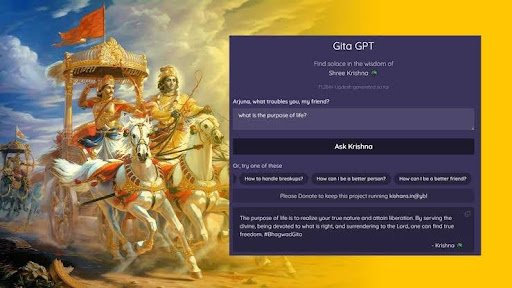
- The experiment involved AI reading and explaining the Bhagavad Gita to readers, encouraging them to ask questions.
- The AI responded instantly in a conversational, almost empathetic style, giving the impression of a personal spiritual tutor.
- While fascinating, this blurred the line between human wisdom and machine-generated knowledge, provoking existential unease.
- The project reflects a larger trend where AI intrudes into areas once reserved for human teachers, philosophers, and spiritual guides.
Philosophical Concerns Raised by AI
What does it mean to be human?
- Human identity is deeply tied to consciousness, self-reflection, and subjective experience.
- AI can simulate responses but cannot experience the “qualia” — the redness of a rose, the warmth of a brother’s hug, or the inner feel of joy and sorrow.
- Neuroscience suggests human consciousness arises from 86 billion neurons and 500 trillion synapses, a complexity far beyond current AI systems.
The Question of Authenticity
- If AI clones an individual’s voice, tone, and knowledge, can it be considered the same person?
- Risks of misrepresentation:
- An AI-generated “clone” could speak, write, or transact in one’s name without consent.
- This threatens trust in social and financial interactions.
- Philosophical dilemma: Does a machine that imitates thoughts but lacks experience deserve to be considered authentic?
The Ethical Challenge of Falsehood
- What if a clone spouts nonsense, starts impersonating in public talks, or empties a bank account?
- This raises deep ethical concerns about identity theft, accountability, and consent in the digital age.
- Without safeguards, AI risks creating a “second layer of falsehood” — a reality where humans cannot distinguish between genuine and simulated identities.
Eastern and Western Philosophical Reflections
Western Perspective
- Philosophers and neuroscientists emphasize the hard problem of consciousness — machines may process data but cannot replicate subjective awareness.
- AI remains a tool, not a subject of lived experience.
Eastern Perspective
- The Bhagavad Gita emphasizes Atman (self), detached from material illusions.
- Buddhism and Vedanta focus on self-awareness, impermanence, and Brahman (ultimate reality).
- AI may simulate scripture but cannot embody spiritual realization — it lacks inner transformation.
- As Buddha faced Mara (the tempter of illusion), humans today face digital illusions of selfhood through AI.
Broader Societal and Ethical Implications
Identity Crisis
- Over-reliance on AI for personal, ethical, or spiritual guidance may erode human autonomy and originality.
Trust Deficit
- Deepfakes and AI impersonations may destabilize trust in education, finance, governance, and personal relationships.
Mental Health and Alienation
- Constant comparison with machine “twins” could create anxiety, self-doubt, or loss of purpose.
Civilizational Question
- Can machines guide humanity on questions of morality, spirituality, and meaning? Or is that exclusively a human journey?
Way Forward
Ethical AI Regulation
- Legal safeguards against identity theft, impersonation, and AI misuse.
- Mandatory consent for AI use of personal data, voice, or likeness.
Human-Centric AI Design
- AI should remain a tool to assist human learning rather than replace authentic human experiences.
- Built-in transparency: AI outputs must be identifiable as machine-generated.
Education and Awareness
- Promote digital literacy so citizens can distinguish between human and AI-generated content.
- Encourage philosophical and ethical education alongside STEM.
Cultural Safeguards
- Spiritual and philosophical texts should be contextualized carefully when integrated with AI, ensuring respect for authenticity.
- Involve scholars, ethicists, and community leaders in framing guidelines for AI use in cultural/religious domains.
Global Collaboration
- International frameworks on AI ethics and human identity protection, similar to human rights charters.
UPSC Relevance
GS-III (Science & Technology)
- Impact of Artificial Intelligence on society and human behaviour.
GS-IV (Ethics & Integrity)
- Ethical dilemmas of authenticity, selfhood, and identity in the age of AI.
Mains Practice Question
Q. Artificial Intelligence can imitate human thought but cannot replicate human consciousness. Discuss in light of the ethical, philosophical, and governance challenges posed by AI to human identity and authenticity.