
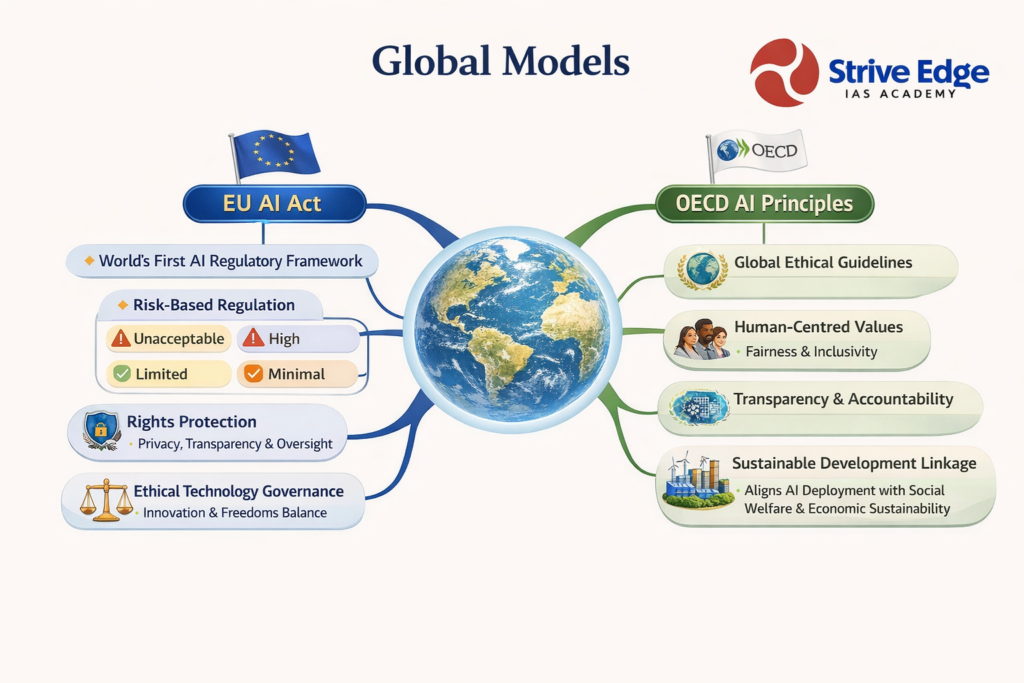
Context
- Artificial Intelligence is rapidly transforming employment patterns, productivity systems, and workplace functioning worldwide. The core policy concern is whether AI transformation will advance social justice and shared prosperity.
- India hosted the AI Impact Summit in New Delhi, first such initiative in the Global South. The summit coincided with the World Day of Social Justice, reinforcing human-centred technology discourse.
Government Initiatives for Future of Work
- India is advancing transformative technologies through the AI Mission and National Quantum Mission.
- Research ecosystems are expanding via the Anusandhan National Research Fund and innovation financing mechanisms.
- The Research, Development, and Innovation Fund supports emerging technology development and diffusion.
- Budget 2026–27 proposed a High-Powered Education-to-Employment Standing Committee on future skills. The committee will assess AI’s employment impact and recommend workforce preparedness strategies.
India’s AI Transformation Landscape
- India hosts the largest share of ChatGPT mobile application users globally.
- The country possesses one of the world’s biggest user bases for advanced AI platforms.
- By 2030, AI could generate over 3 million new technology jobs. More than 10 million existing jobs may undergo structural transformation.
- India therefore represents a laboratory for responsible and inclusive AI deployment.
Challenges Associated with AI
- Global discourse on AI remains polarised between productivity optimism and job-loss pessimism.
- However, the Critics warn of rising inequality, labour displacement, and governance deficits. The AI exposure remains uneven across regions, genders, age groups, and social categories.
- In low-income economies, only 11.5% employment faces generative AI exposure. While the exposure rises to nearly one-third employment in high-income countries.
- Thus the structural economic differences widen the global digital divide. Around one in four workers globally faces occupational exposure to generative AI.
- Institutional preparedness remains slower than technological acceleration.
Way Forward
- AI governance must prioritise inclusive institutions and democratic participation.
- Worker participation and social dialogue should shape technological transitions.
- Public investment in skills development and digital infrastructure remains essential.
- Social protection systems must evolve alongside labour market disruptions.
- International collaboration is necessary for equitable AI diffusion. AI deployment should strengthen workplace safety, dignity, and organisational productivity.
- Technology must align with social purpose to build inclusive economic growth.