
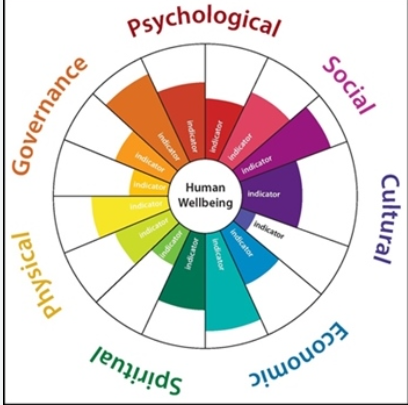
About the Capabilities Approach
- Amartya Sen’s Capabilities Approach defines development as the expansion of substantive freedoms that allow individuals to lead lives they value.
- The term capabilities does not merely refer to personal skills or abilities; it denotes the real opportunities available to individuals to achieve well-being.
- Sen argued that development should not be reduced to economic growth, GDP, or national income, but should instead focus on expanding human choices and freedoms.
- His thinking was shaped through collaboration with Mahbub ul Haq, who emphasised that development must be seen as the enlargement of human choices rather than simply economic progress.
- The framework therefore challenges purely economic metrics of development and places human well-being, dignity, and agency at the centre of development thinking.
Human Development Index (HDI)
- The Human Development Index (HDI) was conceptualised by Mahbub ul Haq, with intellectual contributions from Amartya Sen, to shift the focus of development from mere economic growth to human well-being.
- It measures development through three key dimensions
- Health (life expectancy),
- Education (years of schooling), and
- Standard of living (per capita income),
- Thereby reflects the broader idea that development is the expansion of human capabilities and choices.
Features of the Capabilities Approach
- Freedom as the Core of Development: The approach stresses the moral importance of freedom in achieving human well-being.
- Expansion of Human Choices: Development is understood as increasing the range of meaningful options available to individuals.
- Emphasis on Human Agency: People are viewed as active agents of development rather than passive beneficiaries of policy interventions.
- Open and Context-Sensitive Framework: Sen avoided prescribing a fixed universal list of capabilities, arguing that societies should debate and determine relevant freedoms through public reasoning.
- Distinction between Institutions and Realised Justice: Sen differentiates between niti (formal rules and institutions) and nyaya (justice as experienced in people’s lives).
- Recognition of Social Complexity: The approach acknowledges that human life and social systems are complex and cannot be predicted or engineered through rigid policy frameworks.
- Equality of Autonomy: Sen emphasised that individuals must have equal freedom to shape their own life choices.
Importance of the Capabilities Approach
- Reframing the Meaning of Development: The approach challenges economic reductionism and highlights the centrality of human freedom and dignity.
- Human-Centred Policy Perspective: Development is assessed through social opportunities, economic security, and the ability of individuals to participate meaningfully in society.
- Role of Education in Freedom: Education should nurture reasoning, critical thinking, and civic participation, not merely prepare individuals for employment.
- Strengthening Democratic Life: Citizens equipped with thinking skills and autonomy are essential for a healthy democratic society.
- Relevance in Contemporary Context: In an era of post-truth politics and the growing influence of artificial intelligence, preserving critical thinking and intellectual independence becomes vital.
- Intrinsic Value of Capabilities: Sen emphasised that capabilities have intrinsic value, meaning they are valuable in themselves and not merely tools for economic growth.
Challenges in Realising the Capabilities Approach
- Difficulty of Translating Theory into Policy: Implementing the expansion of freedoms through public policy remains complex, particularly in large societies such as India.
- Declining Standards in Education and Governance: Weakening educational standards limit the development of critical thinking and intellectual autonomy.
- Instrumentalisation of Education: Contemporary policy debates often reduce education to skill development aimed only at employability, ignoring broader freedoms.
- Post-Truth Political Environment: The weakening role of facts, truth, and evidence-based debate undermines democratic discourse and policymaking.
- Disconnect between Theory and Practice: There is a growing gap between philosophical ideas and real-world governance, with limited integration of thought and action (praxis).
- Academic and Institutional Weakness: Universities often fail to translate complex ideas into meaningful public discourse, reducing debates to institutional rhetoric.
- Rise of Plutocratic Populism: Increasing convergence of state power and market interests weakens civil society and narrows development to economic growth alone.
- Simplification of Complex Social Realities: Identity politics, rhetorical narratives, and “alternative facts” often replace careful analysis and evidence.
Way Forward
- Policymaking must prioritise expanding people’s freedoms, choices, and agency rather than focusing solely on economic indicators.
- Education should cultivate critical thinking, ethical reflection, and democratic participation.
- Societies must encourage debate, academic freedom, and evidence-based discourse to determine relevant capabilities.
- Intellectual ideas must be connected with real governance and policymaking, ensuring meaningful integration of thought and action.
- A vibrant civil society is essential to ensure that development policies remain people-centred rather than growth-centred.
- Development must ultimately be understood as the expansion of people’s freedoms, opportunities, and autonomy.