
Why in News: With India set to launch its carbon market in 2026, biochar has gained attention as a promising CO₂ removal technology.
What is Biochar?
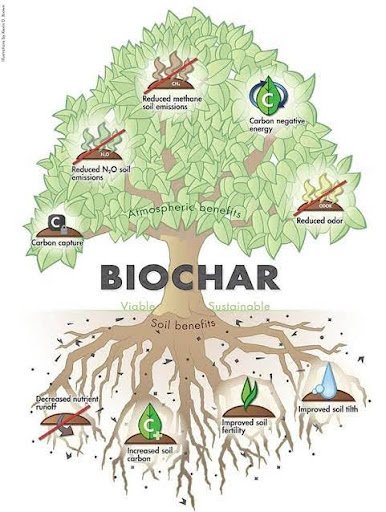
- A carbon-rich type of charcoal made from agricultural residue and organic municipal solid waste.
- Acts as a carbon sink and offers waste management, climate mitigation, and energy generation benefits.
Potential of Biochar in India
- India produces over 600 million tonnes of agricultural residue and more than 60 million tonnes of municipal solid waste annually, much of which causes pollution when burnt or dumped.
- Utilizing 30% to 50% of this surplus waste could generate 15-26 million tonnes of biochar yearly.
- This biochar production can help remove about 0.1 gigatonnes of CO₂-equivalent emissions annually.
- Byproducts like syngas and bio-oil from biochar production can generate additional electricity (8-13 TWh) and substitute fossil fuels, reducing coal use and lowering emissions.
- Biochar can act as a long-term carbon sink, storing carbon in soil for 100 to 1,000 years.
- It offers a significant opportunity to contribute to India’s climate goals by reducing greenhouse gas emissions and improving waste management.
Byproducts of Biochar Production
Syngas (20–30 million tonnes)
- Can generate 8–13 TWh of electricity, replacing 0.4–0.7 MT coal/year
Bio-oil (24–40 million tonnes)
- Can offset 12–19 MT of diesel/kerosene, reducing 2% of fossil-fuel-based emissions
Applications of Biochar
1. Agriculture
- Enhances soil organic carbon and restores degraded soils.
- Improves water retention in semi-dry and nutrient-poor soils.
- Reduces nitrous oxide emissions (a potent greenhouse gas) by 30-50%.
- Lowers fertilizer requirements by 10-20%.
- Increases crop yields by 10-25%.
2. Carbon Capture
- Modified biochar can adsorb CO₂ from industrial exhaust gases, aiding carbon capture efforts (though currently less efficient than conventional methods).
- Acts as a long-term carbon sink by holding carbon in soil for 100 to 1,000 years.
3. Construction Sector
- Can be used as a low-carbon additive in building materials (e.g., concrete).
- Adding 2-5% biochar improves mechanical strength and increases heat resistance by 20%.
- Captures around 115 kg of CO₂ per cubic meter of concrete, turning construction materials into stable carbon sinks.
4. Wastewater Treatment
- Provides a low-cost, effective solution to reduce water pollution.
- One kilogram of biochar, combined with other substances, can treat 200-500 liters of wastewater.
5. Energy Production (Byproducts Utilization)
- Syngas produced during biochar creation can generate 8-13 TWh of electricity annually, replacing coal.
- Bio-oil can offset 12-19 million tonnes of diesel or kerosene annually, reducing fossil fuel imports and emissions.
Why is Biochar Underrepresented in Carbon Credit Systems?
1. No Standardised Protocols: Lack of uniform methods for measuring carbon sequestration and verifying outcomes.
2. Weak MRV Frameworks: Poor measurement and verification tools reduce investor confidence.
3. Policy and Market Gaps: Limited integration in national climate strategies and carbon markets.
4. Low Awareness: Few stakeholders understand biochar’s carbon potential.
5. Tech & Cost Barriers: High costs and limited scalable tech restrict adoption.
Ways to Enable Large-Scale Adoption of Biochar
1. Support R&D
- Develop region-specific feedstock standards
- Optimize biomass use by agro-climatic zones and crop types
2. Policy Integration
- Embed biochar into crop residue management, bioenergy schemes, and State Action Plans on Climate Change
- Recognize biochar as a carbon removal pathway in the Indian Carbon Market
3. Market Incentives
- Provide carbon credits to boost investor and farmer participation
- Create viable business models and stable supply chains
4. Technology Deployment
- Install biochar production units at the village level
- Promote decentralized, small-scale technologies
5. Job Creation & Rural Development
- Potential to create 5.2 lakh rural jobs
- Link climate goals with inclusive economic growth
6. Awareness & Capacity Building
- Educate stakeholders
- Strengthen monitoring, reporting, verification (MRV) frameworks
Conclusion :
Biochar offers a low-cost, scalable solution to India’s climate and rural development challenges. With the right policies, technologies, and market incentives, it can play a key role in achieving climate targets while improving soil health and rural livelihoods.
GS Paper 3:
- Environment and Climate Change: Role of biochar in carbon sequestration and soil health.
- Agriculture: Use of sustainable practices for improving soil fertility and crop yield.
Mains Practice Question:
Q. What is biochar? Examine its potential role in addressing India’s challenges related to soil degradation, carbon emissions, and rural economic development.”