
Budget Philosophy and Policy Orientation
- Budget 2026 prioritises prudence over disruption, avoiding major Big Bang economic announcements.
- The approach relies on multiple sector-specific measures to drive medium-term economic momentum.
- Diffused policymaking is preferred due to heightened geoeconomic and geopolitical uncertainties.
- The Budget targets manufacturing, services, and labour-intensive sectors like textiles and leather.
Manufacturing and Strategic Sector Focus
- Manufacturing support spans seven priority areas: biopharma, semiconductors, electronics, rare earths, chemicals, capital goods, textiles.
- India Semiconductor Mission 2.0 builds upon earlier gains from existing Production Linked Incentive schemes.
- Electronics Component Manufacturing Scheme allocation increase aims to strengthen global competitiveness.
- Biopharma SHAKTI receives ₹10,000 crore over five years to develop a global biopharma hub.
- Pharmaceutical exports benefit from exemption from recent U.S. tariff measures.
MSMEs, Exports, and Services Sector Measures
- Champion MSMEs initiative offers equity, liquidity, and professional support for export competitiveness.
- MSMEs contribute 48.6% of India’s total exports, highlighting their strategic importance.
- The EU Free Trade Agreement timeline may not immediately offset impacts of U.S. trade restrictions.
- A high-powered Education to Employment and Enterprise Committee targets services sector skill pathways.
- Healthcare and medical tourism receive targeted policy attention due to emerging global strengths.
Regional Development and Infrastructure Push
- Dedicated rare earth corridors benefit Odisha, Kerala, Andhra Pradesh, and Tamil Nadu.
- Coconut Promotion Scheme supports Kerala’s agricultural and livelihood ecosystem.
- East Coast Industrial Corridor enhances industrial connectivity in West Bengal.
- First new national waterway project begins in Odisha, boosting logistics efficiency.
Fiscal Strategy and Revenue Management
- Capital expenditure rises to ₹12.2 lakh crore, around 4.4% of GDP, highest in a decade.
- Focus includes freight corridors, training institutes, and coastal cargo promotion initiatives.
- Direct tax reliefs are limited to protect fiscal stability amid rising expenditure commitments.
- Corporate tax revenue is projected to increase nearly 14% over 2025-26 estimates.
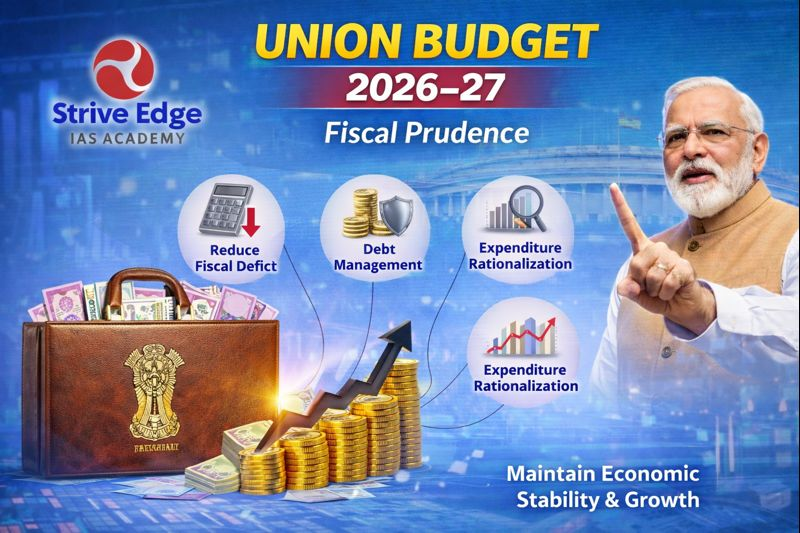
- Fiscal deficit is targeted at 4.3% of GDP, continuing the consolidation trajectory.