
Economic Context and Budget Outlook
- Budget 2026–27 arrives during a goldilocks phase of high growth and low inflation.
- India has become the fourth-largest economy, overtaking Japan in global economic ranking.
- Geopolitical crises and tariff wars create risks for sustaining long-term economic momentum.
- The Budget balances optimism with realistic assessment, avoiding short-term policy stimuli.
Fiscal Strategy and Capital Expenditure
- Capital expenditure target raised to ₹12.2 lakh crore for FY27, signalling infrastructure-led growth continuity.
- Fiscal deficit fixed at 4.3% of GDP, reaffirming commitment to fiscal consolidation.
- Gross borrowing estimated at ₹17.2 trillion, while net borrowing stands at ₹11.7 trillion.
- Debt-to-GDP ratio targeted at 50% in midterm, currently estimated around 55.6%.
- Nominal GDP growth assumed above 10%, implying CPI inflation near 4%.
Manufacturing and Frontier Sector Support
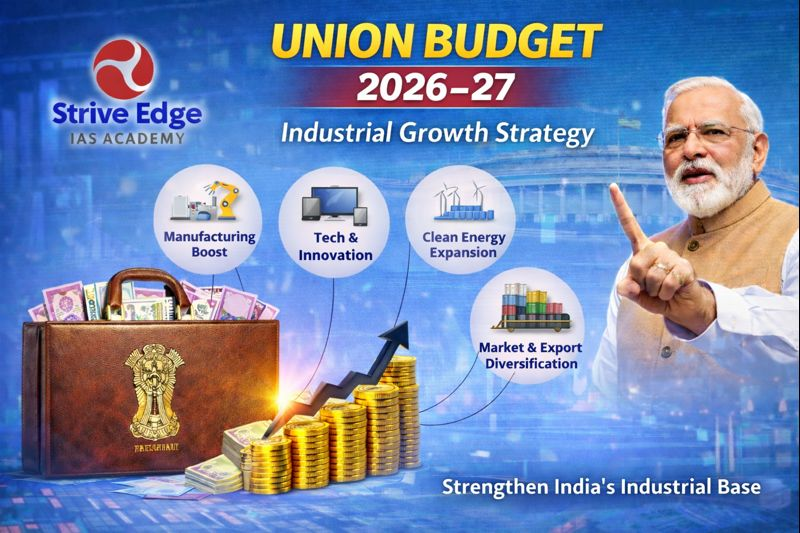
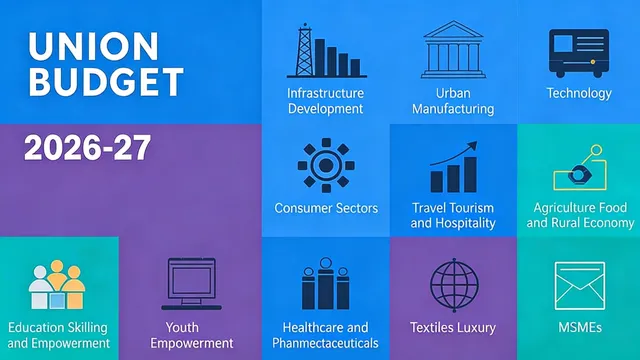
- Budget prioritises manufacturing, MSMEs, khadi, and handicrafts from the opening speech.
- Support expanded for seven strategic sectors, including semiconductors, biopharma, and textiles.
- Electronics Component Manufacturing Scheme outlay increased to ₹40,000 crore.
- India Semiconductor Mission 2.0 aims to reduce dependence on vulnerable global supply chains.
- ₹10,000 crore allocated for container manufacturing, strengthening export logistics infrastructure.
MSMEs, Exports, and Structural Measures
- Export sectors like textiles, leather, and seafood targeted due to higher U.S. duties.
- Proposed ₹10,000 crore SME Growth Fund addresses equity gaps for scalable enterprises.
- Financing reforms signal structural strengthening beyond traditional bank credit models.
- Logistics investments focus on freight corridors and transport networks for export competitiveness.
Concerns, Gaps, and Policy Silences
- Disinvestment targets appear ambitious, with ₹47,000 crore target yielding only ₹8,768 crore previously.
- Zero-tax incentive until 2047 proposed for global cloud services using Indian data centres.
- Services sector employment expectations appear contradictory amid automation and artificial intelligence adoption.
- Budget remains silent on rupee volatility highlighted in the Economic Survey.
- Lack of a comprehensive industrial policy and domestic demand strategy risks weakening manufacturing growth.