
Rare Earth Corridors and Critical Mineral Strategy
- The Union Budget announced rare earth corridors in Odisha, Kerala, Andhra Pradesh, and Tamil Nadu.
- Corridors aim to strengthen mining, processing, research, and manufacturing of critical minerals.
- The initiative seeks to reduce India’s heavy dependence on Chinese rare earth imports.
- India’s rare earth imports increased from $14.1 million in 2014 to $17.5 million in 2024.
- Over 45% of India’s imports currently originate from China.
- Rare earth elements comprise 17 metals, grouped into light and heavy categories.
- Light rare earths include lanthanum, cerium, neodymium, and samarium.
- Heavy rare earths include dysprosium, terbium, ytterbium, and yttrium.
- The policy strengthens supply chain resilience and industrial competitiveness.
- These elements are essential for electric vehicles, wind turbines, defence, smartphones, and hard drives.
- China holds nearly half of global reserves and produces over 60% of global output.
- It controls around 92% of global refining capacity, dominating the value chain.
- Further, China has supplied nearly 30% of global exports in the past five years.
Semiconductor Mission 2.0 and Electronics Manufacturing Push
- The Electronics Component Manufacturing Scheme outlay was raised from ₹22,805 crore to ₹40,000 crore.
- The scheme already has investment commitments double its original target.
- The application window remains open until 2027 for indigenously manufactured capital machinery.
- The government announced India Semiconductor Mission (ISM) 2.0 to strengthen domestic capabilities.
- ISM 1.0 had an outlay of ₹76,000 crore to expand semiconductor ecosystem foundations.
- ISM 2.0 will focus on equipment, materials, and full-stack Indian intellectual property.
- The mission aims to fortify semiconductor supply chains and reduce external dependence.
Carbon Capture, Utilisation, and Storage for Net-Zero Goals
- The Budget earmarked ₹20,000 crore for Carbon Capture Utilisation and Storage (CCUS).
- CCUS captures CO₂ from power plants, steel, cement, chemicals, and refineries.
- Captured carbon is either utilised in products or stored in geological formations.
- The Department of Science and Technology released a CCUS roadmap in December 2025.
- The roadmap aligns CCUS with India’s net-zero target for 2070.
- CCUS is prioritised for hard-to-abate sectors, including iron and steel industries.
- India’s approach is research-led, focusing on indigenous technology development.
- The plan follows a three-phase progression from laboratory to commercial readiness.
- Emphasis is on point-source capture and shared transport and storage infrastructure.
- Integration into existing industrial facilities is prioritised over greenfield deployment.
- Estimated initial research cost is ₹4,500 crore over the next two years.
High-Speed Rail Corridors and Transport Infrastructure
- Seven high-speed rail corridors were approved with a total 4,000 km network.
- The total projected outlay is ₹16 lakh crore.
- Corridors will connect Mumbai-Pune, Pune-Hyderabad, Hyderabad-Bengaluru, Hyderabad-Chennai, and Chennai-Bengaluru.
- Northern corridors include Delhi-Varanasi and Varanasi-Siliguri via Patna.
- Travel time between Chennai and Bengaluru will reduce to 1.5 hours.
- Pune to Mumbai travel time will drop to 45 minutes.
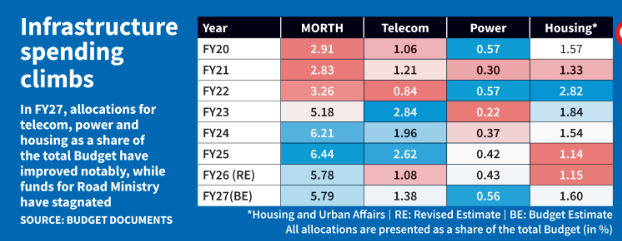
- Railways received ₹2,78,030 crore, a 10.8% increase from the previous fiscal.
- ₹1,20,000 crore is earmarked for safety measures, including Kavach deployment.
- Road Transport and Highways received ₹3.09 lakh crore, a 10.7% hike.
- Allocation to NHAI increased to ₹1.87 lakh crore.
Aerospace Manufacturing and Seaplane Connectivity
- The Budget removed 7.5% to 15% customs duty on components for civilian and training aircraft.
- Raw materials for defence aircraft maintenance and overhaul were exempted from customs duty.
- Incentives were announced to indigenise seaplane manufacturing.
- The policy aims to enhance last-mile connectivity and tourism promotion.
- A viability gap funding scheme will support seaplane operations.
- Seaplanes remain part of the UDAN scheme since 2018, but routes are pending.
Tourism Development and Cultural Infrastructure
- A pilot scheme will upskill 10,000 tourist guides across 20 iconic destinations.
- A National Institute of Hospitality will train professionals for the tourism sector.
- A National Destination Digital Knowledge Grid will document cultural and heritage sites.
- Buddhist circuits will be developed in Arunachal Pradesh, Sikkim, Assam, Manipur, Mizoram, and Tripura.
- Fifteen archaeological sites, including Lothal, Dholavira, Sarnath, and Leh Palace, will be upgraded.
- The initiative will create curated walkways for experiential heritage tourism.
- Ecologically sustainable tourism trails will be developed across mountain and coastal regions.
- Trails include Himachal Pradesh, Uttarakhand, Jammu and Kashmir, Eastern and Western Ghats.
- Turtle nesting and bird-watching trails will be developed in coastal and lake regions.
- Tourism allocation stands at ₹2,438 crore for 2026–27, slightly lower than last year.
Defence Modernisation and Strategic Autonomy
- Defence allocation set at ₹7.85 lakh crore, highest ever.
- Constitutes 2% of GDP and 14.67% of total Union expenditure.
- Capital expenditure raised to ₹2.19 lakh crore, up 22%.
- 75% of capital procurement reserved for domestic industries.
- ₹1.85 lakh crore allocated for capital acquisitions.
- Major projects include fighter aircraft, submarines, drones, and smart weapons.
- Revenue spending enhanced for pensions, border infrastructure, R&D, and veterans’ healthcare.
- Policy reinforces self-reliance and industrial capacity in defence manufacturing.
- Strategic commentary highlights the need for higher long-term defence-to-GDP ratios.