
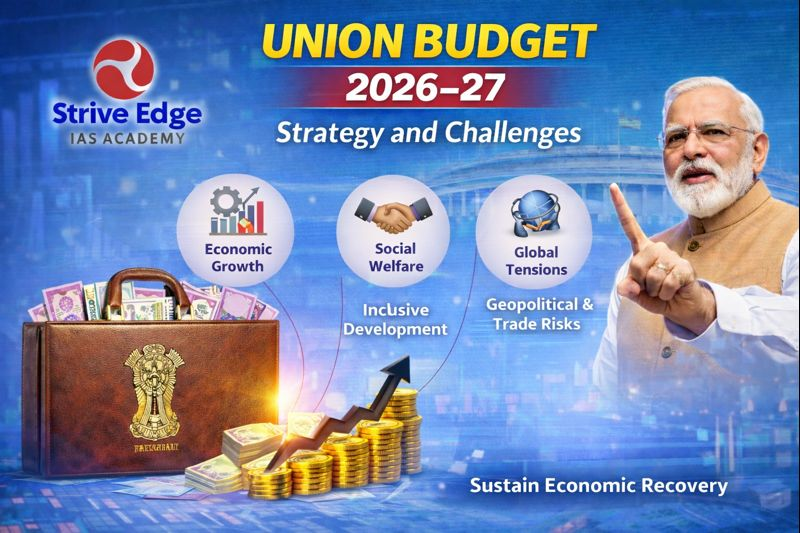
Nature and Policy Role of the Union Budget
- The annual Budget is a political and financial statement addressing short- to medium-term challenges.
- It outlines revenue, expenditure, and government priorities, with emphasis on fine print over headlines.
- The Budget offers insight into broad economic direction due to absence of long-term policy frameworks.
Geopolitical Context Shaping Budget 2026–27
- The Budget is framed amid heightened global turmoil during the second Trump presidency.
- Steep U.S. tariffs have weakened prospects for closer India-U.S. economic engagement.
- India is pursuing stronger ties with the European Union through a major free trade agreement.
- China has imposed restrictions on critical minerals, machinery exports, and skilled workers for EVs.
- India’s import dependence on China remains high despite policy efforts since 2020.
Manufacturing Performance and Structural Concerns
- The manufacturing sector shows weak performance despite headline GDP growth of 6.5%–7% annually.
- Manufacturing’s share in GDP and total employment has declined or stagnated.
- Official GDP estimates appear overstated compared to Annual Survey of Industries data.
- Fixed investment growth has remained modest, eroding industrial capacity over the last decade.
Import Dependence and Policy Limitations
- Rising reliance on imported capital and intermediate goods constrains domestic industrial performance.
- An inverted duty structure raises tariffs on intermediates above final goods, discouraging investment.
- Initiatives like Make in India, Aatma Nirbhar Bharat, and PLI show limited impact on import reduction.
- Mobile phone assembly success reflects high import content rather than deep domestic value addition.
Tariff Reforms and Ease of Production
- The Budget proposes customs duty rationalisation to correct inverted duty structures.
- Lower duties on capital and intermediate goods aim to encourage domestic value addition.
- Simplified import procedures seek to reduce delays and improve export competitiveness.
Electronics, Rare Earths, and Strategic Inputs
- Electronics components remain India’s largest import dependence category, mainly sourced from China.
- The Budget proposes dedicated rare earth corridors across mineral-rich coastal and southern States.
- Rare earths support EV manufacturing, electronics, and critical technology supply chains.
- Tax exemptions on capital goods extend to lithium-ion cell production for battery storage.
Labour-Intensive Exports and MSME Clusters
- Trade integration is seen to begin with labour-intensive goods for export diversification.
- The Budget promotes new MSME clusters and modernisation of 120 legacy industrial clusters.
- Financial support aims to enable MSMEs to access capital markets and improve productivity.
Investment Gaps and Centre-State Fiscal Silence
- High-technology manufacturing requires foreign direct investment and proprietary multinational technologies.
- Net FDI as a ratio of GDP has approached zero in recent years.
- SEZ firms are allowed limited domestic sales instead of stronger export facilitation measures.
- The Budget remains silent on Centre–State fiscal challenges amid Finance Commission recommendations.