
Context and Reference to Budget 2025–26
- Budget 2026–27 assessed against outcomes of the previous middle-class tax cut strategy.
- Government expected higher compliance and rising incomes to offset reduced tax rates.
- The anticipated revenue buoyancy did not materialise as initially projected.
Tax Revenue Performance and Shortfalls
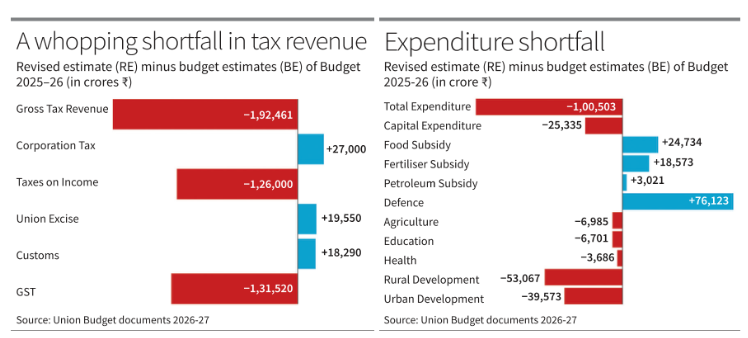
- Income tax collections fell short of estimates by ₹1.26 lakh crore in Revised Estimates.
- Goods and Services Tax collections showed a further shortfall of ₹1.31 lakh crore.
- Corporate tax and excise duty performance marginally reduced the overall gross tax gap.
- Total gross tax revenue shortfall remained around ₹1.92 lakh crore.
Impact on Expenditure and Development Priorities
- Fiscal deficit rules link expenditure levels directly to realised tax collections.
- Revenue shortfalls triggered across-the-board expenditure reductions.
- Capital expenditure, agriculture, education, health, and urban development faced budgetary cuts.
- Reduced spending affected employment generation, income support, and essential public services.
External Risks and Macroeconomic Uncertainty
- India faces current account surplus with the United States and deficit with China.
- Potential export decline from U.S. tariff escalation could worsen external balance.
- Economic Survey assigned 10% probability to external sector deterioration.
- Budget planning assumed continuity of stable global conditions.
Demand-Side Strategy and Employment Concerns
- Budget emphasises fiscal prudence, supply-side measures, and MSME credit guarantees.
- Employment outcomes, especially among youth and urban women, remain weak.
- Corporate investment growth continues to be subdued despite repeated policy approaches.
- Public capital expenditure prioritised infrastructure over development-oriented spending.
Policy Gaps and Missed Opportunities
- Employment-intensive sectors like education, health, and agriculture received limited emphasis.
- Welfare and development spending noted for strong multi-round demand generation potential.
- Environmental concerns, particularly urban pollution, received no specific budgetary focus.
- Absence of a demand-led strategy raises questions on long-term employment sustainability.