
Overall Orientation of Social Sector Budget
- Budget 2026–27 introduces no new flagship social welfare schemes, marking a notable departure.
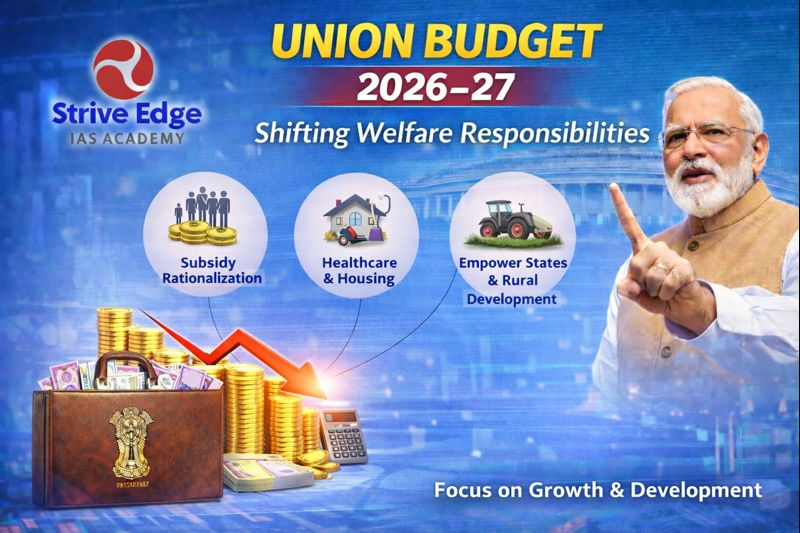
- Welfare agenda increasingly shaped through legislation and national norms, not direct central spending.
- Social sector continues to receive low priority in both allocations and actual expenditure trends.
Allocation Trends for Vulnerable Groups
- Key schemes include NSAP, SAMARTHYA, PALNA, PM POSHAN, and Saksham Anganwadi.
- Nominal allocation increases range from 0.2% for NSAP to 5.2% for Saksham Anganwadi.
- Revised Estimates for 2025–26 remain below Budget Estimates, indicating persistent underspending.
- Welfare coverage for children, pregnant women, elderly, single women, and persons with disabilities remains constrained.
Health and Education Spending Patterns
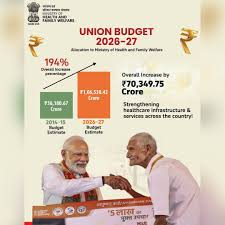
- Health allocations rise by 6.4%, while education allocations increase by 8.3% in Budget Estimates.
- Revised Estimates for both sectors fall 3.7% and 5.2% below initial allocations.
- Budget growth figures thus mask actual contraction in real spending capacity.
Declining Expenditure in Major Social Heads
- Largest Revised Estimate declines observed in Urban Development, Rural Development, and Social Welfare.
- Jal Jeevan Mission spending fell from ₹67,000 crore BE to ₹17,000 crore RE.
- PMAY-Grameen and PMAY-Urban saw significant downward revisions despite repeated headline allocations.
- Centrally Sponsored Schemes display systematic underspending across most welfare sectors.
Shift of Welfare Responsibility to States
- Post-2015 reforms increased State cost-sharing obligations under Centrally Sponsored Schemes.
- VB-G RAM G allocation of ₹96,000 crore requires additional ₹56,000 crore from States.
- True welfare spending now depends on State budgetary capacity and fiscal prioritisation.
Federal Fiscal Constraints and Concerns
- States receive only 34% of total tax revenues, below the 41% Finance Commission recommendation.
- Higher reliance on cesses and surcharges reduces divisible tax pool for States.
- Finance Commission grants declined from ₹1,32,767 crore to ₹1,29,397 crore.
- Growing welfare burden raises concerns over State fiscal space and service delivery outcomes.