
In short :
With urban rooftop space limitations constraining India’s solar ambitions, Building-Integrated Photovoltaics (BIPV) has emerged as a promising land-neutral technology to convert buildings into self-sustaining energy generators.
What is BIPV?
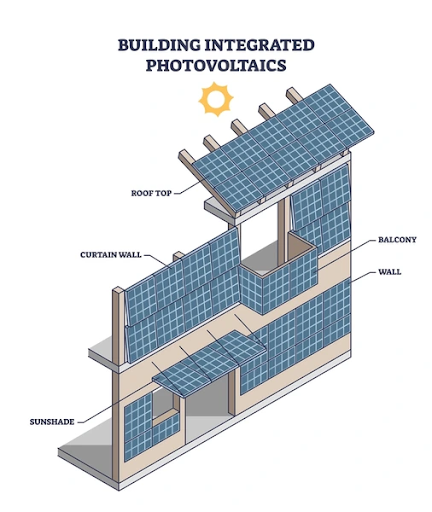
- BIPV refers to solar energy systems integrated into the building envelope (e.g., façades, windows, rooftops).
- Unlike rooftop solar systems (RTS), BIPVs replace traditional building materials (glass, cladding, tiles) with solar panels that double as structural elements.
- They offer both energy generation and aesthetic/architectural utility.
Advantages & Use Cases :
- Ideal for dense urban areas where roof space is limited.
- Can be integrated into façades, railings, windows, balconies, and public infrastructure.
- Examples: CtrlS Datacenters (Mumbai), Renewable Energy Museum (Kolkata), railway stations (Vijayawada, Sahibabad).
Challenges in India :
- High upfront cost, lack of awareness, no dedicated incentives.
- Policy and regulatory gaps, especially in building codes and solar mission incentives.
- Dependence on imports and limited indigenous manufacturing.
STEPS TAKEN FOR BIPVs
PM Surya Ghar Muft Bijli Yojana (2024) allows BIPV under residential subsidy norms (up to ₹78,000 for 3 kW systems).MNRE issued operational guidelines to incorporate BIPV as an eligible system in rooftop subsidy schemes.
Way Forward :
- Include BIPV in National Building Code, Energy Conservation Building Code, and Eco Niwas Samhita.
- Provide higher subsidies for BIPV in commercial and industrial sectors.
- Promote public-private pilot projects to demonstrate feasibility and gain public trust.
- Boost R&D and indigenous manufacturing under production-linked incentive (PLI) schemes.
- Encourage use of Renewable Energy Service Company (RESCO) models and long-term PPAs to de-risk investments.
| UPSC Relevance: GS3 – Energy & Infrastructure:Sustainable urban development, Renewable energy technologies and national targets (e.g., 300 GW solar by 2030). GS2 – Government Policies:Role of schemes like PM Surya Ghar Yojana and urban policy reforms. Mains Practice Question: “India’s solar energy goals cannot be achieved by rooftop and ground-mounted systems alone. Examine the role of Building-Integrated Photovoltaics (BIPV) in meeting sustainable urban energy needs.” |