
Syllabus: Major crops – cropping patterns in various parts of the country
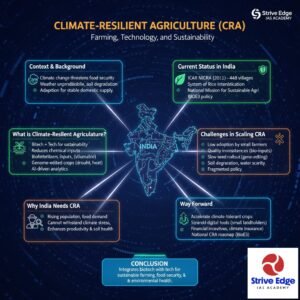
Context and Background
- Climate change threatens India’s food security through weather unpredictability, soil degradation, and rising pollution.
- Agriculture must adapt to ensure stable domestic food supply under increasing climatic uncertainty.
What is Climate-Resilient Agriculture?
- Climate-resilient agriculture (CRA) integrates biotechnology with complementary technologies for sustainable farming.
- CRA reduces dependence on chemical inputs while maintaining or improving farm productivity.
- Key tools include biofertilizers, biopesticides, and soil-microbiome analysis.
- Genome-edited crops are developed for tolerance to drought, heat, salinity, and pests.
- AI-driven analytics integrate environmental and agronomic variables for locally tailored farming strategies.
Why India Needs Climate-Resilient Agriculture
- India’s rapidly growing population intensifies demand for reliable agricultural productivity.
- Around 51% of net sown area is rainfed, producing nearly 40% of national food output.
- Rainfed agriculture is highly vulnerable to climate variability and extreme weather events.
- Conventional farming methods alone cannot withstand increasing climate-related stresses.
- CRA enhances productivity while simultaneously protecting environmental and soil health.
Current Status in India
- ICAR launched NICRA in 2011 to enhance farmer resilience to climate variability.
- Project demonstrated location-specific CRA technologies in 448 climate-resilient villages.
- Technologies include system of rice intensification, aerobic rice, zero till wheat, and direct seeding.
- Climate-resilient crop varieties tolerant to extreme weather conditions were promoted.
- National Mission for Sustainable Agriculture focuses on rainfed areas, water efficiency, and soil health.
- BioE3 policy identifies CRA as a priority for biotechnology-led agricultural solutions.
- Several CRA-relevant technologies are already commercialised.
- Bio-input companies support soil health and reduced chemical dependence.
- Digital agriculture sector is expanding with AI-enabled advisories and precision farming tools.
Challenges in Scaling CRA
- Low adoption among small and marginal farmers due to limited access, awareness, and affordability.
- Quality inconsistencies in biofertilizers and biopesticides undermine farmer trust.
- Slow rollout of climate-resilient seeds and uneven adoption of gene-editing technologies.
- Digital divide restricts access to AI-based decision-support tools.
- Soil degradation, water scarcity, and accelerating climate volatility compound adaptation challenges.
- Fragmented policy coordination risks delaying large-scale CRA implementation.
Way Forward
- Accelerate development and deployment of climate-tolerant and genome-edited crops.
- Strengthen quality standards and supply chains for biofertilizers and biopesticides.
- Expand digital tools and climate advisories for small landholders.
- Provide financial incentives, climate insurance, and credit support during transition phases.
- Establish a coherent national CRA roadmap under the BioE3 framework.