
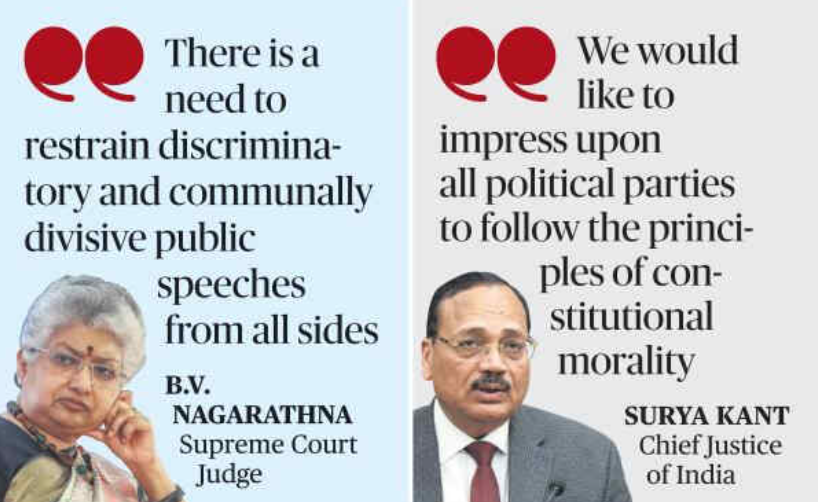
Context: The Supreme Court has emphasized that political leaders and constitutional functionaries must uphold fraternity and constitutional morality.
Philosophical Foundations of Constitutional Morality
- Constitutional morality denotes adherence to constitutional values regulating democratic power and citizen conduct.
- It balances individual liberty with institutional discipline within a constitutional governance framework.
- Historian George Grote introduced the concept in nineteenth-century democratic theory discourse. He emphasised reverence for constitutional procedures, institutions, and rule-bound governance.
- It promotes self-restraint among institutions and citizens to preserve democratic stability.
Constitutional Morality in the Indian Constitutional Framework
- The Constitution does not explicitly mention constitutional morality as a textual expression. However, its spirit permeates constitutional design, values, and institutional arrangements.
- The Preamble embodies justice, liberty, equality, and fraternity as ethical constitutional foundations.
- Fundamental Rights protect citizens from arbitrary state power and rights violations.
- Directive Principles guide governments towards socially just and welfare-oriented policymaking.
- Fundamental Duties encourage responsible citizenship aligned with constitutional ideals.
- Institutional separation of powers ensures accountability and prevents authority concentration.
- The term morality appears in Articles 19(2), 19(4), 25(1), and 26 constitutional provisions.
Judicial Interpretation and Doctrinal Evolution
- The Supreme Court has substantively expanded constitutional morality through progressive constitutional interpretation.
- Naz Foundation (2009) case: Prioritised constitutional morality over socially dominant public morality.
- Manoj Narula (2014) case: Stressed ethical governance aligned with constitutional norms.
- Puttaswamy (2017) case: Linked constitutional morality with dignity, privacy, and liberty protections.
- Navtej Singh Johar (2018) case: Advanced equality and dignity for LGBTQI+ communities.
- Sabarimala (2018) case: Upheld gender equality over exclusionary religious practices.
- NCT Delhi (2018) case: Reinforced cooperative federalism and institutional constitutional respect.
Significance in Democratic Governance
- Constitutional morality ensures supremacy of the Constitution over political or institutional authority.
- It strengthens democratic culture by preventing authoritarian power concentration.
- It enables constitutional adaptation to progressive social transformation.
- Minority rights receive protection against majoritarian social and political pressures.
- It restrains arbitrary executive and legislative decision-making.
- It fosters responsible, participatory, and ethically conscious citizenship.
Key Challenges
- Judicial application sometimes appears inconsistent across comparable constitutional disputes.
- Public morality frequently overrides constitutional ethics in social debates.
- Constitutional awareness remains limited among large sections of citizens.
- Criminalisation in politics weakens ethical legitimacy of governance institutions.
- Expansive judicial reliance risks institutional overreach concerns.
Way Forward
- Constitutional literacy must be institutionalised through education and civic awareness programmes.
- Legislative conduct frameworks should enforce ethics, transparency, and accountability norms.
- Periodic constitutional audits can evaluate institutional adherence to constitutional principles.
- Media campaigns should popularise constitutional values through multilingual outreach.
- Governance models must institutionalise inclusion, equality, and non-discrimination.
Conclusion: Constitutional morality transforms constitutional text into ethical democratic practice. Its observance determines depth, inclusivity, and sustainability of Indian democracy.