
Syllabus: Issues Related to Women
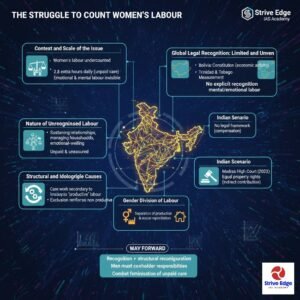
Context and Scale of the Issue
- Women’s labour remains systematically undercounted, despite its centrality to social functioning.
- A 2023 United Nations report shows women spend 2.8 extra hours daily on unpaid care work.
- Domestic labour has entered discourse, but emotional and mental labour remains invisible.
Nature of Unrecognised Labour
- Includes sustaining relationships, managing households, and supporting emotional well-being.
- This labour ensures family stability and social reproduction, yet remains unpaid and unmeasured.
- Such work is rarely included in economic accounting or policy design.
Structural and Ideological Causes
- Feminist scholars highlight systemic marginalisation of care work in economic frameworks.
- Care work is framed as secondary to male-dominated “productive” labour.
- Economic models privilege GDP growth and physical infrastructure over social infrastructure.
- Public spending often sidelines childcare, elder care, and mental health services.
- These sectors are predominantly staffed and sustained by women’s unpaid or underpaid labour.
Gender Division of Labour
- Gendered separation between production and social reproduction sustains power inequalities.
- Biological reproduction was used to mask historical and social subordination of women.
- Exclusion of women’s labour reinforces its treatment as non-productive.
Global Legal Recognition: Limited and Uneven
- Institutional recognition of unpaid care work is fragmented across countries.
- Bolivia’s Constitution (Article 338) recognises household work as economic activity.
- Trinidad and Tobago (1996) mandates measurement and valuation of unremunerated work.
- Argentina provides pension credits for unpaid care work related to child-rearing.
- No framework recognises mental and emotional labour explicitly.
Indian Scenario
- India lacks a legal framework recognising or compensating unpaid care labour.
- Madras High Court (2023) recognised household labour as contributing to family assets.
- The ruling granted wives equal property rights for indirect economic contribution.
Way Forward
- Recognition must accompany structural reconfiguration of gendered social relations.
- Men must actively co-shoulder care responsibilities.
- Without change, unpaid care work will remain disproportionately feminised.