
Context
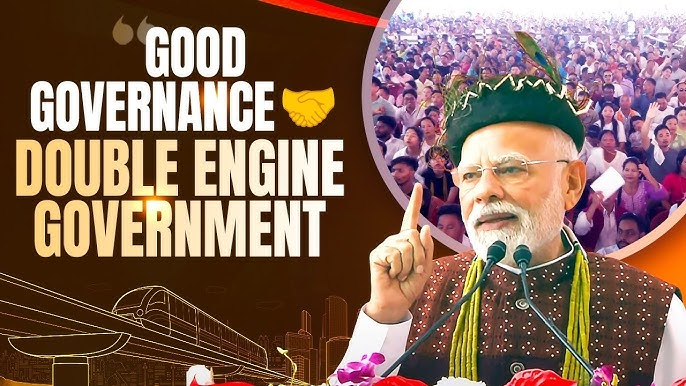
- Prime Minister Narendra Modi advocated “double-engine government” during southern visits.
Meaning of Double-Engine Government
- It is often associated with BJP-led National Democratic Alliance rule and refers to political alignment between Union and State governments.
- It suggests governance synergy improves development outcomes and presented as mechanism for faster project execution.
Advantages of Double-Engine Government
- Alignment may enable smoother Centre-State coordination.
- Politically aligned States may face lower Union interference.
- Discretionary fund flows may operate with fewer frictions.
- Administrative clearances may move faster under alignment.
- Claimed to enhance development delivery efficiency.
Challenges Associated
- Federal Accommodation Issues
- Narrative seen as undermining federal pluralism while India’s federalism accommodates diverse political mandates.
- Efficiency vs Democracy Debate
- Suggests multi-party federalism reduces governance efficiency but risks framing democracy as administrative inefficiency.
- It pits political symmetry against representative federalism.
- Partisan Bias Concerns
- Greater discretion exists in Centrally Sponsored Schemes (CSS) while the opposition states allege delays in fund releases.
- Allegations arise regarding role of central agencies.
- Centralisation Risks
- May legitimise expansion of Union political control and weakens culture of federal restraint.
Way Forward
- Strengthen cooperative federalism over political alignment narratives.
- Ensure rule-based, transparent fiscal transfers.
- Reduce CSS conditionalities causing administrative delays.
- Protect States’ fiscal autonomy amid GST regime constraints.
- Recognise diverse State-specific development pathways.