
Context
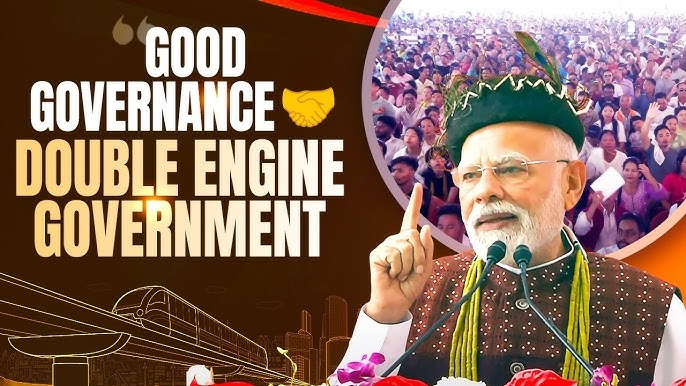
- The idea of a “double-engine government” has gained prominence in electoral politics. While it promises faster development through alignment, it raises serious concerns about India’s federal structure.
What is meant by Double Engine Government?
- Refers to a situation where the same political party governs both the Union and State governments.
- It is argued that such alignment ensures better coordination, faster decision-making, and accelerated development.
- At face value, it reflects cooperative federalism (coordination between Centre and States). However, in practice, it may imply that States ruled by different parties receive less support, raising constitutional concerns.
Advantages of Double Engine Government
- Administrative Coordination
- Easier policy implementation due to ideological alignment.
- Reduces conflicts and delays between Centre and States.
- Faster Development Outcomes
- Improved project approvals, funding flows, and execution efficiency.
- Potential for better Centre-State synergy in welfare delivery.
- Policy Continuity
- Ensures uniformity in governance priorities across levels.
- Helps in implementing large-scale national schemes effectively.
- Political Stability
- Reduces friction, enabling smooth governance and quicker decisions.
However, these advantages are meaningful only when benefits are extended equally to all States, irrespective of political alignment.
Challenges Associated with Federal Structure
- Threat to Cooperative Federalism
- Suggests that development may depend on political alignment, not constitutional rights.
- Undermines the idea that Union represents all States equally.
- Distortion of Fiscal Federalism
- Public funds collected through national taxation belong to the entire Union, not a ruling party.
- Allocation cannot be based on political considerations.
- Issues in Resource Distribution: Concerns raised by Southern States regarding
- Use of recent population data, penalising States with better population control.
- Growing use of cesses and surcharges, which are not shared with States, reducing their fiscal share.
- Weakening of State Autonomy
- States feel reduced to “beggars” for funds, despite constitutional guarantees.
- Governor’s Role and Legislative Delays
- Governors delaying assent to Bills in opposition-ruled States (e.g., Tamil Nadu, Kerala).
- Supreme Court rulings:
- Punjab case (2023): Governor cannot stall legislation through inaction.
- Tamil Nadu case (2025): Prolonged delay is unconstitutional.
- Case of Delhi
- Frequent conflicts between elected government and Lieutenant Governor led to governance paralysis.
- Erosion of Federal Spirit
- Even if formal federal structure exists, its spirit weakens due to political centralisation.
Reforms Required
- Strengthening Fiscal Federalism: Make Finance Commission recommendations more binding and ensure transparent and rule-based resource allocation.
- Rationalising Cesses and Surcharges: Limit excessive use to protect divisible pool of taxes.
- Fixing Governor’s Role: Introduce statutory timelines (e.g., 3 months) for assent to Bills. Also, provide for deemed assent in case of delay.
- Revitalising Inter-Governmental Mechanisms: Strengthen Inter-State Council (Article 263) as a genuine platform for dialogue.
- Ensuring Political Neutrality: Governance should not be used to reward or punish States politically.
- Promoting True Cooperative Federalism: Encourage partnership model, not hierarchy between Centre and States.
Conclusion
- The idea of a double-engine government may promise efficiency, but development cannot depend on political alignment. India’s federal structure is built on fairness, equality, and institutional safeguards, not partisan advantage. Thus, preserving the spirit of cooperative federalism is essential to ensure that every State and citizen receives equal opportunity and dignity.