The Earth’s surface, is in a perpetual state of transformation. This dynamic nature stems from both internal (endogenic) and external (exogenic) forces, each playing a vital role in sculpting the diverse physiographic features observed today.
- These forces govern processes ranging from the violent upheaval of mountains to the gentle weathering of rocks, cumulatively shaping the major landforms that define our planet’s surface.
Types of Mountains;
Mountains make up a large proportion of the earth’s surface. Based on their mode of formation, four main types of mountains can be distinguished.

1. Fold Mountains
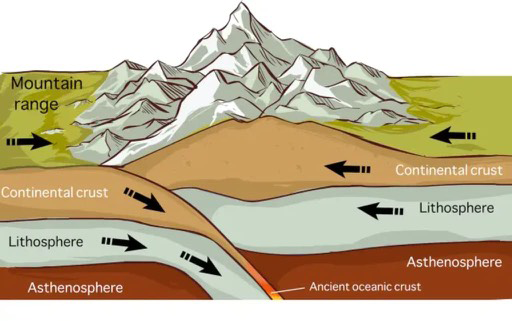
Formed by compressional tectonic forces, these mountains result from the buckling and folding of sedimentary rock strata under immense pressure, typically along convergent plate boundaries.
- They are often referred to as “young mountains” due to their geological youth and are characterized by their towering heights, sharp peaks, and complex geological structures.
- Occurs at convergent plate boundaries (continental-continental or oceanic-continental) where long periods of sediment accumulation in geosynclines (large, linear depressions) and Compressional forces push sedimentary layers together, causing them to fold.
- The folded rocks are uplifted to form mountains and erosional forces begin shaping the surface.
- Associated Geological Features are Overfolds, nappes and recumbent folds, thrust faults and fold-thrust belts.
Characteristics of Fold Mountains
- Physiographic Traits – Lofty peaks, deep valleys, rugged, steep terrain, High seismicity and tectonic activity, Parallel ranges and complex topography.
Types of Folds in Fold Mountains
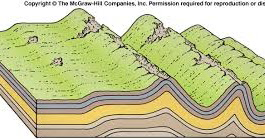

- Anticline simple fold
- Symmetrical Fold – Uniform compressive force from both sides. It is common in early stages
- Asymmetrical Fold – Uneven pressure; one limb steeper than the other. It is Found in mature folded terrains.
- Overfold- Extreme compression causes one limb to override. For example, Alps.
- Recumbent Fold – Horizontal folding; both limbs almost parallel. For example, the Himalayas.
- Nappe- Intense folding and faulting displace fold units. For example, the European Alps.
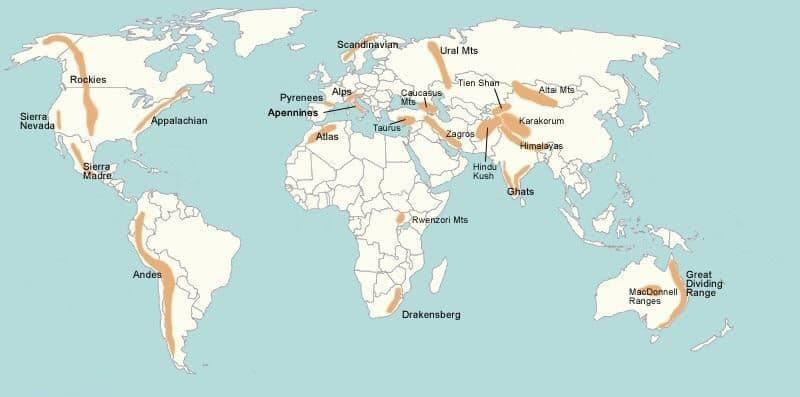
| Mapping: Examples of Fold Mountains (Global) are Himalayas, Alps, Andes, Rockies, Urals, Aravallis. |
DIY Mapping:
| Mountain Range | Highest Peaks | Location | Description |
| Caucasus Mountain | Mt. Elbrus | Europe | Located between the Black Sea and the Caspian Sea |
| Scandinavian Mountains | Galdhøpiggen | Europe (Finland, Norway, Sweden) | The western sides of the mountains drop precipitously into the North Sea and Norwegian Sea, forming the fjords of Norway, whereas to the northeast they gradually curve towards Finland. |
| Carpathian Mountains | Gerlachovsky štít | Europe | Range of mountains forming an arc across Central and Eastern Europe. |
| Ural Mountains | Mt. Narodnaya | Russia | This mountain range act as a boundary between Europe and Asia. |
| Hindukush Mountains | Mt. Trich Mir | Pakistan and Afghanistan | Folded mountain with rugged topography which makes it difficult for transportation. |
| Himalayas | Mt. Everest | Asia | Young fold mountains in Asia which separates Indian sub-continent from Asian plains |
| Arakan Yoma | Mt. Kennedy peak | Myanmar | It extends from north to south direction. Shifting cultivation is practised. |
| Kunlun Mountains | Mt. Muztag | North of Tibetan plateau in western China | It is one of the young folded mountains. |
| Rocky Mountains (Rockies) | Mt. Elbert (highest peak in the Rockies) | North America Western US (New Mexico State) | It is one of the longest fold mountains in the world and extends from Canada to Mexico |
| Appalachian Mountains | Mt. Mitchell, North Carolina, US (highest peak of Appalachian Mountains) | North America | It is a fold mountain with rich in mineral resources |
| Alps | Mont Blanc (France-Italian border) | Europe | It is a folded mountain and source for rivers like Danube, Rhine, etc. |
| Sierra Nevada | Mt. Whitney | California, USA | Habitat for many Red Indian tribes |
| Alaska Range | Mt. McKinley | North America | Mt. McKinley highest peak in North America |
| Altai Mountains | Belukha mountain | Central Asia | Young folded mountain which extends from Kazakhstan to northern China |
| Andes | Mt. Aconcagua | South America | Longest mountain chain in the world |
| Atlas Mountains | Mt. Toubkal | Northwestern Africa | Young fold mountain spreading over Morocco and Tunisia |
| Drakensberg Mountains | Mt. Lesotho | South Africa | Young folded mountain |
2. Block Mountains:
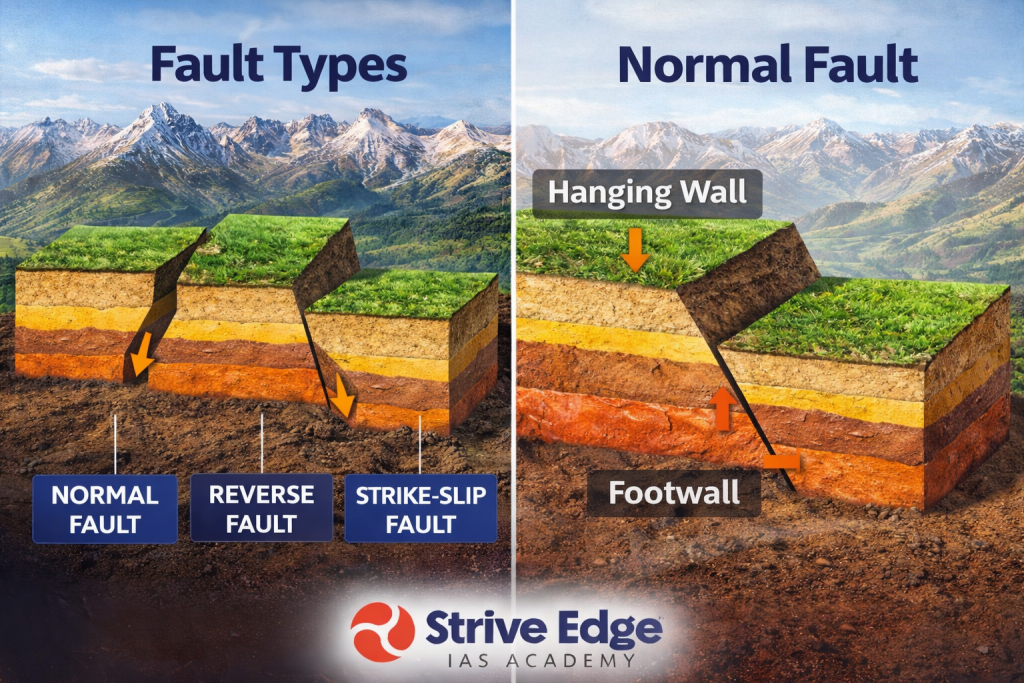
Block Mountains (or fault-block mountains) are mountains formed when large blocks of Earth’s crust are uplifted or tilted along faults, usually due to tensional tectonic forces that create normal faults.
- Block mountains originate through faulting, a process where stress within the Earth’s crust causes fracturing and displacement.
Mechanism of Formation
- Tensional forces pull the crust apart.
- Faults (fractures) develop, typically normal faults.
- Crustal blocks between faults are either:
- Uplifted → forming Horsts (Block Mountains)
- Subsided → forming Grabens (Rift Valleys)
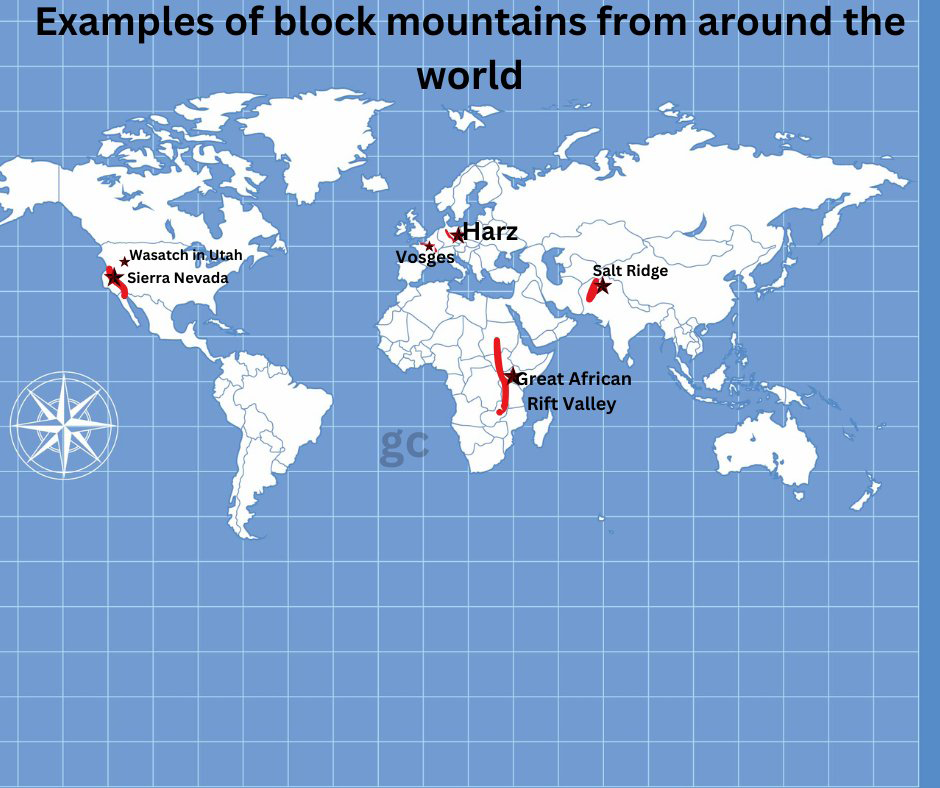
Global Examples of Block Mountains(DIY Mapping)
- Sierra Nevada- USA (California)- Tilted block mountain with steep eastern face.
- Black Forest (Schwarzwald) – Germany- Classic horst in the Upper Rhine graben system.
- Vosges Mountains- France – Form one flank of the Rhine Rift Valley.
- Harz Mountains- Germany – Part of the Central European horst-graben system.
- Baikal Mountains- Russia- Border lake Baikal Rift.
- Drakensberg Mountains- South Africa – Elevated escarpment due to block faulting.
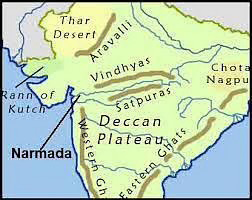
Examples from India – India is largely dominated by fold mountains and plateaus, but block faulting has played a significant role in some regions:
- Satpura Range- Block mountain– Formed by faulting between Narmada and Tapti.
- Vindhya Range- Tilted block– Forms southern escarpment of Indo-Gangetic plains.
- Narmada Rift Valley- Graben– Bordered by Satpura and Vindhya ranges.
- Malwa Plateau (MP)- Tilted fault block– Shows block faulting.
FOLDING vs FAULTING
| Folding | Faulting |
|
|