
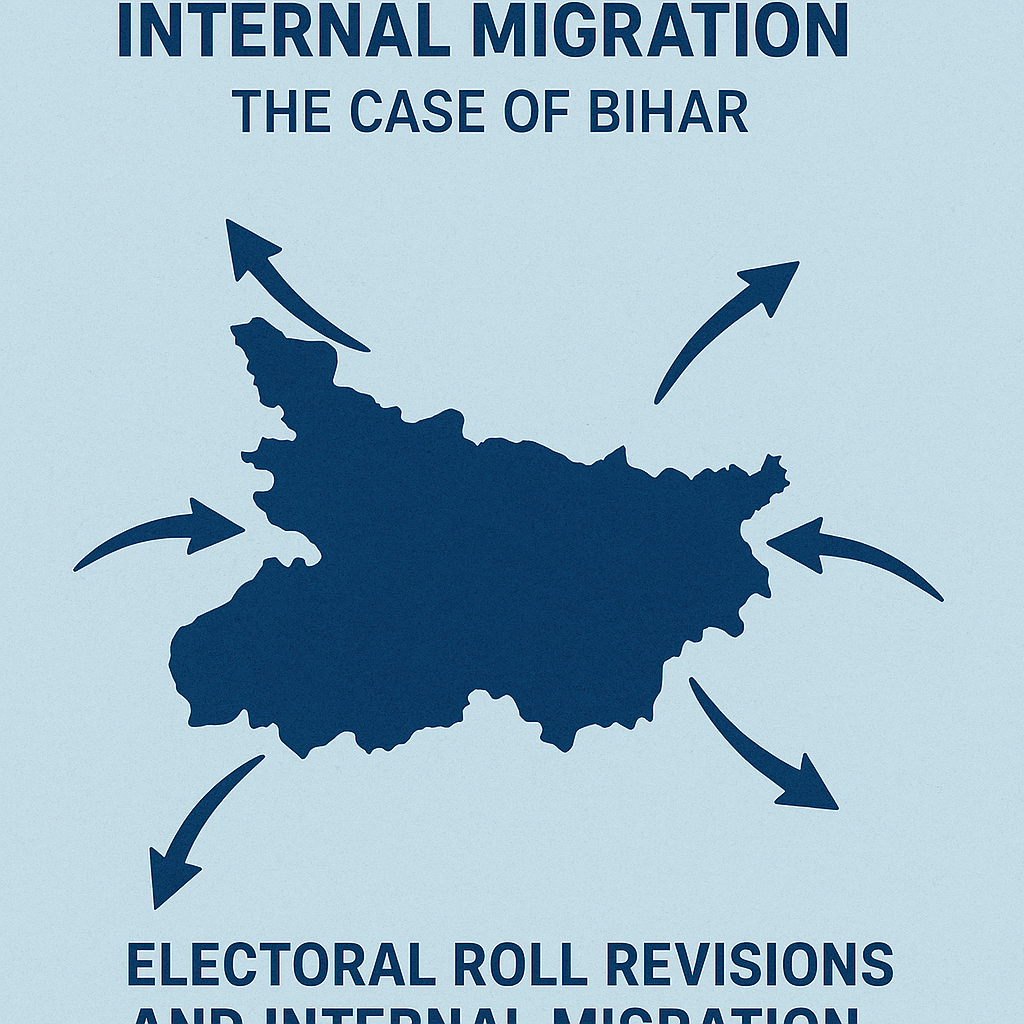
Why in News: The Election Commission of India has initiated a Special Intensive Revision (SIR) of Bihar’s electoral rolls. This move aims to enforce residency-based voting rights and address demographic changes caused by large-scale internal migration from Bihar.

Reasons for Initiating Special Intensive Revision (SIR)
1. Significant Changes in Electoral Rolls
- Over the past two decades, widespread urbanization and internal migration have substantially altered the composition of electoral rolls.
2. Concerns Over Voter List Accuracy
- The Election Commission of India (ECI) identified issues such as duplicate entries and inclusion of ineligible voters, affecting the integrity of electoral rolls.
3. Nationwide SIR Initiative
- To address these concerns, the ECI launched a nationwide Special Intensive Revision exercise, aiming to update and clean electoral rolls comprehensively.
4. Priority to Bihar
- Bihar, which last underwent SIR in 2003, has been prioritized for this exercise. The revision is particularly important ahead of the State Assembly elections scheduled for November 2025.
5. Enforcing the principle of citizenship and residency in electoral terms
- Voters should be registered and vote only where they are ordinarily resident.
Implications of Bihar’s Special Intensive Revision (SIR) of Electoral Rolls
- Improves electoral roll accuracy by removing migrants who no longer reside in Bihar.
- Enforces residency-based voting, ensuring voters participate only where they ordinarily live.
- Changes constituency demographics in Bihar, potentially altering election outcomes.
- Affects political dynamics in migrant destination states like Maharashtra, Tamil Nadu, and Delhi.
- Accelerates migrants’ transition to permanent residents in host states, reshaping voter bases.
- Reflects migration patterns driven by economic opportunities from Bihar and Uttar Pradesh to urban centers.
- Influences national politics by shifting voter distribution and representation across states.
- Highlights growing political importance of migrant populations in metropolitan areas.
Arguments Supporting the Special Intensive Revision (SIR)
1. Constitutional Mandate of the Election Commission of India (ECI)
- Under Article 324, the ECI has plenary powers to conduct free and fair elections.
- Supported by Supreme Court rulings, such as Mohinder Singh Gill vs. Union of India (1977).
2. Need to Clean Duplicate Electoral Rolls
- Migration and multi-location enrolment create risks of duplicate and fraudulent voting.
- SIR helps sanitize electoral rolls and uphold electoral integrity.
3. Precedents of SIR Exercises
- Similar intensive revisions have been conducted before (1952–2004), particularly after state reorganisations or demographic changes.
4. Technology-Enabled Transparency
- Use of digitised databases, photographs, and GPS-based voter records enhances monitoring and reduces human error or manipulation.
5. Political Neutrality of the Process
- ECI claims all political parties were notified and given the opportunity to appoint Booth Level Agents (BLAs) to oversee the SIR.
Arguments Against the Special Intensive Revision (SIR)
1. Shift of Burden on Citizens
- Unlike previous practices where objections had to be proved by challengers, now voters bear the burden of proof to maintain their enrolment.
- This contradicts Rule 18 of the Registration of Electors Rules.
2. Arbitrary Cutoff Year (Post-2003 Divide)
- Only voters enrolled after 2003 are subject to strict verification, which lacks clear legal justification and appears arbitrary.
3. Risk of Disenfranchisement
- Vulnerable populations, especially in flood-prone and marginalized areas like Seemanchal, may be excluded for lacking formal birth certificates despite possessing Aadhaar or EPIC cards.
4. Procedural Irregularities and Errors
- Complaints include erroneous address entries (e.g., “cremation ground”), missing names, and blank entries, such as those reported in Muzaffarpur district.
5. Political Timing and Allegations of Bias
- Conducting SIR only in Bihar before state elections raises suspicions of political manipulation favoring the ruling alliance, as alleged by opposition parties.
Way Ahead and Recommendations
1. Clarify Official Citizenship Documentation
- The government should notify a clear list of documents acceptable as proof of citizenship under the Citizenship Act to remove ambiguity.
2. Broaden Accepted Identity Documents
- Inclusion of documents like Aadhaar, Voter ID, Ration Card, and MNREGA job card is necessary, especially to protect marginalized and rural voters.
3. Adhere to ECI’s Own Established Practices
- Reinstate inclusive enumeration methods similar to those followed in 2003 without imposing additional burdens on voters.
4. Ensure Judicial Oversight Post-Election
- Courts must retain the power to review electoral roll revisions and disputes post-election to safeguard electoral justice, as established in Mohinder Singh Gill.
5. Conduct Uniform, Nationwide Revisions
- To maintain fairness and avoid selective targeting, any intensive roll revision exercise should be implemented uniformly across all states rather than singling out Bihar.
UPSC Relevance:
GS Paper 1 (Indian Society & Social Issues)
- Impact of internal migration on demographics and social structure.
GS Paper 2 (Polity, Governance & Constitution)
- Electoral reforms and the role of the Election Commission of India (ECI).
UPSC Mains Practice Question
Q. “Discuss the challenges and implications of enforcing residency-based voter registration in India, with reference to Bihar’s Special Intensive Revision of electoral rolls.”
Prelims Related Quick facts
Special Intensive Revision (SIR) of Electoral Rolls
Definition: Door-to-door verification of voter lists through house-to-house enumeration.
Legal Basis: Conducted under Section 21(3) of the Representation of the People Act, 1950 and Article 324 of the Constitution.
Hybrid Process: Combines intensive and summary revision, requiring extra documents for voters enrolled after 2003.
Process: BLOs distribute pre-filled forms; voters must update info and submit proof of citizenship if needed.
Verification: Electoral Registration Officers review and decide on inclusion or deletion, referring doubtful cases under the Citizenship Act.
Scale: Over 8 crore voters in Bihar being re-verified with help of 1 lakh BLOs and 4 lakh volunteers.