

The Emergency Provisions in the Indian Constitution (Articles 352 to 360) empower the Centre to override the usual federal structure and assume greater control during exceptional situations. These provisions are inspired by the Weimar Constitution of Germany and are intended to safeguard the sovereignty, unity, and integrity of India in times of crisis.
Dr. B.R. Ambedkar called these provisions “the safety valve of the Constitution.”
Types of Emergencies in the Constitution
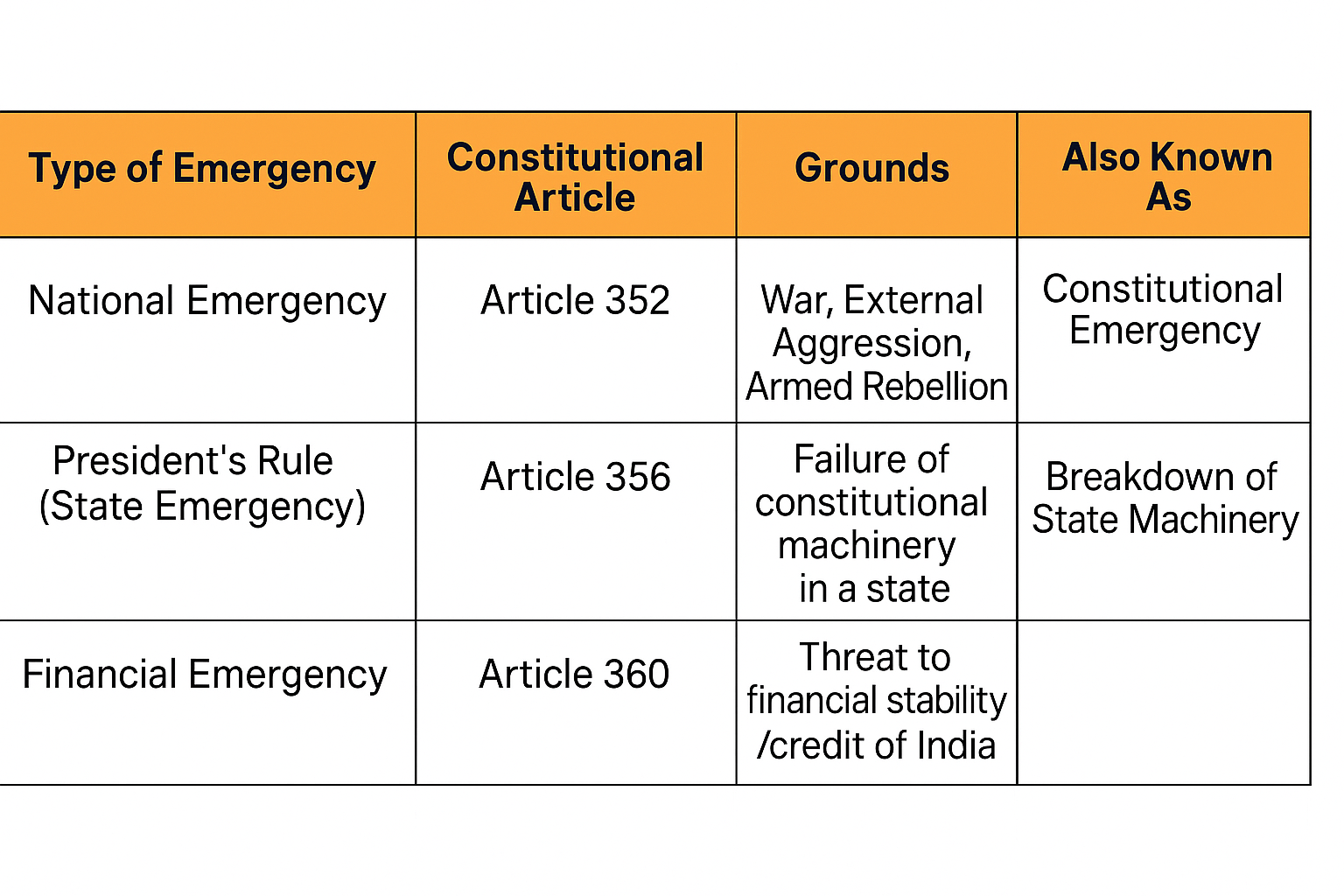
NATIONAL EMERGENCY – Article 352
A National Emergency is declared by the President under Article 352 if the security of India or any part thereof is threatened by:
- War
- External Aggression
- Armed Rebellion
- The term used in the Constitution is “Proclamation of Emergency.”
- The emergency can also be declared pre-emptively, i.e., before actual war/aggression/rebellion occurs.
Types of National Emergency
- External Emergency: Declared on grounds of war or external aggression.
- Internal Emergency: Declared on grounds of armed rebellion.
- The term “armed rebellion” was inserted by the 44th Constitutional Amendment Act (1978), replacing the earlier term “internal disturbance.”
Examples:
- A declared war between India and another country – War
- Cross-border military hostility without formal war – External Aggression
- Armed uprising within the country – Armed Rebellion
| Important FactsThe 38th Amendment Act, 1975 made the President’s decision immune from judicial review, but this was reversed by the 44th Amendment Act, 1978.In Minerva Mills v. Union of India (1980), the Supreme Court held that a Proclamation of Emergency can be challenged in court if it is mala fide or based on irrelevant grounds. |
Parliamentary Approval and Duration
- The Proclamation must be approved by both Houses of Parliament within one month.
- If Lok Sabha is dissolved during this period, the Rajya Sabha’s approval is sufficient, and the newly elected Lok Sabha must approve it within 30 days of its first sitting.
- Once approved, the Emergency:
- Remains in force for six months
- Can be extended indefinitely, with parliamentary approval every six months
- Special majority is required in both Houses for approval and continuation: Majority of total membership + 2/3rd of members present and voting
Revocation of Emergency
- The President can revoke the Proclamation at any time by issuing another proclamation (no parliamentary approval needed).
- If Lok Sabha passes a resolution disapproving the continuation (by simple majority), the President must revoke the Emergency.
Effects of National Emergency
Centre–State Relations
Executive:
- Centre gains the power to give directions to states on any matter (even those in the State List).
Legislative:
- Parliament can make laws on subjects in the State List.
- President can issue ordinances on state subjects if Parliament is not in session.
- Such laws cease to operate 6 months after the Emergency ends.
Financial:
- President can alter financial relations (distribution of revenues) between Centre and States.
Tenure of Legislatures
Lok Sabha:
- Its term can be extended by one year at a time beyond its normal tenure, but not beyond six months after the Emergency ceases.
State Assemblies:
- Their tenure can also be extended in the same manner as Lok Sabha.
Impact on Fundamental Rights
Article 358 – Suspension of Article 19
- Article 19 (freedom of speech, movement, etc.) automatically gets suspended during a National Emergency declared on grounds of war or external aggression.
- Cannot be suspended during Emergency declared due to armed rebellion (44th Amendment).
- Article 19 is automatically revived once the Emergency ends.
Article 359 – Suspension of Enforcement of Fundamental Rights
- President may suspend the right to move any court for the enforcement of specified Fundamental Rights (excluding Article 20 and 21).
- The suspension can last:
- For the entire period of Emergency or a shorter period
- It must be laid before Parliament for approval
- Fundamental Rights themselves are not suspended, only the remedy is suspended.
Instances of National Emergency in India :
| Year | Reason | Context |
| 1962 | War with China | Chinese aggression in NEFA (now Arunachal Pradesh) |
| 1971 | War with Pakistan | Indo–Pakistan War leading to creation of Bangladesh |
| 1975 | Internal Emergency | Political instability and internal unrest (declared by Indira Gandhi government) |
- The 1975 Emergency was declared while the 1971 Emergency was still in operation.
- Both the 1971 and 1975 Emergencies were revoked in 1977.
The National Emergency provisions represent a temporary departure from the federal scheme and significantly enhance central authority to deal with extraordinary threats. While it is a constitutional safeguard, its misuse during the 1975 Emergency underscores the importance of judicial review, transparency, and accountability in its application.
PRESIDENT’s RULE — Article 356
Also known as: “State Emergency” or “Breakdown of Constitutional Machinery”
- Article 355 of the Constitution places a duty on the Union to ensure that the government of every state functions in accordance with the Constitution.
- In pursuance of this duty, the Centre may take over the governance of a state under Article 356, in case of a failure of constitutional machinery.
Grounds for Imposition
Article 356:
- If the President is satisfied that the government of a state cannot be carried on in accordance with the provisions of the Constitution, he can issue a Proclamation of President’s Rule.
- The Governor’s report is usually the basis for such satisfaction, but it is not mandatory—the President can act suo motu.
Article 365:
- If a state fails to comply with any direction of the Centre, it is deemed that the state government cannot be carried on constitutionally, thereby justifying the imposition of President’s Rule.
Parliamentary Approval and Duration
- The Proclamation must be approved by both Houses of Parliament within two months.
- If Lok Sabha is dissolved, the Rajya Sabha’s approval is sufficient initially. The proclamation must then be ratified by the new Lok Sabha within 30 days of its first sitting.
- Once approved, President’s Rule:
- Continues for 6 months
- Can be extended every 6 months with parliamentary approval
- Maximum period: 3 years, subject to:
- A national emergency being in operation
- The Election Commission certifying that elections to the concerned state cannot be held
Consequences of President’s Rule
Once imposed, the President assumes extraordinary powers:
Executive Powers:
- The President assumes all functions of the state government.
- Powers of the Governor and Council of Ministers are suspended.
Legislative Powers:
- The State Legislative Assembly may be suspended or dissolved.
- The Parliament assumes power to make laws for the state.
- The President may delegate legislative powers to any authority (often the Governor or Parliament).
Other Provisions:
- The President can suspend constitutional provisions relating to bodies or authorities in the state.
- However, the Constitution cannot be suspended in totality—unlike during National Emergency.
Judicial Review of President’s Rule
- 38th Amendment Act, 1975: Made the President’s satisfaction “final and conclusive”, barring courts from reviewing it.
- 44th Amendment Act, 1978: Revoked this provision—President’s satisfaction is now subject to judicial review.
- Landmark Judgment – S.R. Bommai v. Union of India (1994):
- Strictly limited the scope of Article 356
- Allowed judicial review of the proclamation
- Asserted that malafide use of Article 356 can be struck down by the courts
- Emphasized that the floor of the Assembly is the only valid ground to test majority, not the Governor’s personal opinion
President’s Rule under Article 356 is a critical provision to preserve constitutional governance in the states, but its misuse has historically undermined federalism. Landmark reforms and judicial intervention—especially through the S.R. Bommai judgment—have helped restore constitutional checks and balances.
FINANCIAL EMERGENCY — Article 360
Also Known As: Economic Crisis Emergency; Status: Never Invoked in Indian History
Grounds for Declaration
- Under Article 360, the President can declare a Financial Emergency if he is satisfied that: “The financial stability or credit of India or any part of its territory is threatened.”
- This provision gives the Union government sweeping control over fiscal governance, both centrally and in the states.
Parliamentary Approval & Duration
- The Proclamation must be approved by both Houses of Parliament within two months of its issuance.
- In case of Lok Sabha dissolution, the following conditions apply:
- Rajya Sabha’s approval is sufficient initially.
- The new Lok Sabha must approve the proclamation within 30 days of its first sitting.
- Once approved, the Financial Emergency remains in force until revoked by the President.
- Unlike National Emergency or President’s Rule, there is no time limit or periodic reapproval required.
Effects of Financial Emergency
If imposed, it leads to significant centralisation of financial authority:
Union’s Fiscal Control over States
- The executive authority of the Union extends over financial matters of the states.
- Money Bills or other financial legislations passed by a state legislature may be reserved for the President’s consideration.
Salary Reductions
- The President may issue directions:
- To reduce the salaries and allowances of persons serving under the state government.
- To reduce the salaries and allowances of persons serving the Union, including:
- Judges of the Supreme Court
- Judges of the High Courts
Criticism of Emergency Provisions (including Financial Emergency)
Many members of the Constituent Assembly raised concerns about potential misuse:
| Critique | Concern Raised |
| Federalism | Central government could become all-powerful, compromising state autonomy. |
| Separation of Powers | Union executive might override all other state institutions. |
| Democratic Rights | Fundamental Rights could be weakened or suspended. |
| Constitutional Spirit | Checks and balances between Centre and States could erode. |
| Misuse Risk | Dr. B.R. Ambedkar acknowledged the risk of political misuse, saying: “I do not altogether deny that there is a possibility of the Articles being abused or employed for political purposes.” |
While Financial Emergency under Article 360 has never been invoked, its sweeping nature gives the Centre considerable power over states’ fiscal independence. It serves as a constitutional safeguard for national stability—but also poses significant threats to federalism if used politically or arbitrarily.