
Context: India imports 90% of its crude oil requirement, making ethanol blending a critical national energy security imperative. The ongoing West Asia war is being seen as a wake-up call to replicate Brazil’s ethanol model and permanently reduce import dependence.
The Inspiration: Brazil’s Proálcool Model
- In 1975, post the Arab-Israeli Yom Kippur War oil shock, Brazil launched Proálcool mandating minimum 11% anhydrous alcohol blending in petrol.
- By 1979, Brazil introduced cars running on 100% hydrous alcohol (E100) during the second oil shock triggered by Iran’s Islamic Revolution.
- By 1985, domestic ethanol production reached nearly 1,200 crore litres with dual pump fuel stations for E30 and E100.
- In 2003, Brazil introduced Flex-Fuel Vehicles (FFVs) capable of running on both Gasoline C (E30) and E100 using electronic sensors — today ethanol powers more than half of Brazil’s vehicles.
India’s Progress in Ethanol Supply
- In 2024, India’s total fuel alcohol consumption was 3,492.4 crore litres, including 1,202.8 crore litres of ethanol in Gasoline C.
- The overall ethanol mix for light-duty vehicles stood at 51.8% with Gasoline C ethanol content set at 30% since August 2015.
Key Achievement in Feedstock Diversification
- Ethanol Supply by Feedstock
- Till 2017-18, ethanol was produced exclusively from C-heavy molasses, a dark brown byproduct of cane processing.
- From 2018-19, the Centre set fixed ex-distillery prices for ethanol derived from rice, maize, and damaged foodgrains thus incentivising feedstock diversification.
- As much as 69% of ethanol supplied in 2024-25 was from grains, mainly maize and rice, including surplus FCI stocks and broken/damaged grain sourced from the open market.
- Ex-distillery price for ethanol from C-heavy molasses is fixed at ₹57.97 per litre; from B-heavy molasses at ₹65.61; from sugarcane juice/syrup at ₹71.86; and from rice, maize, and damaged foodgrains at ₹73.48.
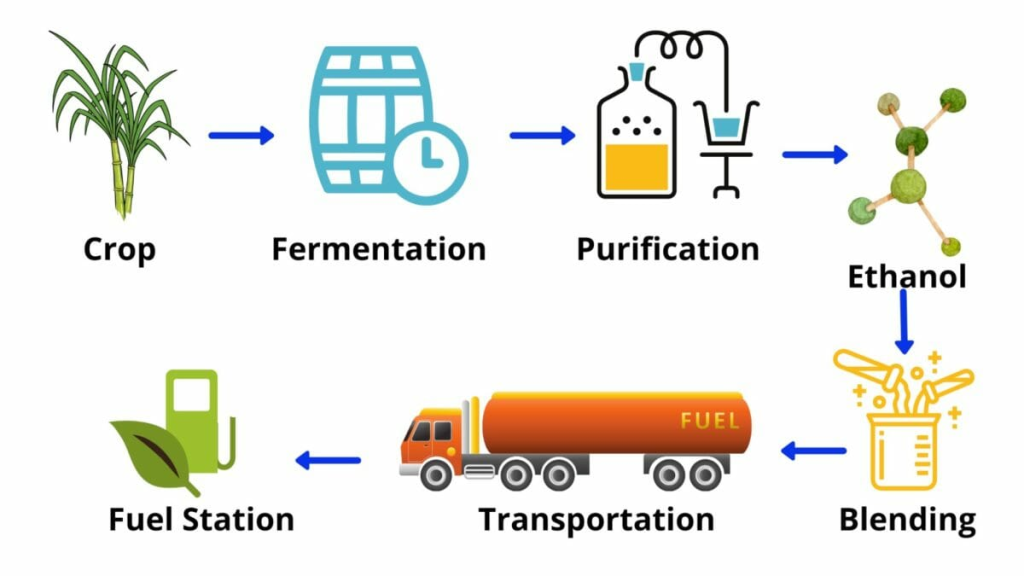
- Ethanol production involves fermentation of sugar by yeasts in molasses or cane juice, breaking down into simple sugars before distillation and dehydration to ethanol with 99.99% alcohol concentration.
Policy and Taxation Framework
- Currently, ethanol is covered under GST, attracting 5% GST, while petrol remains outside GST and attracts both Central excise duty and State value-added tax.
- Ethanol-blended petrol and pure petrol are treated as identical for taxation purposes, a policy inconsistency that needs rationalisation.
- The government must work with the auto industry and OMCs to gradually increase the ethanol blending mandate from 20% to 30% and incentivise production of flex-fuel vehicles.
- Fuel stations should have separate dispensing units for E30 and E100 fuels, with consumers choosing either depending on the price parity between the two.
- An aggressive ethanol use strategy would require a relook at taxation thus bringing all fuels blended with ethanol under GST is essential for competitive pricing.
Way Forward
- Replicate Brazil’s flex-fuel vehicle model and the government should push all new vehicles to be flex-fuel based and nudge companies to provide conversion kits for existing vehicles.
- Increase blending mandate progressively from 20% to 30%, incentivising both production of E30 and E100 fuels with separate dispensing infrastructure.
- Bring all ethanol-blended fuels under GST to create a level playing field with pure petrol and rationalise the taxation anomaly.
- Expand feedstock base further as India is surplus in sugarcane, rice, and maize, and can increase production much more for E30 and E100 fuels without food security risks.
- Cap excess crude oil imports by substituting with domestically produced ethanol as India already produces over 1,800 crore litres per annum and can scale further with the right policy support.
- Use the current Iran war stress as a strategic opportunity to permanently reduce import dependence, just as Brazil used the 1970s oil shocks to build energy self-reliance.