
Syllabus: Effect of policies and politics of developed and developing countries on India’s interests
Background and Historical Context
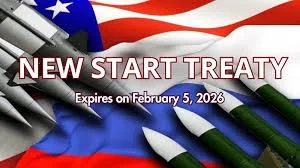
- The New Strategic Arms Reduction Treaty (New START) expired on February 5, 2026.
- It symbolised a cooperative phase in U.S.–Soviet nuclear engagement.
- Earlier Cold War rivalry centred on nuclear build-up and technological competition.
- Both superpowers pursued massive weapons testing and space race dominance.
Evolution of Nuclear Arms Control
- Cold War nuclear race led to accumulation of massive strategic arsenals.
- By the 1980s, each side possessed over 10,000 nuclear warheads.
- The United States held a significant numerical advantage.
- Strategic Arms Limitation Talks (SALT) capped arsenals but did not reduce them.
START I: A Turning Point
- START I negotiations began in 1982 amid complex geopolitical tensions.
- The treaty was signed in July 1991 before Soviet Union’s collapse.
- It marked the first agreement mandating actual arsenal reductions.
- Warhead limits were reduced to 6,000 strategic weapons each.
- Delivery systems were also proportionally curtailed.
Progress Through Successive Treaties
- Later agreements reduced deployable warheads to 1,700–2,200 levels.
- New START (2010) capped deployed warheads at 1,550 each.
- These frameworks significantly cut Cold War peak stockpiles.
Geopolitical Shifts and Treaty Expiry
- New START had a lifespan of about 15 years.
- It was expected to evolve into more ambitious arms reductions.
- Rising geopolitical tensions have reversed disarmament momentum.
- Renewed imperial competition and tariff conflicts shape strategic thinking.
China Factor and Future Negotiations
- The U.S. demands China’s inclusion in future arms control frameworks.
- Washington resists limits if rival powers expand arsenals unchecked.
Implications for Global Non-Proliferation Regime
- Expiry may weaken the Nuclear Non-Proliferation Treaty (NPT) framework.
- It could also affect the Comprehensive Nuclear-Test-Ban Treaty (CTBT).
- Existing regimes are viewed as normatively strong but structurally unequal.
Way Forward
- Treaty expiry offers scope for broader, more equitable negotiations.
- Future frameworks must reflect multipolar nuclear realities.