
Context
- Cities generate 90% of total government revenue and nearly 67% of India’s GDP, yet Urban Local Bodies (ULBs) receive disproportionately limited fiscal devolution from Finance Commissions.
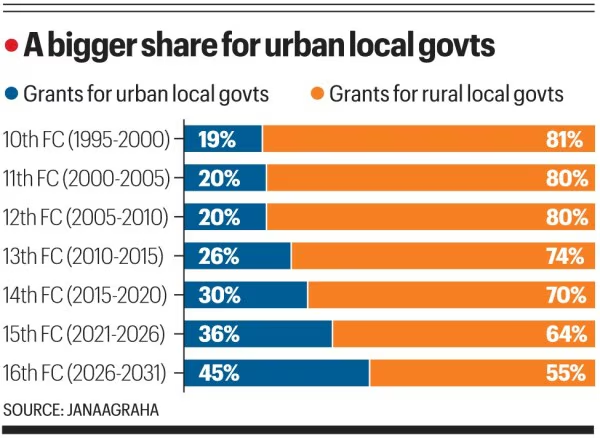
- The 16th Finance Commission allocated ₹3.56 lakh crore to ULBs for 2026-31, but structural limitations continue to constrain genuine urban fiscal autonomy.
Issues with Finance Commission Grants
- 15th FC urban grants: ₹1.2-1.3 lakh crore over five years, which is approximately 0.12-0.13% of GDP (when India’s GDP hovered around ₹200-210 lakh crore).
- 16th FC urban grants: ₹3.56 lakh crore (₹75,000 crore per year), yet India’s projected GDP of ₹400 lakh crore means the ratio remains virtually unchanged at 0.13% of GDP.
- Urban population crossed 470 million in 2020 and is projected to approach 600 million during 2026-31, meaning per capita transfers stagnate or even decline in real terms.
- Under the 15th FC, ₹90,000-95,000 crore of total local body grants remained unspent, including ₹30,000-35,000 crore meant specifically for ULBs thus raising serious absorption capacity concerns.
- Problem of Tied Grants
- Tied grants earmark funds for specific sectors i.e. water supply, sanitation, and wastewater management, thus severely restricting cities’ fiscal autonomy and planning flexibility.
- The 16th FC approach is even more restrictive, introducing performance-based grant conditions that withhold funds until specific criteria are met.
- Performance conditions include improving fiscal discipline, conducting regular local body elections, publishing audited accounts publicly, and constituting State Finance Commissions.
- Critically, 20% of funds are linked to additional conditions, thus primarily raising Own Source Revenue (OSR) of ₹1,200 per household through property taxes and user charges, failing which cities lose that share entirely.
Federal Concerns
- ₹10,000 crore kept as one-time incentive for peri-urban merger of urban villages with population exceeding one lakh thus raising serious federal concerns.
- Urban development is constitutionally a State subject under the 12th Schedule; Central incentives inducing administrative mergers represent dangerous federal overreach.
- In states like Kerala, where rural local governments function robustly, merging rural areas into urban agglomerations risks creating administrative and civic complications.
- Merging peripheries of only 10% of urban towns may translate into lopsided urban integration driven primarily by revenue generation objectives rather than genuine development needs.
- Critical Gaps in the 16th FC Approach
- 16th FC remains largely silent on climate change, a growing urban governance challenge requiring dedicated financial attention.
- Cess revenues collected by the Centre amount to approximately 2.2% of GDP thus roughly ₹8.8 lakh crore, yet remain entirely outside the divisible pool.
- Much of this cess revenue is generated from cities themselves, yet does not appear in OSR calculations, thus creating a fundamental fiscal asymmetry.
- Cities are being asked to increase their own revenues while the Centre retains large cess collections generated primarily from urban economic activity.
Way Forward
- Include cess and surcharge revenues in the divisible pool to correct the structural fiscal asymmetry between the Centre and urban bodies.
- Increase urban grants to at least 1% of GDP to match the scale of urban population growth and infrastructure demands.
- Reduce the tied grant proportion and expand untied funds, allowing cities to plan expenditure based on locally identified priorities.
- Strengthen State Finance Commissions and ensure the timely constitution and implementation of their recommendations for genuine fiscal federalism.
- Adopt a “cities plan their own futures” framework where the Centre acts as an enabler rather than a conditioner of urban fiscal decisions.
Key Constitutional Articles
- Article 280: Directs President to constitute Finance Commission every 5 years.
- Article 270: Distribution of Union taxes between Centre and States
- Article 275: Grants-in-aid to States needing financial support from the Centre
- Article 281: Procedure for submitting Finance Commission report to Parliament
Article 293: Governs borrowing powers of StatesKey Functions