
Context
- The Economic Survey 2025–26 supports delaying strict FRBM fiscal targets for the Centre.
- Rationale given is need for policy flexibility amid volatile geopolitical and geoeconomic conditions.
- Survey simultaneously flags deteriorating fiscal health of States due to revenue and expenditure pressures.
Centre’s Fiscal Performance
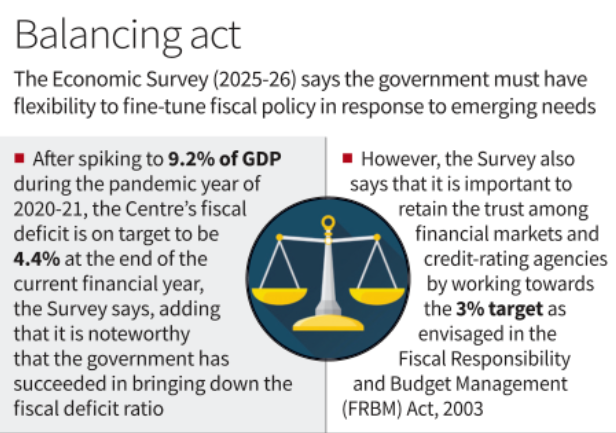
- Centre’s fiscal deficit peaked at 9.2% of GDP in 2020–21 during the pandemic.
- Deficit is projected to decline to 4.4% of GDP in FY26.
- This aligns with commitment to halve the pandemic-era deficit within five years.
- Survey notes emphasis on improving expenditure quality alongside higher capital spending.
- Fiscal consolidation achieved without legislative compulsion under FRBM framework.
FRBM Framework and Credibility Concerns
- FRBM Act target of 3% deficit by March 2020 has been repeatedly deferred.
- Survey acknowledges public perception demanding restoration of strict fiscal discipline.
- Only one successful achievement of the 3% target since 2003 is noted.
- Repeated slippages have weakened India’s fiscal credibility in financial markets.
- Post-COVID consolidation restored trust among investors and credit-rating agencies.
- Survey stresses importance of maintaining this restored credibility.
States’ Worsening Fiscal Position
- States in revenue surplus declined from 19 in 2018–19 to 11 in 2024–25.
- Collective revenue deficit rose from 0.1% to 0.7% of GDP.
- Survey links deterioration to lower revenues and rising expenditure, including cash transfers.
- Warns that persistent deficits constrain long-term fiscal sustainability at subnational levels.
Key Policy Implication
- Calls for balanced fiscal flexibility for the Centre.
- Simultaneously urges greater fiscal discipline and revenue strengthening among States.
- Full form: Fiscal Responsibility and Budget Management Act, 2003
- Objective: Ensure fiscal discipline, inter-generational equity, and long-term macroeconomic stability.
- Focus: Guide Central Government towards sustainable deficit and debt management.
- CAG Role: Mandatory annual compliance audit of FRBM provisions.
- Mandatory Budget Statements (Laid Before Parliament)
- Macro-Economic Framework Statement: Economic outlook and assumptions.
- Medium-Term Fiscal Policy Statement: Fiscal targets and rolling projections.
- Fiscal Policy Strategy Statement: Policy stance and fiscal priorities.
- Key Fiscal Targets
- Fiscal Deficit
- Original target: ≤ 3% of GDP
- Deadline: 31 March 2021
- Actual (2023–24, CAG): 5.32% of GDP
- Revised path: < 4.5% of GDP by FY 2025–26
- Public Debt Limits
- General Government (Centre + States): ≤ 60% of GDP
- Central Government: ≤ 40% of GDP
- Deadline: End of FY 2024–25
- Current (2023–24):
- Central Government: 57% of GDP
- General Government: 81.3% of GDP
- Additional Guarantees
- Cap: ≤ 0.5% of GDP per year
- Linked to: Consolidated Fund of India
- Fiscal Deficit
- FRBM Amendment, 2018:
- Removed targets for Revenue Deficit and Effective Revenue Deficit.
- Shifted focus to debt and fiscal deficit anchoring.