

G7: From Economic Club to Strategic Forum
Why in News
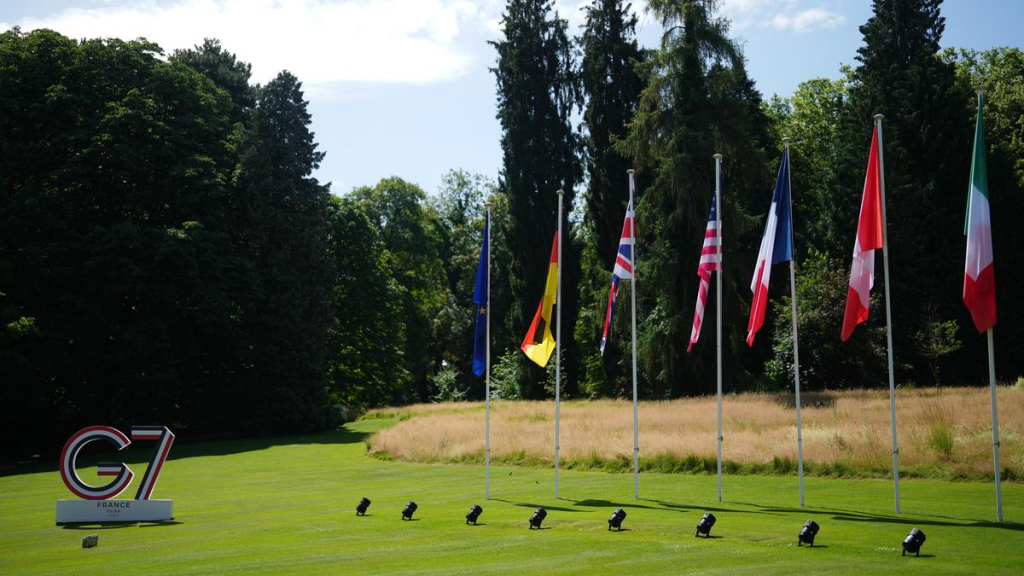
- The 52nd G7 Summit was held in Evian, France on June 15-17, 2026. PM Modi participated and discussed Ukraine war, US-Iran deal, AI, global economic imbalances and developing country debt burdens.
Origin and Evolution of G7
- Context of Formation:
- The Non-Aligned Movement mobilised decolonised societies challenging Western economic dominance.
- The 1973 Yom Kippur War triggered the first oil shock highlighting risks to Western economic order.
- French President Giscard d’Estaing and West Germany’s Chancellor Helmut Schmidt organised the first World Economic Summit in 1975.
- Leaders of UK, Italy, Japan and US met at Chateau de Rambouillet, France beginning as the Group of Six.
- Canada joined in 1976 transforming it into the G7.
- Expansion and Contraction:
- Following the Cold War, Russia was progressively integrated and formally joined in 1998 making it G8.
- Russia’s annexation of Crimea in 2014 led to its expulsion reverting the grouping back to G7.
Evolution: From Economy to Strategic Platform
- 1970s:
- G7 emerged as a platform for industrialised countries to address financial challenges.
- The decade of the New International Economic Order (NIEO) saw Global South demand transformation of World Bank and IMF.
- 1980s:
- G7 coordinated responses to Soviet invasion of Afghanistan, Falklands dispute and Iran-Iraq war.
- In 1982, G7 expressed shock over Israel’s invasion of Lebanon and warned about West Asian energy disruptions.
- 1990s:
- In 1990, G7 convened in Houston to prevent Saddam Hussein from profiting by invading Kuwait.
- G7 proved it could apply economic pressure on countries violating international norms for the first time.
- Mikhail Gorbachev attended the 1991 London G7 summit signalling USSR’s integration into Western financial architecture.
- Recent Years:
- G7’s most visible role has been opposing Russia’s military campaign in Ukraine.
- The grouping now addresses climate change, pandemic preparedness, energy security, critical minerals and supply chain preservation.
India and the G7
- India has been invited as an important outreach partner to G7 summit meetings and consultations.
- Other outreach partners include Egypt, South Africa, Brazil, South Korea, Ukraine and UAE.
- India’s participation reflects G7’s recognition of India’s growing strategic and economic importance globally.
- As the world grapples with Strait of Hormuz closure and supply chain disruptions, G7 provides a critical discussion forum.
Significance of G7
- G7 provides leaders informal interaction not possible within UN’s confined formal structure.
- It maintains the globalised economic structure without allowing systemic cracks to spread.
- The EU participates as a permanent guest strengthening the forum’s collective economic and political weight.
- G7 has evolved from a strictly economic platform to a strategic international mechanism over five decades.
Source: The Hindu
