
Syllabus: Inclusive growth and issues arising from it.
Context: Women’s Time Poverty and Economic Contribution
- Women contribute around 18% to India’s GDP, largely due to unpaid and uncounted labour.
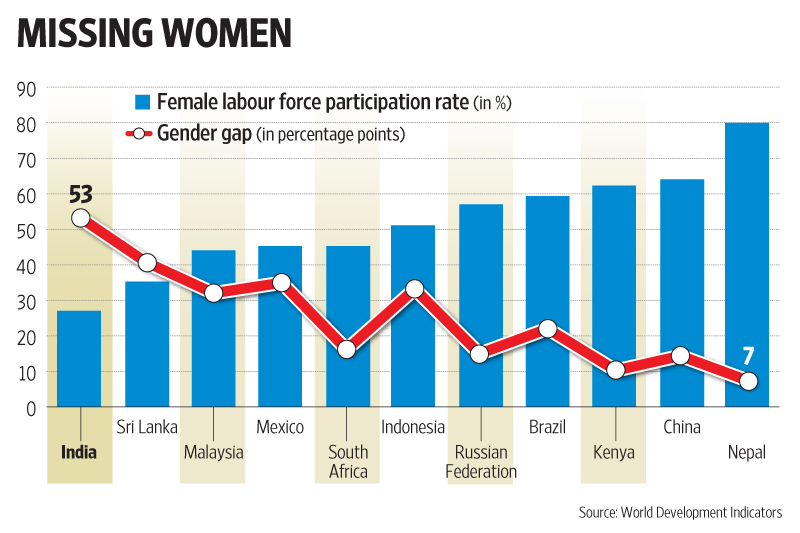
- About 40% of women participate in the labour force, mainly in unpaid agricultural work.
- 60% of non-participating women cite domestic and care responsibilities as primary constraints.
- Barriers include care burdens, limited skills, mobility restrictions, and weak job creation.
Evidence from Time Use and Budget Trends
- Time Use Survey 2025 shows unpaid care work rose from 364 to 366 minutes daily.
- Time spent on paid work increased from 68 to 76 minutes, raising total work hours.
- Gender Budget reached 8.9% of total Union allocations, around 1% of GDP.
- Over 75% allocations fall under Part B and Part C, indicating limited redesign of schemes.
Reimagining Infrastructure and Care Systems
- PMAY homes should be counted as “gender-complete houses” with water, sanitation, electricity, and clean energy.
- Budget could mandate convergence with Jal Jeevan Mission, Swachh Bharat, Ujjwala, and rooftop solar.
- Childcare remains fragmented across Palna, Anganwadis, and POSHAN schemes.
- A “Care Infrastructure Convergence Window” can pool funding and measure women’s time saved.
Labour Demand and Employment Strategies
- Agriculture receives only 4.2% of gender budget flows, despite employing most women.
- PM-KISAN benefits landowners, predominantly male, limiting women’s economic mobility.
- Employment-Linked Incentive scheme targets 3.5 crore jobs, with a proposed 50% women’s share.
- MGNREGA/VB-GRAM G employs over 50% women, proposing expansion from 100 to 125 days.
Entrepreneurship and Digital Future
- Women own nearly 60% of unincorporated manufacturing enterprises, but only 4% are registered.
- 64% of Mudra accounts belong to women, mostly in Shishu loans below ₹50,000.
- ₹660 crore allocation under India AI Mission earmarks 33% for women-focused inclusion.
- Emphasis needed on digital skilling, safety, mobility, and childcare-linked entrepreneurship support.
Conclusion: Outcome-Based Gender Budgeting
- Budget success should measure women’s time freed, income generated, and agency expanded, not just expenditure.