

Graduate Unemployment and Employability in India
Why in News
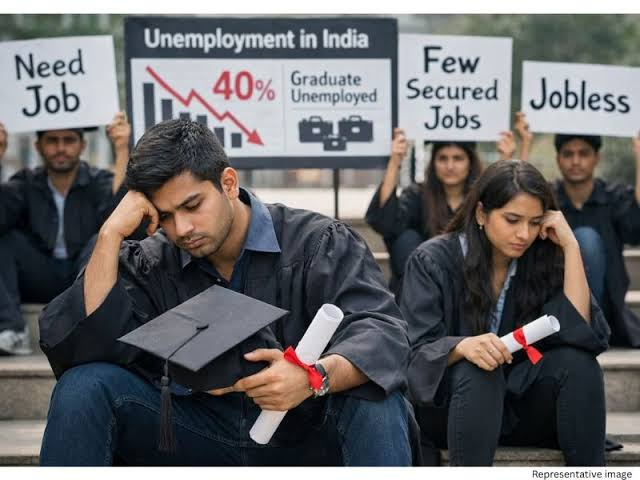
- India is witnessing an unprecedented expansion in higher education with thousands of new colleges established. Nearly one in three graduates are unemployed raising serious concerns about the quality of growth.
Issue: Graduates Outpacing Job Creation
- In engineering alone, graduate numbers have risen sharply while job creation has not kept pace.
- The IT services sector — historically the principal employer of engineering graduates — has slowed hiring considerably.
- Banking, financial services, manufacturing, defence and space sectors have expanded but not grown fast enough to absorb graduates.
- Much of recent investment in semiconductors and advanced manufacturing is capital-intensive rather than labour-intensive.
- As a result, large investments do not translate into proportionate job creation for graduates.
Causes: Skill Mismatch and AI Disruption
- Skill Mismatch:
- Students graduate with strong academic credentials but limited exposure to laboratories, manufacturing and real-world problem-solving.
- Employers frequently find graduates need substantial additional training before they can contribute effectively.
- Companies are now running their own training programmes to bridge this gap — far less common a few decades ago.
- AI Disruption:
- AI is changing the nature of work much faster than educational institutions can adapt.
- Companies want graduates who can work with AI systems, validate outputs and understand ethical AI use.
- Four years ago when today’s graduates entered college, these skills were not widely discussed at all.
- Many graduates are entering a labour market that demands skills different from what they were trained for.
Concern: Capital-Intensive Jobless Growth
- Manufacturing is being transformed by automation, robotics and Industry 4.0 systems rapidly.
- Many supervisory and operational factory roles that engineers once filled are now automated.
- Even as factories expand output, they require fewer workers and supervisors than before.
- Employment growth may not automatically match economic growth in the age of digitalisation.
- India focused on manufacturing products designed elsewhere rather than on research, development and design.
- Countries that control intellectual property and technology create far more opportunities than mere manufacturers.
- India’s dependence on external technologies for semiconductors and strategic components carries serious national security risks.
Way Forward: R&D, Startups and Industry-Academia Link
- Research and Innovation:
- India must invest much more aggressively in indigenous research, innovation and product development.
- The goal should be to develop products not only for India but for global markets.
- India must identify strategic areas where it can become a global technology leader.
- UPI’s success demonstrates that India is fully capable of building world-class digital platforms.
- Entrepreneurship and Startups:
- Neither government nor industry can create enough jobs for every graduate.
- More graduates must become creators of enterprises rather than only seekers of employment.
- Traditional lenders avoid early-stage risk — India needs more investors willing to support innovation at ideation stage.
- India’s startup ecosystem has progressed but needs stronger support for deep-technology ventures.
- Industry-Academia Collaboration:
- Universities cannot design relevant programmes without active industry participation.
- Industry cannot expect job-ready graduates without contributing to curriculum development, internships and skill development.
- Curricula must be aligned much more closely with industry requirements than is currently the case.
Source: The Hindu
