
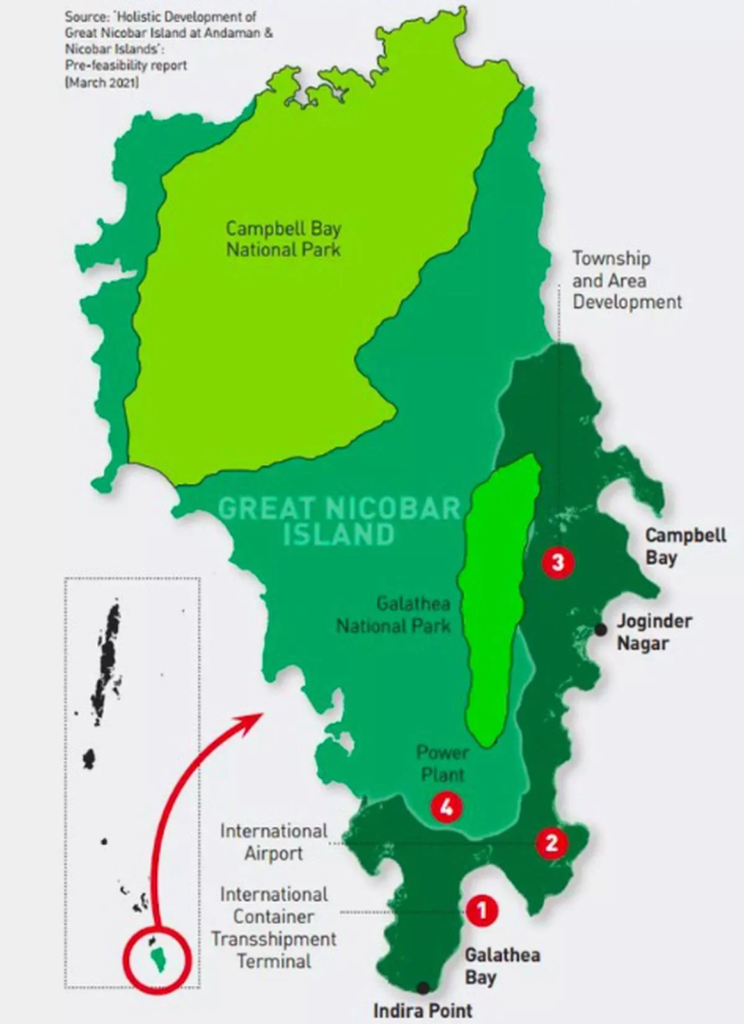
Nature and Scale of the Project
- The project is an integrated infrastructure plan proposed by ANIIDCO.
- It includes a transshipment terminal, airport, township, and power plant.
- The estimated investment ranges between ₹80,000–90,000 crore.
- About 130.75 square kilometres of forest land will be diverted.
- This diversion represents nearly 18% of Great Nicobar’s total area.
- The project is expected to generate over 1.28 lakh jobs by 2052.
Strategic and Economic Significance
- Great Nicobar lies approximately 40 kilometres from the Malacca Strait.
- The Strait is a critical global maritime trade route.
- India seeks a stronger presence amid growing geopolitical competition.
- A cargo transshipment hub reduces reliance on foreign ports.
- It enables greater participation in the global maritime economy.
- Permanent infrastructure may curb illegal exploitation of marine resources.
Ecological Importance and Environmental Concerns
- Great Nicobar is part of a sensitive Biosphere Reserve ecosystem.
- Surveys identified 20,668 coral colonies near the project site.
- The project proposes translocating 16,150 coral colonies to safer locations.
- The island hosts Leatherback turtles, Nicobar Megapode, and Saltwater crocodiles.
- Critics questioned the reliance on one-season Environmental Impact Assessment data.
- The region lies within a seismically active tectonic zone.
Tribal Rights and Social Sensitivities
- The island is inhabited by the Shompen and Nicobari tribes.
- Authorities claim the project avoids displacement of tribal settlements.
- The NGT affirmed protection under the Forest Rights Act.
- Some tribal representatives alleged coercion in land consent processes.
- ANIIDCO must support tribal welfare and protection initiatives.
NGT’s Reasoning and Clearance
- The NGT adopted a balanced approach between ecology and national interest.
- It accepted findings that no major coral reefs existed in work zones.
- The tribunal approved coral translocation as an acceptable safeguard.
- It held that one-season environmental data was legally sufficient.
- It confirmed the port did not violate ICRZ-IA protected zones.
Conclusion
- The Great Nicobar Project reflects tensions between strategic growth and conservation. Its success depends on balancing national security, biodiversity, and tribal rights. Sustainable implementation remains crucial to prevent irreversible ecological damage.