
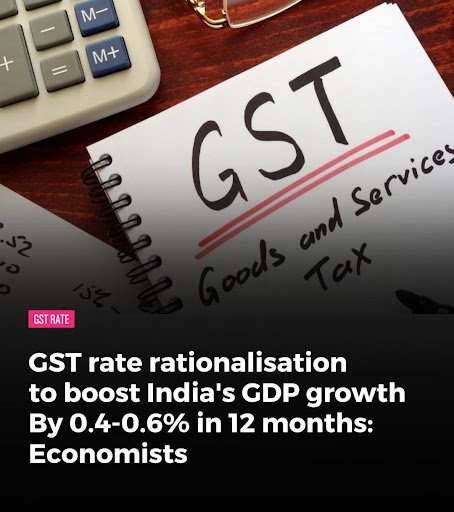
Why in News: The Union government has proposed rationalisation of GST rates by reducing the current seven slabs to four ( <1%, 5%, 18%, 40%), with most goods moving into the 5% and 18% categories. The Group of Ministers (GoM) has accepted this proposal, and the GST Council will discuss it in its upcoming meeting.
Introduction
- The Goods and Services Tax (GST), introduced in July 2017, subsumed a range of indirect taxes with the objective of creating a unified national market.
- While GST marked a landmark reform, its complicated slab structure—spanning seven rates from 0.25% to 28% along with compensation cess—has often been criticised for complexity, classification disputes, and uneven impact on consumers and revenues.
- The Union government has now proposed rationalisation of GST slabs, a move accepted by the Group of Ministers (GoM) on rate rationalisation, to be discussed in the upcoming GST Council meeting.
Proposed Changes in the GST Structure
Reduction in slabs: From seven to four broad categories.
- <1% for precious items (diamonds, semi-precious stones, jewellery, precious metals).
- 5%.
- 18%.
- 40% for “sin goods” (tobacco, cigarettes, online gaming).
Restructuring of existing items:
- 99% of goods in the 12% slab to move to 5%.
- 90% of items in the 28% slab to move to 18%.
- The remainder in the 28% slab to be pushed to a higher 40% rate.
Rationale Behind Rationalisation
- Simplification: Current multiplicity of slabs (0.25%, 3%, 5%, 12%, 18%, 28% + cess) complicates compliance and administration.
- Reducing disputes: Fewer slabs minimise classification issues and litigation between industry and tax authorities.
- Consumer focus: Move towards cheaper essential and household goods, aligning GST with its original promise of being a “good and simple tax.”
- Economic stimulus: Lowering tax rates may boost demand, aiding consumption-driven growth.
- Political economy: Aimed at showing commitment to next-generation reforms, as highlighted by the Prime Minister in his Independence Day speech.
Impact on Consumers
- Lower effective tax rate: SBI estimates show the average GST rate will fall to 9.5% by 2026–27 from 14.4% in 2017 and 11.6% in 2019.
- Cheaper household goods: Soap, toothpaste, toiletries to move from 18% to 5%.
- Essential goods unaffected: Food items such as sugar, tea, coffee, edible oil, spices, lifesaving drugs, and low-cost apparel will remain at 5%.
- Reduction in semi-luxury products: Non-luxury cars, ACs, refrigerators expected to shift from 28% + cess to 18%.
- Luxury/sin goods targeted: Tobacco, cigarettes, online gaming to attract the highest 40% rate to discourage use.
Revenue Implications
- Estimated hit: Between ₹1.1–1.8 lakh crore annually.
- Distribution of burden: Half to be borne by the Centre and half by States.
Union government’s position:
- Fiscal cushion available, especially with record RBI dividend transfer of ₹2.69 lakh crore in 2024–25.
- Even with lower transfers in the future, Centre can absorb its share of the loss.
State concerns:
- Post-cess compensation era, states are wary of reduced revenue streams.
- Kerala and other states have demanded a compensation mechanism for losses incurred due to rationalisation.
Implications for Fiscal Federalism
- Consensus building: GST is run by the Council with Centre–State cooperation. Any realignment of rates requires buy-in from all states.
- Risk of strain: States dependent on GST revenues may resist if compensation is not assured.
- Need for mechanisms: A formula-based compensation fund or alternative revenue mobilisation strategies may be essential to sustain trust.
Way Forward
- Rationalisation must be phased to avoid sudden shocks to state revenues.
- Stronger compliance and widening of the GST net can partially offset revenue losses.
- Non-tax revenues (dividends, disinvestment, user charges) can help absorb shortfalls.
- Centre should commit to a time-bound compensation mechanism for states to maintain federal harmony.
- Simplification should be accompanied by digital strengthening of GSTN (network) for real-time monitoring and minimising evasion.
Conclusion
Balancing consumer welfare, fiscal prudence, and cooperative federalism will determine whether this reform fulfils its promise of making GST truly a “good and simple tax” and a cornerstone of India’s economic architecture.
UPSC Relevance
GS Paper III – Indian Economy
Mains Practice Questions
Q. “Simplification of the GST structure through rate rationalisation is expected to benefit consumers but poses challenges for revenue mobilisation and federal harmony.” Discuss.