
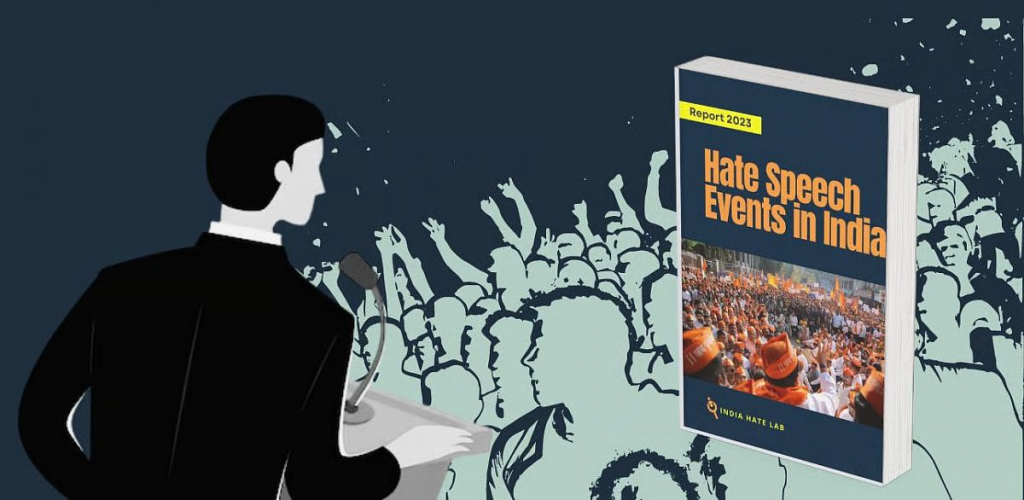
Context
- The Gauhati High Court issued notice to Assam CM Himanta Biswa Sarma following petitions seeking criminal prosecution for alleged communal speeches. The Supreme Court had earlier redirected these petitioners to the High Court, remarking that the Court risks becoming a political battleground whenever elections approach.
What is Hate Speech?
- According to the 267th Law Commission Report (2017), hate speech refers to words or actions meant to stir hatred against groups based on race, ethnicity, gender, religion, or sexual orientation.
- Hate speech does not always take the form of explicit incitement to violence; it often operates as prejudicial discourse that marginalises vulnerable communities.
- It frequently operates through “dog whistles” as deliberately ambiguous statements that allow speakers to claim plausible deniability while communicating divisive messages.
- Hate speech is fundamentally about power i.e. dominant groups using speech to exclude and silence those who are more vulnerable, entrenching a democratic deficit.
Constitutional and Legal Framework
- Constitutional Basis
- Article 19(1)(a) guarantees freedom of speech and expression.
- Article 19(2) permits reasonable restrictions to protect sovereignty, public order, morality, dignity, and to prevent incitement to offences.
- Key Legal Provisions
| Law | Provision | Scope |
| BNS 2023 | Section 196 (formerly IPC 153A) | Penalises promoting enmity between groups |
| BNS 2023 | Section 299 (formerly IPC 295A) | Punishes deliberate acts outraging religious feelings |
| IT Act 2000 | Section 66A (struck down) | Was used for online hate speech — invalidated in Shreya Singhal (2015) |
| RPA 1951 | Section 8 | Bars those convicted of promoting group enmity from contesting elections |
| SC/ST Atrocities Act 1989 | Relevant provisions | Punishes intentional insult or humiliation of SC/ST members |
| Protection of Civil Rights Act 1955 | Relevant provisions | Punishes incitement of untouchability through words or signs |
Key Judicial Pronouncements by Supreme Court (SC)
- Shaheen Abdulla vs Union of India (2022): SC observed a rising climate of hate and directed police to take suo motu action without waiting for formal complaints.
- Tehseen Poonawalla vs Union of India (2018): SC issued detailed guidelines to curb mob lynching and hate speech, including mandating nodal officers in every district to prevent lynching and cow vigilantism.
- Pravasi Bhalai Sangathan vs Union of India (2014): SC asked the Law Commission to define hate speech and recommend ways to empower the Election Commission to curb it during elections.
- Shreya Singhal vs Union of India (2015): SC struck down Section 66A of the IT Act as unconstitutional, holding that vague terms like “annoyance” and “insult” do not qualify as reasonable restrictions under Article 19(2).
Existing Recommendations and Legislative Attempts
- 267th Law Commission Report (2017) recommended adding Sections 153C and 505A to the IPC to criminalise incitement to hatred and provoking violence.
- Viswanathan Committee (2015) proposed adding Sections 153C(b) and 505A to punish incitement based on religion, race, caste, gender, and disability, with up to two years imprisonment.
- Bezbaruah Committee (2014) proposed amending Section 153C IPC with up to five years imprisonment and Section 509A IPC with up to three years imprisonment.
- The Hate Speech and Hate Crimes (Prevention) Bill, 2022, a Private Member Bill, was introduced in the Rajya Sabha but was not passed.
- The Karnataka Hate Speech and Hate Crimes (Prevention) Bill, 2025 is seen as a potential state-level precedent, though it has been criticised for failing to adequately address the discriminatory and structural dimensions of hate speech, with overly broad definitions risking arbitrary application.
Way Forward
- Legal Reforms
- A precise legal definition of hate speech targeting expression that incites violence or discrimination must be created, with tiered penalties from fines to imprisonment for severe cases.
- Viswanathan and Bezbaruah Committee recommendations should be implemented by adding specific provisions in the BNS 2023.
- Dedicated hate speech legislation must adequately recognise the structural and discriminatory dimensions of hate speech rather than framing it merely as a law-and-order concern.
- Institutional Strengthening
- The SC must initiate contempt proceedings against state officials who fail to comply with its hate speech directives.
- Independent oversight bodies must be established to monitor hate speech trends with appropriate privacy safeguards.
- The Election Commission must exercise its existing powers under the RPA more consistently against candidates using communal rhetoric during elections.
- Social and Educational Approaches
- Media literacy and critical thinking must be integrated into school curricula to build public resilience against hate speech and propaganda.
- Building a broader social consensus that resists stereotypes and divisive narratives is ultimately as important as legal reform.