

Syllabus: Issues relating to Education
Background and Rationale
- NEP 2020 seeks holistic, socially relevant education aligned with Viksit Bharat 2047 vision.
- India has over 1,000 universities and thousands of institutions with outdated regulatory frameworks.
- Multiple regulators caused overlapping mandates, excessive inspections, and paperwork-driven governance.
- Institutions focus on processes over outcomes, weakening teaching, research, and innovation.
Key Features of the Bill
- The Bill creates Viksit Bharat Shiksha Adhishthan as an apex higher education regulator.
- It is anchored in Entry 66 of the Union List for national standards.
- Three separate councils are created for regulation, accreditation, and academic standards.
- This separation avoids conflict of interest and strengthens institutional credibility.
- It proposes repeal of UGC Act 1956, AICTE Act 1987, and NCTE Act 1993.
- This unifies higher education governance under a single modern regulatory architecture.
- A technology-based single window system ensures public self-disclosure by institutions.
- Institutions must disclose governance, faculty, finances, infrastructure, programmes, and outcomes.
Expected Institutional Impact
- Streamlined regulation will expand access and improve Gross Enrolment Ratio (GER).
- Institutions can focus on teaching quality, interdisciplinary learning, and skill development.
- Students become active stakeholders through feedback and grievance redress mechanisms.
- Learners can demand better governance and academic standards through structured participation.
Global and Governance Benefits
- A unified standards framework will improve global credibility and academic mobility.
- It supports faculty exchange, collaborative research, and international student inflows.
- Faceless digital regulation reduces delays, discretion, and corruption.
- Public disclosure strengthens trust, accountability, and performance-based autonomy.
Conclusion
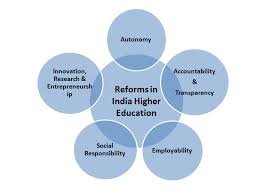
- The Bill promotes Atmanirbharta in higher education through autonomy, transparency, and outcome-based regulation.
- A coherent regulatory framework can help produce globally competitive, socially responsible citizens.
