
About HCES and MPCE
- The Household Consumption Expenditure Survey (HCES) tracks spending patterns of Indian households.
- Conducted by Ministry of Statistics and Programme Implementation every five years, it estimates Monthly Per Capita Expenditure (MPCE).
- Covers both rural and urban households across goods and services categories.
- 2022–23 and 2023–24 rounds provide the first MPCE update in over a decade.
- Findings inform poverty estimation, social policy design, and middle-class consumption analysis.
Key Long-Term Consumption Shifts (1999–2000 to 2023–24)
- Food and Beverages
-
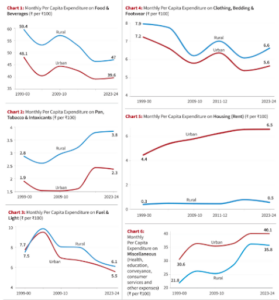
- Food share in MPCE declined in urban areas from ₹48 to ₹39 per ₹100.
- Rural food share reduced from ₹59 to ₹47 per ₹100, confirming Engel’s Law.
- Shift observed from cereals to fruits, eggs, fish, and processed foods.
- Indicates dietary diversification, though access remains unequal across households.
- Intoxicants
- Spending on pan, tobacco, and intoxicants remains low in MPCE composition.
- Accounts for below ₹3.8 per ₹100, despite marginal rural increases.
- Trend highlights need for targeted public health awareness in rural regions.
- Fuel and Energy
- Per capita fuel expenditure declined due to Saubhagya and PM Ujjwala Yojana.
- Urban decline linked to energy-efficient appliances and reliable electricity access.
- Reflects expenditure substitution from biomass or kerosene to modern fuels.
- Clothing and Footwear
- Moderate decline in spending reflects transition from need-based to discretionary consumption.
- Factors include fast fashion, lower textile prices, and market competition.
- Rural spending remains similar or slightly higher due to seasonal needs and aspirations.
- Housing
- Urban rent share increased from ₹4.46 to ₹6.58 per ₹100, indicating rental stress.
- Rural rent remains minimal due to self-owned housing and informal tenure systems.
- Miscellaneous Services
- Miscellaneous spending rose sharply, especially in rural MPCE.
- Rural share increased from ₹21.87 to ₹35.82 per ₹100.
- Includes health, education, transport, and consumer services.
- Reflects aspirational spending, digital penetration, and service access expansion.
Overall Trend
- Indian households are transitioning from subsistence consumption to aspirational, service-oriented spending.