
Context and Strategic Setting
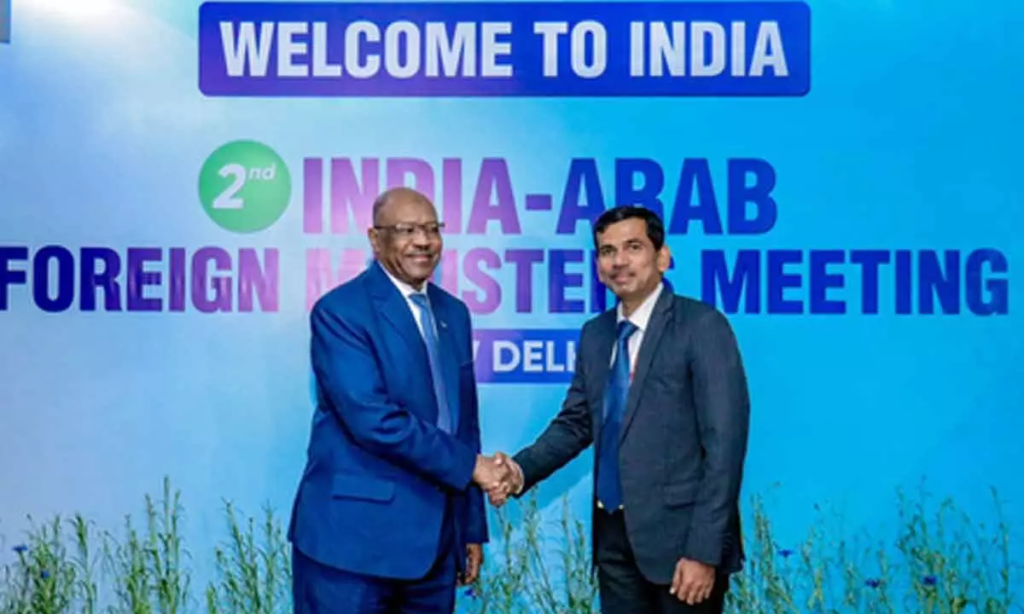
- Second India–Arab Foreign Ministers’ Meeting convenes in Delhi on January 30–31, 2026.
- Meeting occurs amid regional conflicts, global power shifts, and uncertain rules-based international order.
- Security concerns include Iran tensions, Syria instability, and evolving Gaza ceasefire dynamics.
- Emerging Saudi–UAE fault lines over Yemen and regional influence signal potential realignment risks.
Institutional Framework of Engagement
- League of Arab States (LAS) formed in Cairo on March 22, 1945, now comprising 22 members.
- India–LAS dialogue institutionalised through MoU in March 2002, enabling annual high-level meetings.
- Arab–India Cooperation Forum (AICF) launched in 2008, first meeting held in Manama in 2016.
- India’s Ambassador to Egypt designated as Permanent Representative to LAS since December 2010.
- New platform, India–Arab Chambers of Commerce, Industry and Agriculture, scheduled for inauguration.
Strategic and Political Pillars
- Strategic partnerships signed with Oman (2008), UAE (2015), Saudi Arabia (2019), Egypt (2023), Qatar (2025).
- Convergence observed between Vision 2030, Centennial 2071, Vision 2035, Vision 2040, and Viksit Bharat 2047.
- India supports LAS partners in multilateral platforms such as BRICS and SCO.
Trade, Connectivity, and Digital Cooperation
- Bilateral trade exceeds $240 billion, routed through Suez Canal, Red Sea, and Gulf of Aden.
- CEPA agreements with UAE and Oman expand trade targets, UAE trade reset to $200 billion by 2030.
- Major investment commitments include UAE $75 billion, Saudi Arabia $100 billion, Qatar $10 billion.
- India–Middle East–Europe Economic Corridor (IMEC) enhances logistics and strategic connectivity.
- Digital integration includes RuPay in UAE, UPI in multiple LAS states, and rupee–dirham settlements.
Energy and Security Cooperation
- Region supplies 60% crude oil, 70% natural gas, and over 50% fertilisers to India.
- Qatar LNG deal of $78 billion ensures 7.5 million tonnes annually for 20 years.
- ADNOC–Indian Oil LNG contract covers 1.2 million tonnes annually for 14 years.
- Duqm Port access in Oman strengthens India’s maritime reach and regional surveillance.
- Defence cooperation includes Tejas, BrahMos, Aakash, cyber, space, and drone technologies.
Future Outlook
- Partnership positioned as a pillar of India’s geopolitical, economic, and security architecture.
- Emphasis on trust, connectivity, and collective prosperity to navigate a volatile global environment.