
Why in News: India’s rapid growth in electric vehicle adoption and renewable energy is increasing lithium battery waste.
Context
- India’s decarbonisation drive has led to rapid electrification, especially in the Electric Vehicle (EV) sector.
- Lithium battery demand is projected to increase from 4 GWh in 2023 to 139 GWh by 2035.
- Growing use of Battery Energy Storage Systems (BESS) further amplifies this demand.
Why Lithium is Preferred for EV Batteries
- High power density and lightweight for better efficiency.
- Longer battery life with low maintenance.
- High capacity and low internal resistance for better performance.
- Fast charging with simple charge management.
- Low self-discharge, losing only about 5% charge per month.
Problems with Lithium-ion Batteries
- Energy density is still lower than petrol.
- Needs protection circuits to prevent thermal runaway.
- Performance declines over time.
- Quick charging is not possible at freezing temperatures.
- Degrades faster when exposed to heat.
- Mining lithium causes environmental issues.
- Liquid electrolyte is highly flammable.
Rising Environmental Concerns
- Lithium batteries contributed to 7,00,000 tonnes of e-waste out of the 1.6 million metric tonnes in 2022.
- Improper disposal leads to leakage of hazardous substances into the environment.
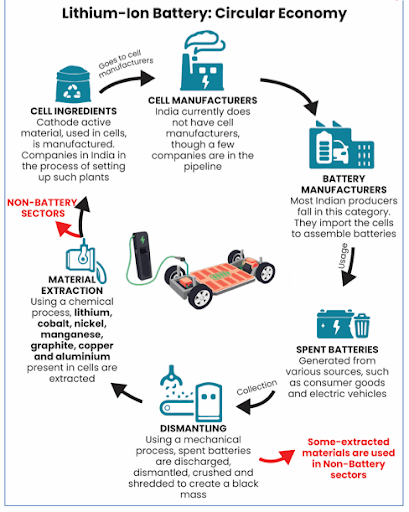
- Valuable minerals like lithium, cobalt, and nickel go unrecovered without proper recycling.
- Water Consumption: Lithium mining, especially in arid regions like the Lithium Triangle (Chile, Argentina, Bolivia), uses huge amounts of water.
- Ecosystem Disruption: Mining disturbs fragile ecosystems, particularly in salt flats and mountainous regions, threatening biodiversity.
Battery Waste Management Rules (BWMR), 2022
- Introduced Extended Producer Responsibility (EPR), making producers fund battery collection and recycling.
- Recyclers depend on EPR floor price (the minimum price paid for recycling services) to remain viable.
Issues in Implementation
1. Inadequate EPR Floor Price
- The current floor price is too low to support advanced recycling needs.
- Encourages informal or fraudulent recyclers issuing fake certificates or dumping waste.
2. Economic Implications
- Failure to recycle batteries could cost India $1 billion in foreign exchange by 2030.
- Missed opportunity to reduce mineral import dependence.
3. Non-compliance by Producers
- Some manufacturers adopt double standards for developed and developing countries.
- Refusal to comply affects the development of a sustainable recycling ecosystem.
4. Global Disparity
- In the UK, battery producers pay up to ₹600/kg for recycling EV batteries.
- India’s proposed rate is less than one-fourth, even after adjusting for purchasing power.
Recommendations for Improvement
1. Fair and Globally Comparable EPR Floor Price
- Price should cover full recycling costs — from collection to recovery.
- Can be eased to market-driven rates once the ecosystem matures.
2. Stronger Enforcement Mechanisms
- Digitise EPR certificate tracking, conduct audits, and enforce strict penalties.
- Encourage producer accountability through regular audits of recyclers.
3. Integration of Informal Recyclers
- Train and formalise the informal sector to expand capacity and eliminate hazardous practices.
4. Stakeholder Collaboration
- Initiate multi-stakeholder dialogue (government, industry, recyclers) to finalise viable pricing models.
Conclusion
India stands at a critical juncture where battery waste management is not only an environmental but also an economic and strategic imperative. India can transform battery waste into a catalyst for green growth, building a robust circular economy aligned with its Net Zero goals.
UPSC Relevance
GS Paper II – Governance
- Government Policies & Interventions
- Regulatory Bodies – Battery Waste Management Rules (BWMR)
GS Paper III – Environment, Economic Development
- Environmental Pollution and Degradation
UPSC Mains Practice Question:
Q. “India’s push for electrification and renewable energy must be matched with an equally strong focus on battery waste management.” Discuss the challenges in managing lithium battery waste in India and suggest a robust strategy to tackle them.