
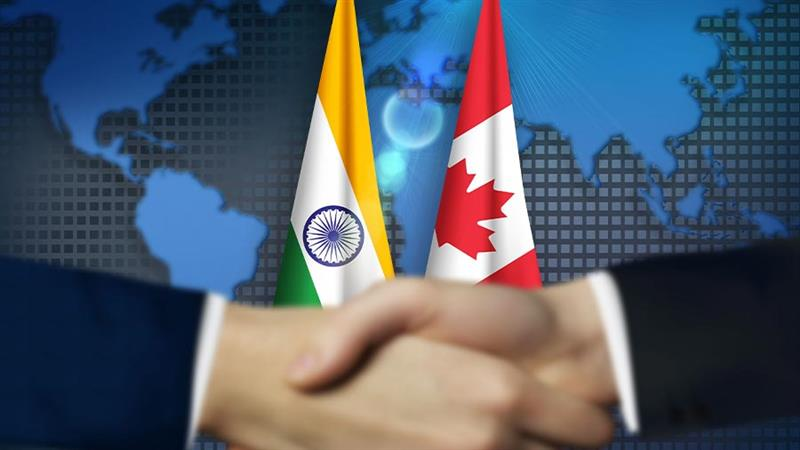
Context: Canadian PM Mark Carney visited India, marking a decisive shift from diplomatic tensions to commercially-anchored engagement. The visit produced landmark agreements across trade, nuclear energy, critical minerals, and defence, signalling renewed political will at the highest levels.
Historical Background
- India and Canada share over 75 years of diplomatic relations, formally upgraded to a “Strategic Partnership” in 2018.
- Security cooperation is anchored in the Joint Working Group on Counter Terrorism (1997) and Framework for Cooperation on Countering Terrorism (2018).
- Legal collaboration is strengthened through the Extradition Treaty (1987) and the Mutual Legal Assistance Treaty (1994).
Key Outcomes of PM Carney’s Visit
- Trade
- Terms of Reference signed to relaunch Comprehensive Economic Partnership Agreement (CEPA) negotiations, targeting bilateral trade of USD 70 billion by 2030.
- In 2024, two-way trade stood at USD 30.9 billion, with India maintaining a goods trade surplus.
- Civil Nuclear Deal
- Department of Atomic Energy signed a USD 2.6 billion, nine-year uranium supply contract with Canada’s Cameco.
- Directly supports India’s goal of achieving 100 GW nuclear power capacity by 2047 under Viksit Bharat.
- Critical Minerals and Clean Energy
- MoU signed for secure critical mineral supply chains, aligning with the G7 Critical Minerals Action Plan.
- Canada officially joining both the International Solar Alliance (ISA) and Global Biofuels Alliance (GBA).
- Defence and Strategic Ties
- First-ever India-Canada Defence Dialogue established, which is a historically absent pillar now institutionalised.
- India formally supported Canada joining IORA as a Dialogue Partner.
- Innovation and People
- AICTE-Mitacs MoU to provide 300 fully-funded research internships for Indian students in Canada.
- Joint Pulse Protein Centre of Excellence to be set up at NIFTEM-K, addressing micronutrient deficiencies.
- PM Carney extended an invitation to PM Modi to visit Canada, signalling a sustained reciprocal partnership.
Strategic Significance
- Canadian pension funds have invested over USD 100 billion in India’s infrastructure and real estate sectors.
- Indian diaspora in Canada exceeds 1.8 million, acting as a vital bridge for economic and people-to-people ties.
- Both democracies share converging interests in a rules-based, free, and open Indo-Pacific.
- Canada’s Indo-Pacific Strategy specifically identifies India as a critical strategic partner.
India’s Uranium Import Strategy
- Indian uranium ore contains only 0.02-0.45% against the global average of 1-2%, making domestic extraction costlier.
- India currently consumes 1,500-2,000 tonnes annually; demand may rise to 5,400 tonnes with nuclear expansion.
- Over 70% of uranium requirements are met through imports from Canada, Russia, Kazakhstan, and Uzbekistan.
The SHANTI Act 2025 enables greater private sector participation in India’s nuclear energy sector.
Challenges
- Khalistani extremist activities openly operating from Canadian soil threaten India’s internal security.
- Trade barriers persist over agricultural tariffs, IPR disputes, and professional mobility restrictions.
- Visa and consular delays worsened significantly following the 2023-24 diplomatic crisis.
- Differences over India’s non-alignment and strategic autonomy occasionally create friction in bilateral ties.
- Canada’s historically inconsistent political will has made sustained engagement structurally unreliable for India.
Way Forward
- Implement NSA-level action plan targeting violent extremism and organised crime networks jointly.
- Finalise CEPA by end-2026 to unlock market access and reduce trade barriers.
- Pursue Early Harvest Agreement in less contentious sectors while CEPA negotiations continue.
- Expand AICTE-Mitacs model to more institutions, deepening education and talent mobility cooperation.
- Leverage Canadian pension fund investments to accelerate India’s infrastructure and clean energy buildout.