

Kalapani-Lipulekh-Limpiyadhura Trijunction Dispute
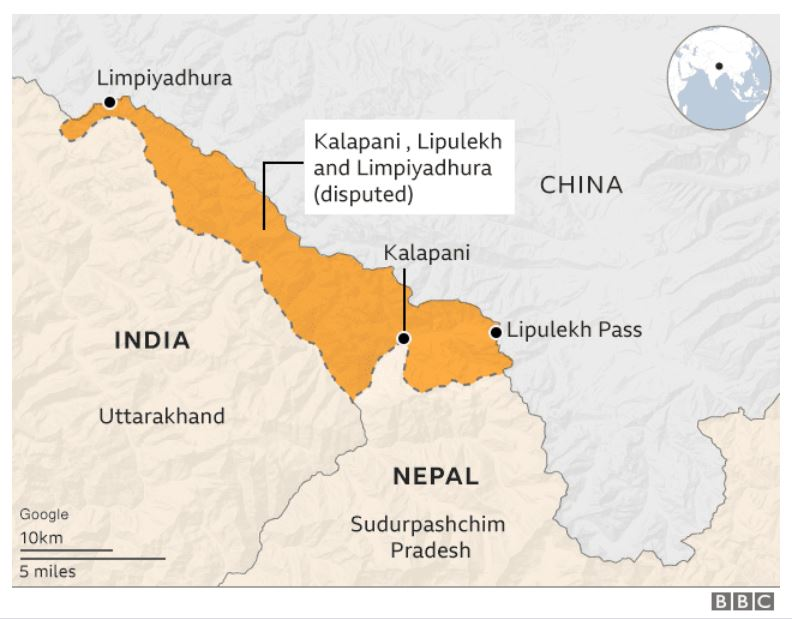
Context: Nepal’s Foreign Minister stated that Nepal is focused on establishing its claim on the Kalapani-Lipulekh-Limpiyadhura trijunction and is not seeking third-party mediation.
Location
- The disputed trijunction lies at the meeting point of India, Nepal, and China in the Himalayan frontier.
- Lipulekh Pass lies near the India-China-Nepal trijunction and serves as a route for the Kailash Mansarovar Yatra.
- Kalapani is located in the Pithoragarh district of Uttarakhand according to India’s position.
Background
- The dispute is rooted in the Treaty of Sugauli (1816) between the East India Company and Nepal, which identified the Kali River as the western boundary of Nepal.
- The treaty did not clearly define the exact source of the Kali River, creating the basis for the dispute.
- Nepal officially raised the Kalapani issue with India in 1998, though the dispute has older colonial roots.
- The dispute gained sharp political attention in 2020 when India constructed a road through the Lipulekh Pass.
- In April 2026, India announced the Kailash Mansarovar Yatra through Lipulekh Pass, triggering fresh protests from Nepal.
- Nepal communicated its objection through an official diplomatic note to both India and China.
Stance of India and Nepal
- India’s Stand:
- Kalapani falls within Pithoragarh district of Uttarakhand under India’s established administrative control.
- The boundary must be determined based on historical evidence and established administrative records.
- The dispute should be resolved through bilateral dialogue with no scope for third-party intervention.
- Nepal’s Stand:
- The Kali River originates from Limpiyadhura or nearby areas, making the entire disputed territory belong to Nepal.
- India’s road construction and administrative presence in the area violate Nepal’s sovereignty.
- Nepal’s revised map reflects its historical and legal claim over Kalapani, Lipulekh, and Limpiyadhura.
PM E-DRIVE Scheme

Context: Delhi plans to induct 2,800 air-conditioned low-floor e-buses under the PM E-DRIVE scheme to strengthen public transport and promote sustainable mobility.
About PM E-DRIVE Scheme
- PM E-DRIVE stands for Electric Drive Revolution in Innovative Vehicle Enhancement.
- Launch: A flagship initiative launched in October 2024.
- It functions under the Ministry of Heavy Industries (MHI).
- The scheme pursues three core goals: accelerating EV adoption, building charging infrastructure, and strengthening domestic EV manufacturing.
What the Scheme Offers:
- Demand incentives are extended to buyers of e-2 wheelers, e-3 wheelers, e-ambulances, and e-trucks.
- Capital grants support procurement of e-buses, creation of charging station networks, and upgradation of MHI testing facilities.
- States are encouraged to sweeten the deal further through road tax waivers, reduced toll and parking charges, and permit exemptions.
Eligibility: Vehicles must be registered under the Central Motor Vehicle Rules (CMVR) and fitted with advanced battery technology to qualify for incentives.
UN Military Gender Advocate of the Year Award
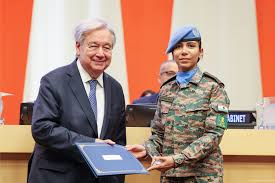
Context: Major Abhilasha Barak was conferred the UN Military Gender Advocate of the Year Award for her outreach work with women and girls during her deployment in Lebanon.
About Major Abhilasha Barak
- She is serving with the Indian Battalion in UNIFIL as Commander of the Female Engagement Team (FET).
- She is also the first woman combat helicopter pilot of the Indian Army.
- She was honoured for outreach and community engagement with women and adolescent girls, and gender sensitisation training for peacekeepers.
- She is the third Indian recipient of this award, after Major Suman Gawani (2019) and Major Radhika Sen (2023).
About UNIFIL
- UNIFIL is a UN peacekeeping mission deployed in Lebanon, with India contributing 642 personnel to the mission.
About the Award
- The award was created in 2016 by the Office of Military Affairs under the Department for Peace Operations.
- It recognises military peacekeepers who best integrate a gender perspective into peacekeeping activities.
- It promotes the principles of UN Security Council Resolution 1325 on Women, Peace and Security.
Indian Knowledge System (IKS)
About IKS
- IKS is an innovative cell established under the Ministry of Education (MoE) at AICTE, New Delhi.
- It was established to promote interdisciplinary research on all aspects of Indian Knowledge Systems.
- Its mandate includes preservation and dissemination of IKS for research and societal applications.
- It covers traditional knowledge across Arts, Literature, Agriculture, Basic Sciences, Engineering, Architecture, Management, and Economics.
Key Functions
- It facilitates and coordinates IKS-based interdisciplinary work across universities, institutions of national importance, R&D laboratories, and different ministries.
- It establishes subject-wise interdisciplinary research groups comprising researchers from institutes and individuals.
- It facilitates funding of research projects and develops mechanisms for their implementation.
- It creates and promotes popularisation schemes to spread awareness of India’s traditional knowledge heritage.
- It makes policy recommendations for the promotion of IKS wherever required.
Mission for Cotton Productivity
About the Mission
- It is a five-year mission under the Ministry of Textiles to improve cotton productivity, sustainability, and promote Extra-Long Staple (ELS) cotton varieties.
- It aligns with the government’s integrated 5F vision for the textile sector (Farm, Fibre, Fabric, Fashion, Foreign).
- It aims to reduce import dependence and enhance global competitiveness of India’s textile sector, where 80% of capacity is driven by MSMEs.
Need for the Mission
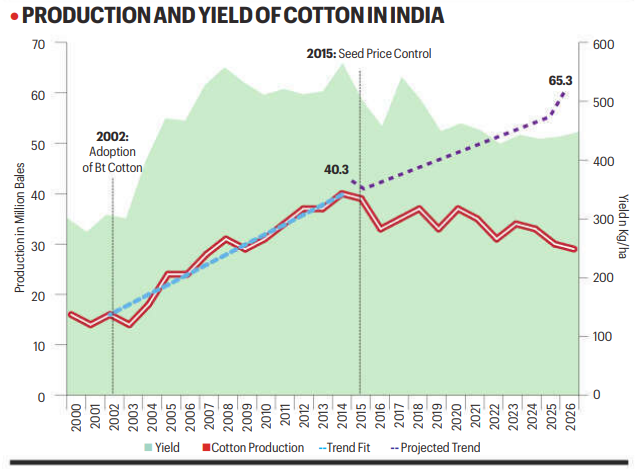
- Cotton yield has remained stagnant at around 435 to 447 kg per hectare between 2023-24 and 2024-25.
- Approximately 67% of India’s cotton is produced on rain-fed areas and 33% on irrigated lands.
- Cotton is highly vulnerable to pests such as Pink Bollworm and Whitefly.
India’s Cotton Profile
- India ranks 1st in cotton acreage with around 40% of the world’s cotton area.
- India ranks 2nd in cotton production with estimated output of 343.47 lakh bales (5.84 MMT) in 2022-23, representing 23.83% of world production.
- India ranks 39th in cotton yield, lower than the USA, China, and Brazil.
- India is the 2nd largest consumer of cotton globally with 22.24% of world cotton consumption in 2023.
- Less than 10% of total cotton consumption in India is imported by the textile industry.
Three Cotton Growing Zones
- Northern Zone: Punjab, Haryana, and Rajasthan.
- Central Zone: Gujarat, Maharashtra, and Madhya Pradesh.
- Southern Zone: Telangana, Andhra Pradesh, and Karnataka.
About Cotton
- Scientific name of cotton is Gossypium spp and it is a semi-xerophyte shrub native to tropical and subtropical regions.
- Four species of cotton are G. Arboreum and G. Herbaceum (Asian cotton), G. Barbadense (Egyptian cotton), and G. Hirsutum (American Upland cotton).
- India is reportedly the only country that grows all four species of cotton.
- G. Hirsutum represents 90% of hybrid cotton production in India and all current Bt cotton hybrids are of this species.
Nipah Virus (NiV)
Origin and Spread
- Nipah Virus first appeared in Malaysian pig farmers in 1999.
- It was detected in Bangladesh and eastern India simultaneously in 2001.
- Traces of the virus have been identified in Cambodia, Ghana, and Thailand.
Structure
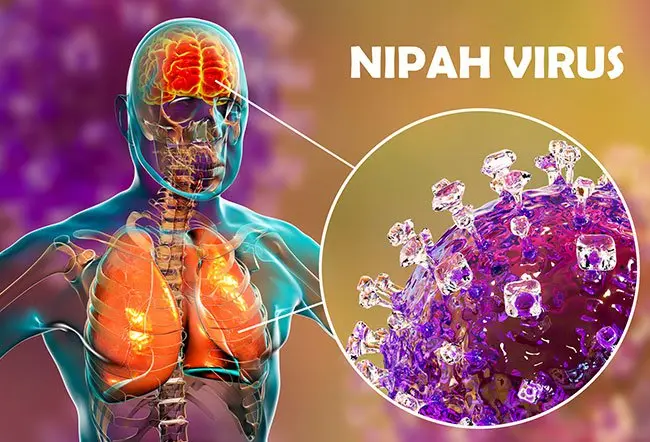
- NiV is a single-stranded, negative-sense RNA virus.
- The virus belongs to the Henipavirus genus of the Paramyxoviridae family.
Transmission
- Spreads through direct contact with infected animals (bats or pigs) via their bodily fluids.
- In Bangladesh and India, a key route is consumption of fruits contaminated with infected fruit bat saliva.
- Later outbreaks demonstrated direct bat-to-human and human-to-human transmission.
Symptoms
- Common symptoms include fever, headache, muscle aches, nausea, and sore throat.
- Severe cases lead to acute encephalitis (brain swelling), seizures, and coma within 24 to 48 hours.
Diagnosis and Treatment
- Diagnostic tests include RT-PCR, Immunohistochemistry (IHC), ELISA, and Serum Neutralisation Test (SNT).
- There is no approved vaccine or specific treatment for Nipah virus in humans or animals.
Ribavirin (an antiviral) may help in lowering mortality in patients with Nipah virus encephalitis.
