
Why in News: India’s youth bulge, once seen as a demographic dividend, is at risk of becoming a time bomb due to outdated education, low employability, and rising job disruption from AI and automation.
Introduction
- Rabindranath Tagore said, “Don’t limit a child to your own learning, for she was born in another time.”
- This resonates with India’s current context: the education system is outdated, curricula lag behind technological disruptions, and the gap between degrees and employability is widening.
- With more than 800 million youth below 35, India’s much-celebrated demographic dividend risks turning into a demographic liability if urgent reforms are not undertaken.
The Promise of Demographic Dividend
- Large youth base: India has one of the largest working-age populations globally.
- Potential economic booster: If properly skilled, this workforce can accelerate growth, innovation, and competitiveness.
- Global comparison: East Asian economies harnessed similar demographics to achieve rapid growth.
The Risk of Liability
- Graduate glut without jobs: Millions of graduates every year remain unemployed or underemployed.
- STEM not immune: Even among engineers, 40–50% remain unplaced in the last decade.
- Employers’ complaint: Increasing difficulty in finding industry-ready talent despite surplus of degree holders.
- Graduate Skills Index 2025: Only 43% of graduates job-ready.
Technology and the Future of Work
- AI as the disruptor: McKinsey – nearly 70% of Indian jobs at risk by 2030; 30% of tasks could be fully automated.
- Job churn: World Economic Forum – 170 million jobs may be created by 2030 but 92 million displaced.
- Curriculum lag: Indian universities revise curricula every 3 years, but industry changes every few months → mismatch.
Early Stage Mismatch (High School Level)
- Awareness gap: Mindler Survey 2022 – 93% of students (classes 8–12) aware of only 7 careers (doctor, engineer, lawyer, teacher, etc.).
- Limited counselling: Only 7% received formal career guidance.
- Mismatch of interests: India Skills Report 2024 – 65% pursue degrees misaligned with aptitude/market needs.
Digital Tools, Analog Mindsets
- Access but poor pedagogy: Smartphones, AI labs exist, but schools remain exam-centric.
- Skill deficit: Students graduate with degrees but little practical exposure.
- EdTech problem: Focus on rote learning and test-prep; certificates (Coursera, Udemy) commoditised.
- Policy lag: Only a few state boards introduce career readiness frameworks; most curricula outdated.
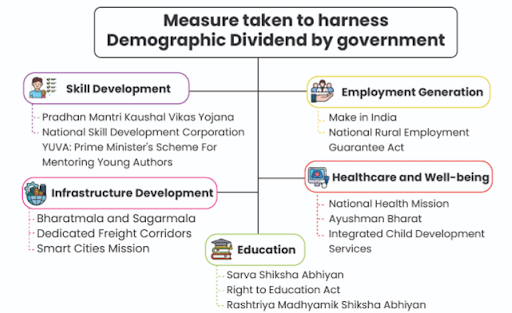
Government Initiatives and Gaps
- Skill India Mission: Target of 400 million trained by 2022 – fell short.
- Other schemes: PMKVY, PMKK, JSS, PMYY, SANKALP, Internship Schemes, etc.
Systemic weaknesses:
- Fragmentation and duplication.
- Emphasis on numbers trained, not quality.
- Weak academia–industry collaboration.
Social and Political Risks
- Unrest risk: Educated but unemployed youth can become a destabilising force (e.g., Mandal protests 1990).
- World Bank warning: Lant Pritchett’s “Where Has All the Education Gone?” shows that literacy without productivity destabilises economies.
- Socio-political instability: Unemployment can escalate into protests, crime, radicalisation.
Way Forward
1. Curriculum Reform: Integrate AI, data literacy, vocational and entrepreneurial modules in schools and colleges.
2. Career Counselling: Institutionalise structured career guidance in schools.
3. Skill-Industry Alignment: Apprenticeships, internships, and co-created courses with industry.
4. National Skilling Framework: Merge fragmented schemes under a single authority with measurable outcomes.
5. Reorient EdTech: Shift from rote to project-based, experiential learning.
6. Public-Private Partnerships: Involve corporates in financing and designing training programs.
7. Lifelong Learning: Encourage re-skilling and up-skilling for an AI-driven economy.
UPSC Relevance
GS Paper I (Society & Population): Issues arising from demographic trends, youth bulge, and regional population imbalances.
GS Paper II (Social Justice & Governance): Education reforms, employability challenges, role of welfare schemes like Skill India Mission, PMKVY, PM Yuva Yojana, etc.
Mains Practice Question
Q1. India’s demographic dividend has long been celebrated as a growth booster, but without adequate education, skills, and jobs, it risks turning into a demographic time bomb. Discuss with reference to technological disruptions and policy gaps.