
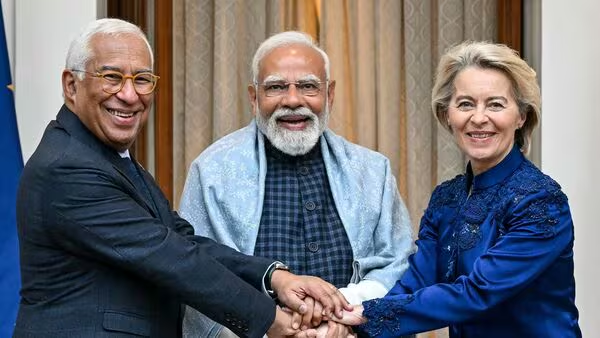
Strategic Significance
- India–EU Free Trade Agreement (FTA) reflects mature negotiation capacity with a major economic bloc.
- EU accounts for nearly 12% of India’s total trade in 2024–25.
- Eight recent FTAs together represented only 16% of India’s total trade.
- Agreement highlights India’s ability to engage powerful counterparts on equal footing.
Key Trade Commitments
- EU will eliminate tariffs on 99.5% of Indian export items.
- Most Indian exports will receive zero-duty access immediately after implementation.
- India has offered tariff concessions on 97.5% of EU exports.
- Both sides preserved strategic agricultural and dairy sector protections.
Resolution of Sensitive Sectors
- Automobile disagreements had derailed negotiations in 2013.
- New quota-based automobile system protects India’s domestic low-end manufacturers.
- European luxury carmakers gain structured access to the Indian market.
- Quota-based wine tariffs benefit French producers while shielding India’s domestic wine industry.
Complementary Strategic Agreements
- Parallel understandings signed on mobility, defence, and technology cooperation.
- These agreements expand engagement beyond trade into strategic partnership domains.
Carbon Border Adjustment Mechanism (CBAM) Issues
- India secured no direct concessions under the EU’s CBAM framework.
- CBAM currently covers six products, but may expand to all industrial goods.
- Agreement ensures any CBAM concessions to third countries apply automatically to India.
Investment and Manufacturing Implications
- India must pursue large-scale manufacturing reforms to attract export-oriented investors.
- FTA could position India as a cost-effective production base for European markets.
Implementation and Procedural Delays
- Agreement requires translation into 27 European languages.
- Ratification needed from all EU member states and European Parliament.
- Delays may weaken benefits amid ongoing U.S. tariff pressures.
Conclusion
- The FTA demonstrates pragmatic trade diplomacy and balanced sectoral protection.
- Timely implementation remains essential to convert negotiated gains into economic advantage.