
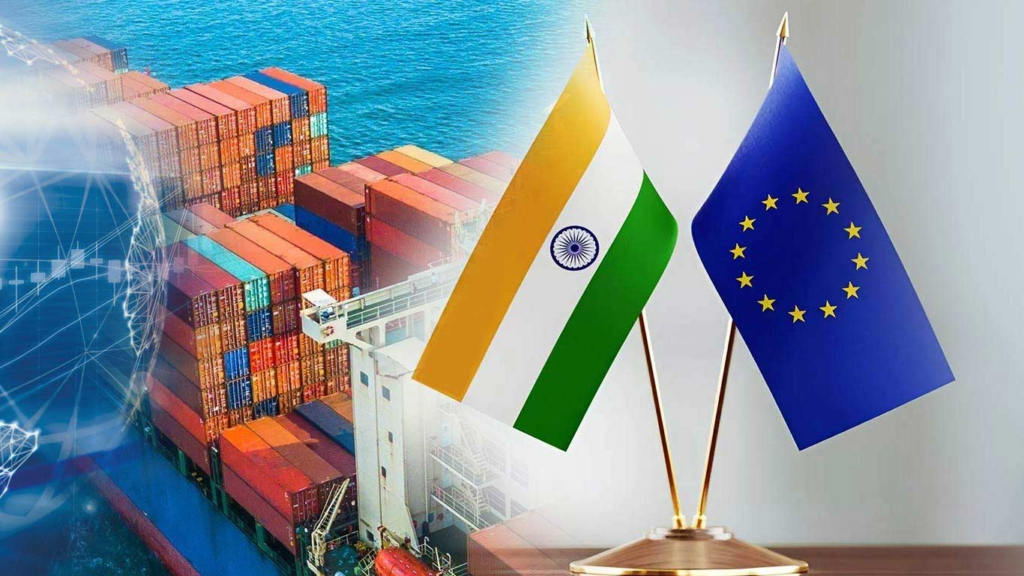
Syllabus: Bilateral, regional and global groupings and agreements involving India and/or affecting India’s interests
Background and Strategic Scale
- Negotiations on the India–EU FTA concluded on January 27, ending nearly two decades of intermittent talks.
- The deal links the second- and fourth-largest customs blocs in global trade architecture.
- The combined market size is estimated at ₹2,091.6 lakh crore, or about $24 trillion.
- The EU accounted for nearly 12% of India’s total trade in 2024–25.
- Bilateral merchandise trade reached ₹11.5 lakh crore ($136.54 billion) in 2024–25.
- Indian exports formed ₹6.4 lakh crore ($75.85 billion) of this merchandise trade.
- Services trade between India and the EU touched ₹7.2 lakh crore ($83.10 billion) in 2024.
EU Tariff Concessions for India
- The EU will eliminate duties on 70.4% of tariff lines immediately.
- These concessions cover nearly 90.7% of India’s export value to the EU.
- Another 20.3% tariff lines will be phased out over three to five years.
- About 6.1% tariff lines will face reduced or quota-based tariffs.
- Overall, EU concessions cover more than 99% of India’s export trade value.
- The EU offered broader commitments across 144 services sub-sectors.
Key Beneficiary Sectors
- Labour-intensive sectors gain about $35 billion in market potential.
- Nearly $33.5 billion will receive zero-duty access from day one.
- Beneficiaries include textiles, apparel, leather, footwear, gems, chemicals, and toys.
- Agricultural products like tea, spices, grapes, cucumbers, and processed foods gain competitiveness.
- AYUSH practitioners can offer services in EU states lacking domestic regulations.
India’s Market Access Offer to the EU
- India will eliminate duties on 49.6% tariff lines immediately.
- Another 39.5% tariff lines will be phased out over five to ten years.
- India’s offer covers 92.1% of tariff lines and 97.5% of trade value.
- Wine tariffs fall from 150% to 20–30% under quota-based systems.
- Automobile duties decline from 110% to 10% for premium segments.
Exclusions, Concerns, and Implementation
- Sensitive agricultural sectors remain excluded under declared ‘red lines’.
- The deal makes limited progress on the Carbon Border Adjustment Mechanism (CBAM).
- India secured a most-favoured concession clause on future CBAM relaxations.
- Implementation is expected in calendar year 2026, pending EU legal approvals.