
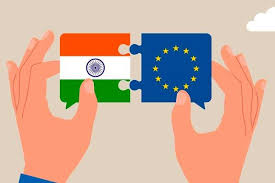
Context and Strategic Setting
- European Commission President and European Council President are chief guests for India’s 77th Republic Day.
- The 16th India-EU Summit aims to finalise a landmark Free Trade Agreement and Security Partnership.
- Partnership reflects pragmatic alignment in a multipolar global order and shared strategic autonomy.
Nature of the Partnership
- Relationship focuses on resilient trade corridors, technological collaboration, and a rules-based international framework.
- Both sides seek reduced dependence on traditional global powers and diversified economic linkages.
Trade and Investment Trends
- The EU is India’s largest trading partner in goods, with trade near US$136 billion in 2024–25.
- Services trade reached a record US$53 billion in 2023, led by IT and professional exports.
- The EU remains a major investor, with FDI stock of €140 billion in 2023.
- Over 6,000 European companies operate across multiple sectors in India.
- Merchandise trade grew 36% in five years, outpacing India’s trade growth with the United States.
- Trade composition is shifting towards electronics, machinery, and specialty chemicals.
Sectoral Opportunities
- Textiles and Apparel benefit from possible elimination of the EU’s 10% tariff barrier.
- Automobiles and E-Mobility combine Europe’s EV technology with India’s cost-efficient manufacturing base.
- Pharmaceuticals and Chemicals leverage India’s capacity for affordable generics and specialty exports.
- Security and Defence Manufacturing moves toward co-production and ammunition exports to European partners.
- Digital and IT Services seek regulatory harmonisation through the Trade and Technology Council.
Key Challenges
- The Carbon Border Adjustment Mechanism imposes a 20–35% carbon levy on certain Indian exports.
- The EU seeks reduced duties on wine and spirits, while India protects sensitive agriculture sectors.
- Strict labour and sustainability standards raise compliance costs for Indian MSMEs.
- Differences over data sovereignty and localisation create friction for European technology firms.
- Geopolitical divergence persists on Russia-Ukraine conflict and energy procurement narratives.
Way Forward
- Finalise the FTA by mid-2026 to counter rising global protectionism.
- Seek transitional relief and technology transfer mechanisms for carbon compliance.
- Expand defence collaboration into joint research on semiconductors, drones, and cyber security.
- Operationalise the India-Middle East-Europe Economic Corridor for faster logistics.
- Strengthen skilled mobility frameworks addressing Europe’s ageing workforce needs.
Conclusion
- India and the EU are emerging as indispensable partners shaping stability in a fragmented global system.