
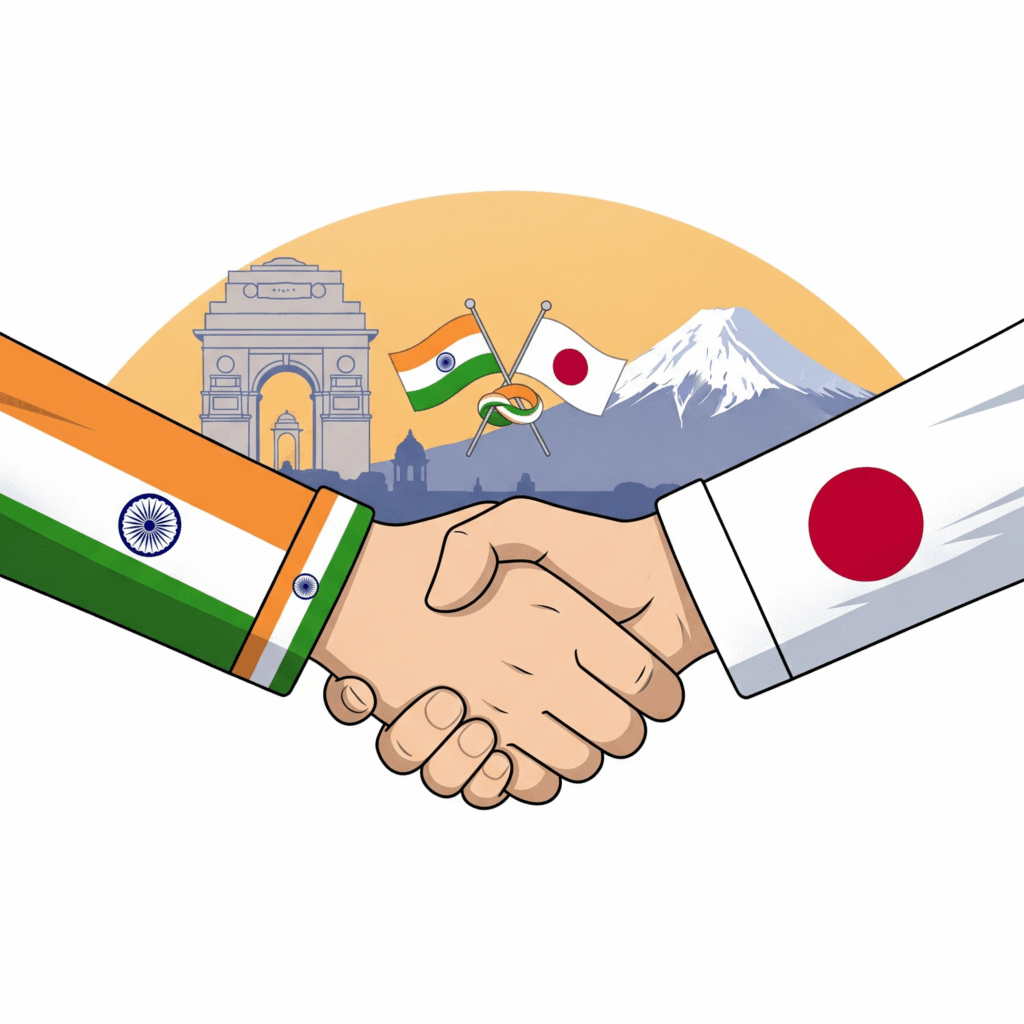
Why in News: Prime Minister Narendra Modi’s visit to Japan (Aug 29, 2025) where Tokyo announced a ¥10 trillion (~$68 billion) investment plan in India.
Introduction
- India and Japan share a civilisational bond dating back to Buddhist linkages and post-war solidarity.
- Over decades, the partnership has evolved into a Special Strategic and Global Partnership (2014).
- In the current flux of global geopolitics — with tentative thaw with China, uncertainties in Indo–U.S. ties, and a turbulent Indo-Pacific — Prime Minister Modi’s August 2025 visit to Tokyo signifies the recalibration of old ties to address new economic and strategic priorities.
Historical Context
- Cultural Foundations: Buddhism, art, and philosophy as people-to-people bridges.
- Post-War Support: India opposed punitive measures on Japan post-WWII; Japan supported India’s early industrialisation.
- 2000s: Strategic convergence — 2008 Joint Declaration on Security Cooperation.
- 2014 onwards: Special Strategic and Global Partnership under Modi–Abe framework.
Economic Cooperation: A Renewed Push
1. Investment Commitment
- Japan pledged ¥10 trillion (~$68 billion) over the next decade.
- Focus: infrastructure, clean energy, manufacturing, technology.
- Long-term confidence in India’s growth story amidst global scepticism on China.
2. High-Speed Rail Project
- E10 series Shinkansen (bullet train) for Mumbai–Ahmedabad corridor.
- Represents technology transfer + flagship symbol of cooperation.
3. Digital & Startup Ecosystem
- Expanded partnership in AI, digital public infrastructure, startup linkages.
- Complementary strengths: Japan’s technology + India’s human capital.
Strategic & Security Dimensions
1. Defence Cooperation
- Revision of 2008 Joint Declaration to align with contemporary realities.
- Stronger maritime cooperation: Malabar exercises, Quad framework.
- Supply-chain security for defence technology and dual-use items.
2. Economic Security Initiative
- Focus on semiconductors, critical minerals, pharmaceuticals, clean energy.
- Anchors Japan in India’s Atmanirbhar Bharat + supply chain diversification strategy.
3. Indo-Pacific Convergence
- Shared vision of Free, Open, and Rules-Based Indo-Pacific (FOIP).
- Maritime domain awareness, connectivity, and resilient infrastructure.
Strategic Balancing in Flux
1. India–China Equations
- Visit followed by SCO Summit in Tianjin → signalling India’s ability to compartmentalise relations.
- With Beijing: limited confidence-building measures (flights, trade facilitation, visas).
- With Tokyo: deepening security & tech cooperation.
2. The U.S. Factor
- Trump’s unpredictability threatens carefully built Indo–U.S. gains (Bush → Biden era).
- Quad momentum at risk due to episodic U.S. engagement.
- India, Japan, Australia may need to sustain Quad credibility independently.
Political & Diplomatic Significance
- Japan as an anchor partner: Reliable, consistent, value-driven.
- Signal of strategic clarity: India balancing U.S. wavering, China’s mistrust, and Japan’s long-term commitment.
- Flexibility with firmness: India keeping dialogue open with all, but prioritising dependable partnerships.
Challenges in the Relationship
- Trade imbalance: Bilateral trade (~$20–22 bn) below potential.
- Slow execution of infrastructure projects (e.g., bullet train delays).
- Strategic autonomy vs alliance frameworks: India cautious about full alignment.
- Japan’s domestic constraints: Demographics, pacifist constitution, limited defence outlay.
Way Forward
1. Deepen Economic Security: Expand tech collaboration, semiconductor hubs, green energy projects.
2. Strengthen Defence Industrial Base: Co-production of military hardware, joint R&D.
3. Maritime Cooperation: Enhanced role in IOR, joint patrols, undersea surveillance.
4. Quad 2.0: India–Japan–Australia to keep momentum alive despite U.S. uncertainties.
5. People-to-People Connect: Promote education, tourism, skill development programmes.
Conclusion
PM Modi’s visit underlines a key message: India’s diplomacy will be flexible, yet strategically clear — and Japan remains the ballast of stability in an uncertain Indo-Pacific.
UPSC Relevance
GS Paper II (IR)
- India’s bilateral relations with Japan.
Mains Practice Question
Q1. India–Japan ties have evolved from cultural goodwill to a strategic partnership rooted in shared Indo-Pacific priorities. Critically examine the role of Japan as India’s anchor partner amid uncertainties in U.S. reliability and challenges with China. (250 words)