
Why in News: Prime Minister Narendra Modi visited Namibia in July 2025, the first visit by an Indian head of government in nearly three decades.
Introduction
- Prime Minister Narendra Modi’s address to Namibia’s National Assembly in July 2025 showcased India’s evolving Africa engagement strategy.
- By quoting Namibian poets, invoking national symbols like Welwitschia mirabilis and the Springbok, and speaking in Oshiwambo, the speech highlighted India’s cultural sensitivity and inclusive diplomacy..
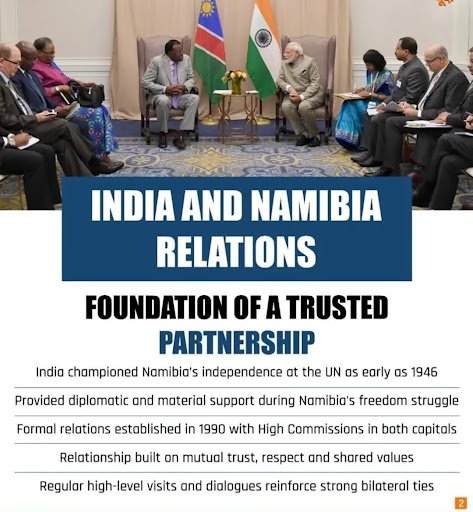
India’s Three-Step Engagement Logic
1. Shared Historical Solidarities
- Anchoring ties in anti-colonial heritage.
- Recalled New Delhi hosting SWAPO’s first diplomatic office.
- Mention of Lt. Gen. Diwan Prem Chand commanding UN peacekeeping during Namibia’s independence transition.
- These references build long-haul legitimacy unlike the West’s episodic presence.
2. Present-Day Pragmatic Cooperation
- Bilateral trade: $800 million; supported by India’s $12 billion development partnership across Africa.
- Targeted capacity-building:
- India-Namibia Centre of Excellence in IT (NUST).
- “India Wing” at Ongwediva campus ($12 million grant).
- Focus on IT and digital training to match Namibia’s youthful, tech-ready population.
3. Future-Oriented Roadmap
- Namibia is the first African country to adopt India’s Unified Payments Interface (UPI).
- Potential transfer of digital public infrastructure, regulatory frameworks, and institutional design.
- Reflects India’s pivot to knowledge-based cooperation and “tech diplomacy.”
Strategic Significance of India–Namibia Ties
1. Energy Security – Namibia is among the world’s top uranium producers, crucial for India’s low-carbon energy transition and nuclear power ambitions.
2. Mineral Supply Chains – Beyond uranium, Namibia has lithium, rare earths, and other critical minerals needed for EVs, semiconductors, and green technologies.
3. Geostrategic Location – Namibia’s Atlantic coastline offers potential for maritime access and connectivity with western Africa and beyond.
4. Partnership in Multilateralism – Shared positions in the Global South, NAM, and G77 strengthen India’s diplomatic weight in pushing for UN reforms and a just global order.
5. Counterbalancing China – Namibia is already a major site of Chinese investment in mining and infrastructure. India’s presence provides African states with strategic choice and autonomy.
6. Knowledge and Technology Transfer – IT training centres and UPI adoption position India as a provider of affordable, scalable technologies, not just raw capital.
7. South–South Development Model – The partnership exemplifies non-conditional, capacity-driven cooperation, offering a model distinct from Western aid or Chinese loans.
Challenges in India–Namibia Engagement
1. Long Gaps in High-Level Visits – Modi’s visit was the first in nearly 30 years, reflecting episodic rather than sustained engagement.
2. Limited Outcomes – Agreements were modest (MoUs on health and entrepreneurship), with no major breakthrough on critical minerals or large-scale projects.
3. Implementation Deficit – India’s Africa policy often suffers from uneven follow-through, raising doubts about delivery.
4. Competition from Other Powers – China and Western nations are more entrenched in Africa, with deeper resource and infrastructure footprints.
5. Domestic Constraints – India’s bureaucratic delays, resource limitations, and fragmented Africa strategy hinder long-term effectiveness.
6. Missed Opportunities – Lack of concrete framework on uranium, workforce skilling, or local value addition weakens India’s strategic leverage.
Way Forward: Beyond Symbolism
India-Africa Forum Summit (Upcoming): A chance to institutionalize cooperation and showcase sustained commitment.
Priorities for India:
- Strengthen implementation capacity.
- Align strategic ambitions with consistent investments.
- Deepen trust by letting African priorities shape the agenda.
Test of Credibility: India’s role as a Global South partner will depend on how consistently and collaboratively it follows through, not just symbolic gestures.
UPSC Relevance
GS Paper II (International Relations):
- India’s engagement with Africa; South–South Cooperation; role of India in Global South diplomacy.
Mains Practice Question
Q. “India’s engagement with Namibia reflects a new model of Africa diplomacy — rooted in history, pragmatic cooperation, and digital innovation.” Discuss the strategic significance of this approach and the key challenges India faces in sustaining it. (250 words)