
Why in News: In June 2024, Myanmar’s military junta ended emergency rule and announced elections amid an ongoing civil war. Over 5,000 civilians have died, and 2.5 million have been displaced since the 2021 coup. The situation calls for India to reassess its Myanmar policy by aligning strategic interests with democratic values.
India’s Current Policy and Its Flaws
India justifies its relationship with the junta on narrow strategic grounds:
- Border security
- China containment
- Connectivity.
New Delhi avoids supporting the National Unity Government (NUG) and resistance forces.
This approach:
- Ignores humanitarian and democratic values.
- Allows China to retain influence.
- Erodes India’s image as a democratic leader in the region.
Why a Progressive, Values-Driven Policy is Feasible
- Values (democracy, federalism) are not separate from national interests.
- By leveraging values, India can:
- Enhance its soft power.
- Increase influence among democratic and ethnic groups in Myanmar.
- Distinguish itself from China.
Proposed 4-Pronged Strategy for India
1. Support for Democracy and Federalism
- Promote India’s image as a federal democracy.
- Engage with NUG, ethnic groups, civil society, and opposition.
- Offer capacity-building, knowledge exchange, and federalism support.
- Counter China’s influence by offering political models, not just weapons.
2. Halt All Weapon Sales to the Junta
- Stop transfer of military hardware (even non-lethal) to the junta.
- Reports indicate India sold equipment and navy-grade diesel post-coup.
- These are used in attacks against civilians.
3. Humanitarian Corridors Along the Border
Open cross-border humanitarian corridors into:
- Sagaing Region
- Chin State
- Northern Rakhine
Steps to take:
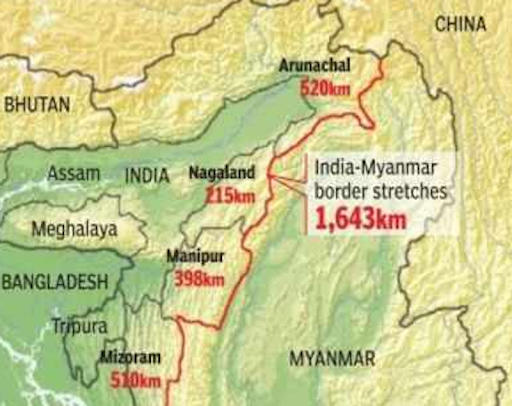
- Revoke the India-Myanmar border fencing plan.
- Reinstate the Free Movement Regime (FMR).
- Collaborate with NGOs, and follow Thailand’s example.
- Ensure aid is not diverted to junta control.
- Use existing aid systems, especially in Mizoram.
4. Stop Deportation of Refugees
- Cease detention and deportation of Myanmar asylum seekers (especially in Manipur).
- Respect the principle of non-refoulement.
- Recognise them as refugees, not illegal migrants, and offer protection.
- Release detained Chin refugees and house them humanely.
Conclusion
India claims to be a friend of Myanmar’s people (Vishwabandhu). To live up to this ideal:
- It must support democratic aspirations, not military oppression.
- A progressive foreign policy that balances values and strategic interests is not only possible but essential for long-term regional stability and India’s global standing.
UPSC Relevance :
1. GS Paper II – International Relations:
- India–Myanmar border dynamics and strategic concerns.
- Impact on India’s Act East Policy and neighbourhood diplomacy.
Mains Practice Question
Q. India’s response to the Myanmar crisis reflects the challenges of balancing strategic interests with democratic values and humanitarian concerns. Critically examine India’s approach in light of the evolving situation in Myanmar.