
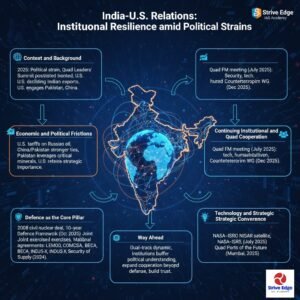
Context and Background
- In 2025, India–U.S. relations faced visible political strain despite strong underlying institutional cooperation.
- Postponement of the Quad Leaders’ Summit reflected diplomatic tensions and opaque official communication.
- Bilateral stress was aggravated by U.S. trade sanctions, declining Indian exports, and tariff disputes.
- India’s exports to the U.S. fell sharply in 2025, signalling worsening economic relations.
- U.S. engagement with Pakistan and China raised Indian concerns about shifting strategic priorities.
Economic and Political Frictions
- U.S. imposed tariffs on India’s Russian crude oil purchases, intensifying economic friction.
- China and Pakistan received lower tariffs and strengthened ties with Washington.
- Pakistan leveraged port access and critical mineral supplies to enhance geopolitical relevance.
- Despite pressures, U.S. officials reiterated that India remains strategically important.
Continuing Institutional and Quad Cooperation
- Institutional engagement expanded despite muted political signalling at leadership levels.
- Quad Foreign Ministers’ Meeting (July 2025) launched initiatives on security, technology, and humanitarian cooperation.
- Quad Counterterrorism Working Group met for the third time in December 2025.
- These engagements demonstrated Quad’s operational relevance beyond summit-level diplomacy.
Defence as the Core Pillar
- Defence cooperation anchors the resilience of India–U.S. relations since the 2008 civil nuclear deal.
- A 10-year Defence Framework Agreement (October 2025) strengthened coordination and information sharing.
- Regular joint exercises like Yudh Abhyas, Tiger Claw, and Malabar enhanced interoperability.
- Foundational agreements include LEMOA (2016), COMCASA (2018), BECA (2020) and INDUS-X (2023).
- Security of Supply Arrangement (2024) reinforced defence logistics reliability.
Technology and Strategic Convergence
- HAL–GE fighter jet engine deal (November 2025) marked deep industrial collaboration.
- NASA–ISRO NISAR satellite (July 2025) strengthened cooperation in disaster management and infrastructure planning.
- Quad Ports of the Future Conference (Mumbai, 2025) focused on resilient Indo-Pacific connectivity.
Way Ahead
- India–U.S. ties display a dual-track dynamic, with institutions cushioning political volatility.
- Deeper institutional understanding beyond defence is crucial for sustaining long-term partnership.
- Expanding cooperation across sectors can preserve trust during diplomatic downturns.